Key points
- The United States Securities and Exchange Commission (SEC) filed civil charges and obtained an emergency asset freeze against Backward Hat Capital on November 20, 2026.
- According to the SEC complaint, the firm raised approximately $560 million from more than 2,000 investors since July 2022 promising minimum monthly returns of 6%.
- Regulators allege more than $250 million went toward paying earlier investors and more than $220 million was transferred directly to the founders.
The SEC filed fraud charges against Backward Hat Capital, an Indianapolis-based firm, and its co-founders for operating an alleged $560 million Ponzi scheme. The federal court granted the regulator a temporary restraining order and the immediate freeze of assets tied to the defendants.
Per the civil complaint filed before the United States District Court for the Southern District of Indiana, those responsible raised capital from more than 2,000 participants between July 2022 and October 2026. Court filings note the company promised to convert clients’ fiat money into digital assets to execute foreign exchange trades using artificial intelligence algorithms.
Promoters assured participants these high-frequency arbitrage strategies would generate minimum returns of 6% per month. The SEC maintains in its complaint that such algorithmic trades were never executed at the promised scale and that the financial model depended solely on incoming new capital.
Fund Diversion and Audit Falsification

The financial breakdown presented by federal investigators details the destination of funds raised over the past four years. According to records cited by the SEC, more than $250 million of the raised capital was used to pay purported returns to earlier fund participants, establishing the typical structure of a pyramid scheme.
In parallel, the complaint indicates co-founders, identified as Phillip Patrick Williams and Devin Allen Johnson, transferred more than $220 million directly to their personal accounts and affiliated entities. The regulatory probe details that the split between both partners was uneven, with more than $130 million directed to Williams and more than $40 million allocated to Johnson.
Court documents indicate these diverted funds financed luxury purchases and covered personal expenses, including gambling debts. The docket also includes Traders Point Capital, tied to Johnson, as a receiving entity for part of the questioned funds.
To sustain the appearance of solvency before clients, defendants allegedly resorted to issuing adulterated financial reports. For this reason, the SEC complaint includes accountant Joseph Anderson, who is accused of preparing false audit reports intended to support the existence of assets and reported profits.
Parallel Actions by the CFTC and Department of Justice
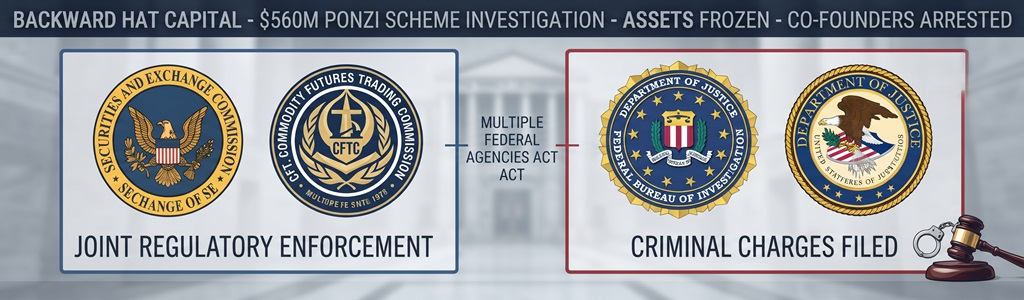
The legal offensive against Backward Hat Capital involves multiple United States federal agencies that acted in coordination during the third week of November 2026. The CFTC filed a parallel civil suit focused on fraudulent promises tied to the foreign exchange market, obtaining an Indiana court appointment of a temporary receiver to manage remaining assets.
On the criminal front, the United States Attorney’s Office for the Southern District of New York made public criminal charges against Williams and Johnson on November 18, 2026. Federal agents carried out the arrest of both co-founders ahead of the civil complaint filing: Williams was arrested in Kokomo, Indiana, while Johnson was captured in Gilbert, Arizona.
The criminal indictment from federal prosecutors estimates the total volume of capital raised through these maneuvers could exceed $600 million, a figure slightly higher than the initial estimate in the SEC civil complaint. Meanwhile, the Federal Bureau of Investigation (FBI) opened an official channel to gather testimonies and documentation from affected investors across various jurisdictions.
On the regulatory front, the SEC charges defendants with violating anti-fraud provisions of the Securities Act of 1933 and the Securities Exchange Act of 1934, along with violations of the Investment Advisers Act of 1940. The agency asks the court for permanent injunctions, full disgorgement of ill-gotten gains with prejudgment interest, and civil monetary penalties.
Legal proceedings will continue in federal courts in Indiana and New York, where preliminary hearings will be held to determine the scope of asset recovery under the appointed receiver’s oversight and the progress of criminal charges against the detained executives.


