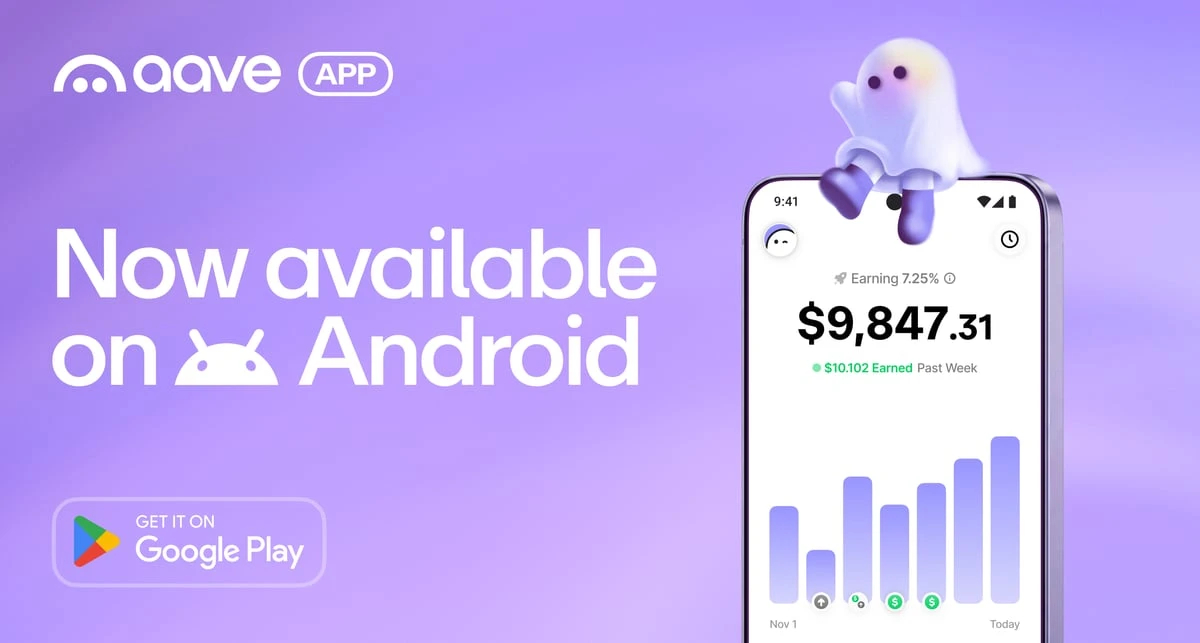
Aave Labs is widening the reach of its consumer savings product, releasing an Android version of the Aave App and adding support for USDT deposits on the TRON network, the company said on November 17.
The move puts a lending protocol that was long the preserve of crypto-native users onto Google Play, where it competes for attention with conventional banking and payments apps. Android users can download the app and join an early-access waitlist, and existing users can hand out Ghost Pass codes that let newcomers skip the queue. The company said the code "ANDROID" would bypass the waitlist while supplies lasted.
The Android release follows the app's debut on iOS in late August, when the first users were admitted through Ghost Passes. Aave Labs said in a 180-day report that app balances have climbed past $45 million and that the product expanded from Arbitrum to five supported chains during the third quarter of 2026. It also added instant deposit onboarding for eligible U.S. users through licensed providers.
According to Aave Labs, the app lets users deposit stablecoins, withdraw through participating banks in eligible countries, recover accounts and authenticate with biometrics. Balances are shown earning interest in real time, and withdrawals carry no fixed lock-up period, though requests remain subject to the platform's conditions.
The headline number is a maximum advertised yield of 7.25% annual percentage rate, with interest accruing every second. Aave cautioned that returns and availability differ by region and that the advertised figure is not a fixed rate. Unlike a bank account, deposits carry no government insurance and sit inside decentralized lending markets, exposing users to smart-contract and digital-asset risk.
TRON's stablecoin base
The TRON integration gives eligible users in supported jurisdictions a route to deposit TRC-20 USDT held in wallets and services on that network. TRON DAO, citing TRONSCAN, said the chain carries more than $94 billion in circulating USDT as of November 2026, alongside more than 414 million accounts, over 16 billion transactions and more than $24 billion in total value locked.
Those are network-wide figures and do not reflect assets held by the Aave App itself. Still, the size of TRON's dollar supply makes it a meaningful distribution channel in markets where stablecoins are used for payments, remittances and day-to-day saving.
"Millions of people in emerging economies already use TRON stablecoins to save and send money," said Stani Kulechov, founder and chief executive of Aave Labs. TRON founder Justin Sun said the integration could let people put USDT they already hold on the network to work in onchain savings. Neither company quantified how much of that audience it expects to convert.
Institutional push alongside retail
The consumer rollout runs parallel to Aave's institutional build-out. In October, Aave V4 introduced dedicated markets involving Ripple's RLUSD and PayPal's PYUSD, extending the protocol's stablecoin infrastructure beyond its established lending pools. Aave also recently acquired Avon, a developer of fixed-rate lending technology, a deal that signaled ambitions to serve institutions needing more sophisticated credit tools as well as retail savers.
Note: Yield is a maximum advertised rate and is not guaranteed; availability is limited to supported jurisdictions.
The launch lands in a difficult stretch for crypto markets. CoinGecko data at 11:13 UTC on November 18 showed Bitcoin at $64,083, down 0.28% over 24 hours and 12.78% over the week, while Ether traded at $1,794.81. The Crypto Fear & Greed Index stood at 11, in "Extreme Fear" territory. There was no market data tying a price move to the app announcement.
What to watch
The immediate test is whether Android early access converts into broad availability across supported jurisdictions. Aave's announcement included no user count or launch-specific deposit total, so download figures alone will not show how much activity the TRON rail attracts. Future disclosures on balances, supported regions and deposit terms would give a clearer picture of scale.
Regulation is the other variable. Lawmakers are still debating how interest-bearing stablecoin products should be treated, and the outcome could shape what Aave and its rivals are permitted to offer. For now, the company is betting that a phone-friendly interface and a familiar dollar token can pull savers away from conventional accounts, even without the deposit guarantees those accounts carry.
The savings app is also a different bet from the protocol's core business. Where Aave's lending pools serve sophisticated borrowers and institutions, the mobile product targets people who want a yield on stablecoins without navigating DeFi dashboards. Whether that audience shows up on Android in numbers large enough to matter is the question the next quarterly update should begin to answer.
Once added, BigGo Finance appears first in Google Search Top Stories, so you get the broadest, most up-to-the-minute, and most comprehensive global financial news first.