Europe is reducing foreign tech dependence whilst Singapore floated its vision for AI-native businesses.
Agentic artificial intelligence (AI), stablecoin use cases, and trust landed at the center of discussions in Singapore Fintech Festival Day 1, with bankers, market players, and regulators exploring how the financial system is being rewired in an era of geopolitical risks.
Ravi Menon, chairman of the board of directors at Global Finance & Technology Network (GFTN), noted how AI is connecting risks globally and eroding past the power of financial sanctions.
“A transaction powered by AI in Singapore may depend on a chip fabricated in Taiwan, a model that's trained in Texas, power generated from Qatari gas, and a cable running through the South China Sea. Every link is a geo-economic exposure,” Menon said.
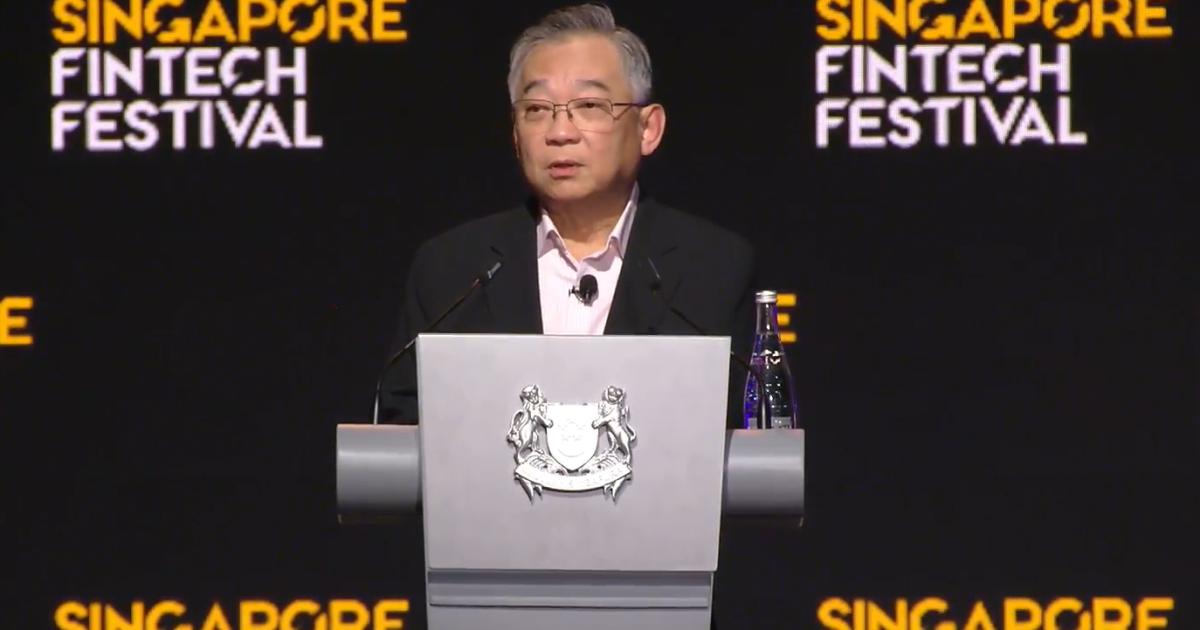
Singapore’s Deputy Prime Minister Gan Kim Yong foresees the rise of what he calls AI-native businesses, and highlighted trust and talent as key factors needed before this can happen.
“AI talent likes to work with one another,” Gan said, adding that the government hopes to build “a momentum, an ecosystem, and community of AI practitioners.”
Europe’s central banks graced the Festival Stage and outlined their ambitions to reduce the region’s dependence on foreign technology, from payments to supply chains, energy, and even cloud infrastructure.
“So many things where we have to do our homework, and we are currently, I believe, on a good path,” said Joachim Nagel, president of the Deutsche Bundesbank.
Ant International CEO Yang Peng said that the financial system's four-party model may be displaced as account-to-account payments become more mainstream.
Executives from SWIFT, Ant International, and HSBC said that the future is multi-choice: multimodal, multi-rail, and multi-asset. For this, all players in the system will need to work together to create common standards and retain customers’ trust.
Stablecoins was also discussed on the SFF floor, with market players noting legal blocks and regulatory questions that prevent wider roll-out of the technology.
“We don’t believe that this new technology will fundamentally change the business drivers, but it will change the infrastructure, the technology,” said Stephanie Cabossioras, chief strategy and global policy officer at Societe Generale-FORGE.
Cabossioras said that it is a challenge for incumbents and financial institutions to offer stablecoins to their clients due to these blocks.
On agentic AI itself, group-level executives from DBS and OCBC emphasized the need to change culture and work processes within an organisation to unlock its benefits.
“You need to understand why you do something in a certain way,” said Melvyn Low, Melvyn Low, group strategy & transformation officer at OCBC.
DBS Group COO Derrick Go shared how their roll-out of chatbots helped lower the volume of calls fielded by its call center staff worldwide. This allowed DBS to deploy the staff to field corporate calls as well, Go said.