London-based Sequent has raised $2.2 million (£1.7m) in pre-seed funding, co-led by Frachtis and Metaplanet, the investment firm of Skype co-founder Jaan Tallinn.
Tallinn led Anthropic’s 2021 Series A.
Sequent uses mathematical proof to show that software follows its safety rules.
Its product, Alan, uses AI to search for the proofs, and a separate checker called HOL4, which uses no AI, confirms every step or rejects the proof.
Engineers state the rules in plain language, such as ‘no user can withdraw more than their balance’, and where a rule fails Alan shows how the code breaks.
The company said testing checks a program only in the cases someone thought to try, while a proof, known as formal verification, shows the code follows its rules in every case.
It said writing proofs by hand needs scarce expertise and months or years of work, and that advances in AI have sharply reduced the cost.
Curve, a decentralised exchange, is Sequent’s first paying customer.
For one type of Curve pool, Alan has proved that no user can take more than a set limit from depositors, whatever they do and in whatever order.
Michael Egorov, CEO at Curve, said: “Audits tell us what reviewers found. Now, whenever we change a pool’s code, we can prove depositors’ money stays protected by the same limit.”
The proof is public and can be re-run independently using HOL4.
The company said the work also found minor accounting and rounding errors, none of which breached the limit.
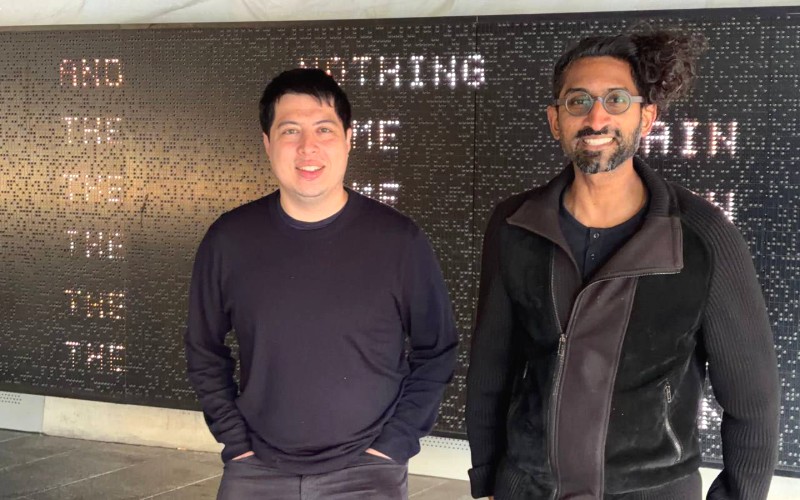
Sequent was founded in London in January 2026 by Charles Cooper, its chief executive, and Ramana Kumar, its chief technology officer.
Cooper leads Vyper, one of the two main programming languages for Ethereum, and in 2021 inadvertently introduced a flaw into its compiler.
In July 2023, attackers used the bug to take user funds from older pools at Curve and at other projects.
Kumar, a former Google DeepMind AI safety researcher, then offered to help prove the compiler correct, and their work led to Sequent.
Kumar co-created CakeML, a compiler proved correct all the way down to the instructions a computer runs.
Whitefox CEO Gillian Harrison to step down after 17 years
Cooper said: “Smart contracts taught us that anything that can be exploited will be.”
He also said AI-powered cyber attacks are eroding the protection of keeping code private, and that AI “is also making mathematical proof economical, and that puts the advantage back with defenders”.
Alan works today on Vyper smart contracts, and Sequent is developing support for Solidity and Solana smart contracts.
It plans to extend Alan to general software written in Rust, C, TypeScript and Python.
Its next step is to prove the Vyper compiler itself, because the Curve proof covers the pool’s source code but not the compiler where the 2021 flaw sat.
The funding will take Alan from early access to full launch, pay for engineering, sales and marketing hires, and cover AI computing costs.
Subscriptions start at $99 a month for individuals, $200 for auditors and from $500 for teams.
Rauno Miljand, managing partner at Metaplanet, said: “As AI writes more code, human review cannot keep up, and asking another AI to mark its own homework is no answer. Sequent is building the safety infrastructure we want in place before it is urgently needed.”