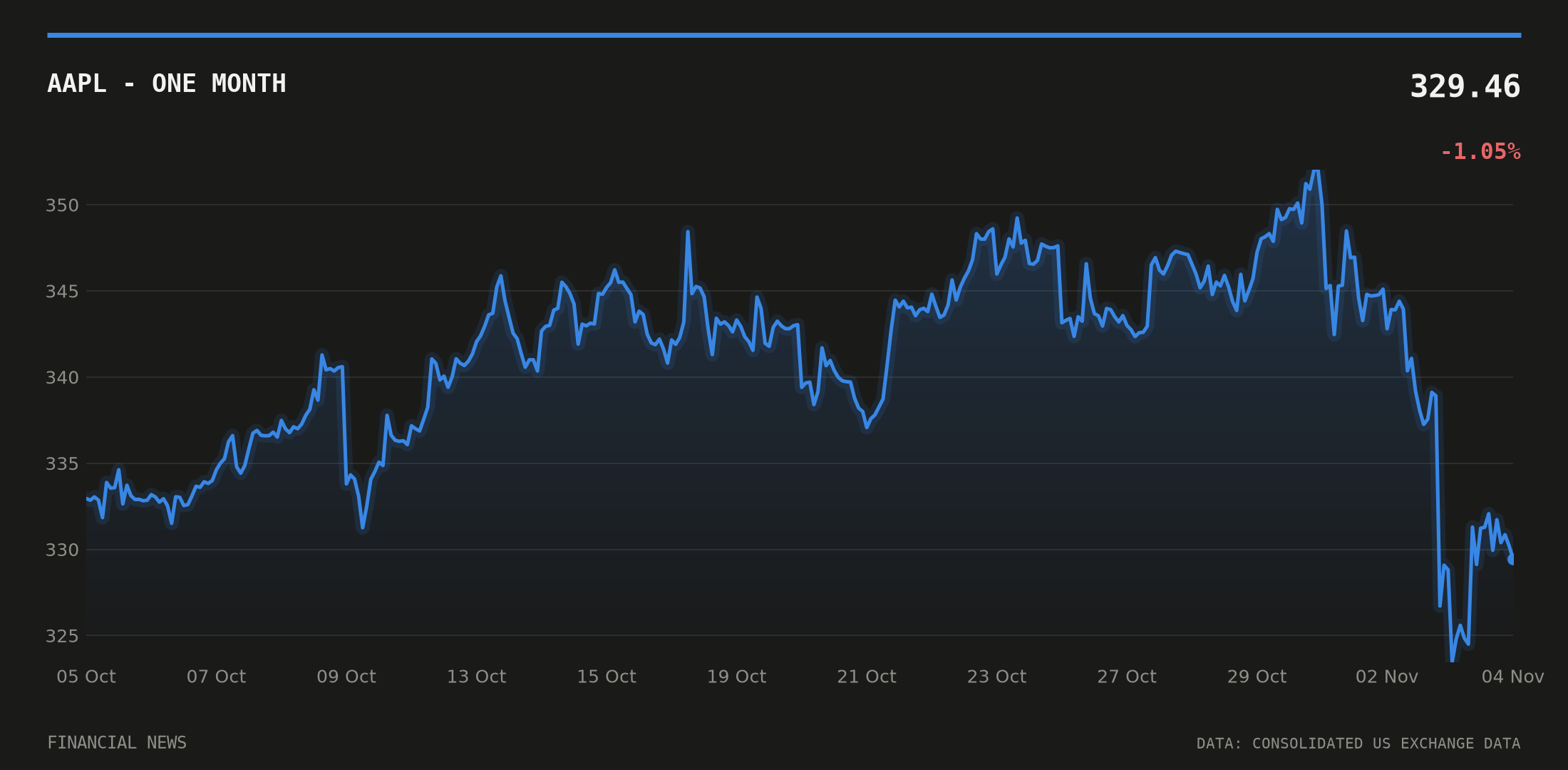
Apple’s (NASDAQ: AAPL) margin guidance for the holiday quarter wiped billions off its share price this week, even as the company reported record iPhone sales. Shares fell roughly 3% in after-hours trading on 2 November and extended losses to about 4.7% in premarket dealing the next day, touching $322.44, as first reported by Tradingpedia.
The number that mattered: Apple guided December-quarter gross margin to 45%-46%, down from 47.9% in the September quarter just reported, as first reported by Quartz. At the midpoint, that would mark Apple’s weakest margin since fiscal 2023’s fourth quarter.
A record quarter, beaten estimates
Apple’s fiscal fourth quarter was strong by most measures. Total revenue reached $114.5bn, up 12% year on year, according to the company’s 8-K filing with the SEC. Diluted earnings per share came in at $2.10, up 14%, including a $0.05 benefit from tariff refunds.
Both figures beat Wall Street. Analysts had expected EPS of $1.99 and revenue of $113.39bn, according to CNBC. iPhone revenue hit a September-quarter record of about $57.6bn, up roughly 17% year on year, as first reported by MacRumors. Greater China revenue rose 21%, also a quarterly record for the region. Full-year revenue reached an all-time company high of $479bn.
Not every line beat. Apple came up short of analyst estimates on iPad sales for the quarter, CNBC reported, a softer spot in an otherwise strong release.
Why the Apple margin guidance spooked investors
The gross-margin guidance overshadowed the beat because it signals rising costs just as the holiday shopping quarter begins. Apple cited higher memory-chip costs as the driver, according to Quartz. Memory components feed directly into the cost of iPhones, Macs and iPads, and a one-to-two-point margin hit on Apple’s scale translates into billions of dollars.
Services guidance added to the pressure. Apple guided December-quarter Services growth to 8%-9%, below the roughly 10.7% analysts had pencilled in, as first reported by Top1Markets. Services carries far higher margins than hardware, so a slowdown there compounds the hardware-margin squeeze rather than offsetting it.
Apple also disclosed that manufacturing and purchase commitments rose by $33bn, pushing total commitments to close to $90bn, according to The Crypto Basic. That increase points to heavier capital outlay tied to the same component-cost pressures flagged in the margin guidance.
A new chief executive’s first call
The quarter also marked the first earnings call for chief executive John Ternus, layering a leadership transition onto the margin story, MacRumors reported. Analysts at the Motley Fool have noted Apple trades at roughly 35 times expected earnings, a multiple that leaves little room for disappointment on margins going forward.
Trading activity reflected the shift in sentiment. The FINRA short-sale volume ratio for Apple stock rose from 0.433 on the day of the earnings release to 0.563 the following session, according to FINRA daily short-sale data, consistent with heavier bearish positioning as the stock fell. Broader markets offered little explanation for the move: the 10-year Treasury yield held steady at 4.91%, barely changed from 4.94% the prior session, according to data from the Federal Reserve Bank of St. Louis, suggesting the sell-off was company-specific rather than driven by a shift in rates.
By 4 November, Apple shares stood at $329.05, down 3.97% over the preceding 20 trading days, having traded as high as $352.05 and as low as $323.45 in that window, according to consolidated US exchange data. Trading volume ran 38% above its 20-day average.
What investors are watching next
The test now is whether Apple’s December-quarter results, when reported early next year, confirm the margin pressure flagged this week or show the company absorbing memory-cost inflation better than guided. Investors will also watch Services growth figures for signs of whether the 8%-9% guidance proves conservative or marks a genuine deceleration from the double-digit pace analysts had expected.
This article is for information only and is not investment advice or a recommendation to buy or sell any asset. Markets move quickly; figures are correct as sourced at the time of writing. Always do your own research before making financial decisions.