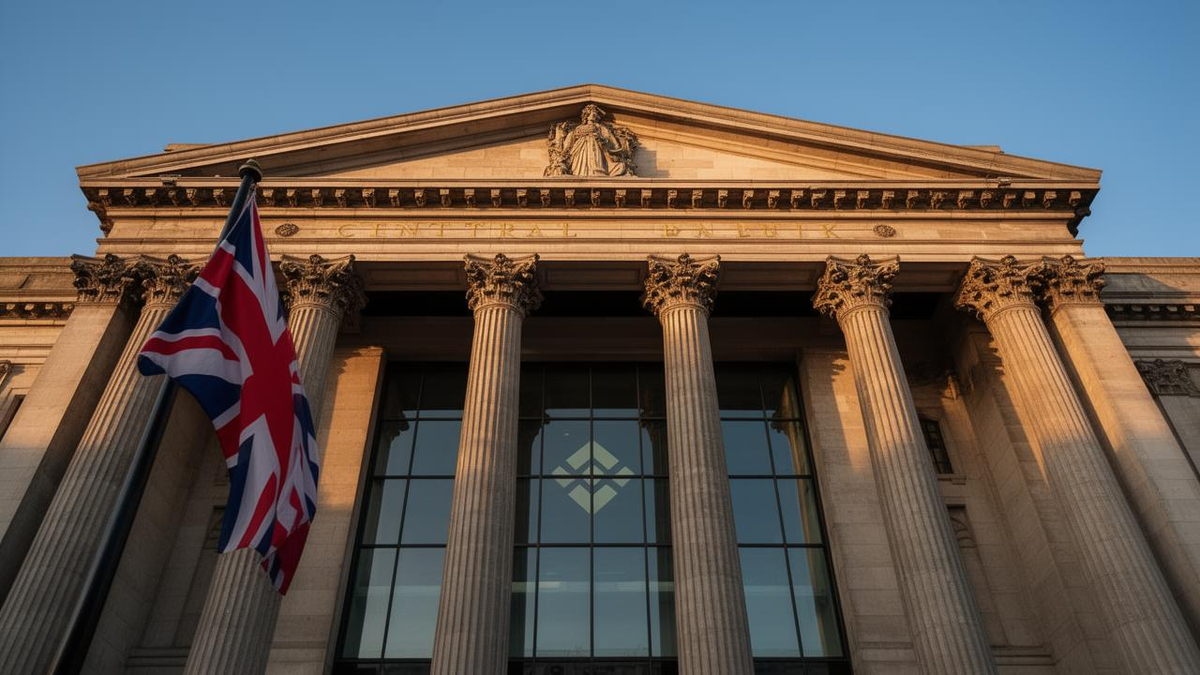
The Bank of England is holding up last month's $6.4 billion theft from Binance as a case study in operational failure rather than a market event, arguing in its November Financial Stability Report that the damage stayed contained because crypto remains loosely tethered to mainstream finance.
The assessment, published Nov. 26, credits the limited fallout to the sector's thin connections with banks and other regulated institutions. The central bank said the episode illustrates the dangers posed by "weaknesses in firms' operational controls" and pointed to social engineering and malware as the attackers' entry points. It is a position the Bank has held since at least March 2022, when it judged direct crypto risks to be limited given the industry's size and degree of interconnection, while warning that the calculation would shift if digital assets became more deeply woven into the traditional system.
What the report leaves largely unexamined is the role Binance's own balance sheet played in keeping the episode from spreading. The exchange absorbed the loss rather than passing it to depositors, pledging more than $6.34 billion of company money - $5 billion of it in the same tokens that were taken - within a day of the breach. That covered roughly 80% of the hole; the remainder had to be sourced on the open market and through over-the-counter desks. Coverage reached about 95% by Nov. 1, when the first phase of withdrawals reopened less than three days after the incident, spanning Bitcoin, Ether, USDT, USDC, BNB, Solana and XRP among other assets. Deposits never closed.
Binance declared full coverage on Nov. 12 and identified three funding sources: part of SAFU, its user emergency fund; a portion of its futures insurance fund above the level its risk framework requires; and corporate treasury. It committed to rebuild SAFU to about $1 billion and did not break out how much each source contributed. A proof-of-reserves snapshot taken at midnight UTC that day covered 198 tokens, with a zero-knowledge proof generated two days later. Such a snapshot confirms customer balances were backed at a single moment; it does not capture obligations elsewhere on the balance sheet or the position a week later. U.S. prosecutors, in a court filing, described the company as self-insuring its losses and said it appears to hold enough to cover them.
The Aave freeze and the stablecoin channel
The breach began on the evening of Oct. 29, when attackers drained hot wallets - the internet-connected accounts an exchange uses to process withdrawals. At 20:24 UTC a single transaction moved 167,464 ETH out of one Ethereum hot wallet; by 20:58 a wallet tied to the attacker had opened a borrowing position on Aave, and by 21:42 the lending protocol's guardian multisigs had executed the first market freeze. A further 444,537 AVAX reached the attacker on Avalanche by 23:04 as the last freezes landed.
The Aave position was the attacker's only one across every network and version: 60 million USDT supplied to Aave V3 on Ethereum against a 19,762 WETH borrow worth about $44.6 million at the time, according to LlamaRisk, which advises the protocol on risk. The adviser later measured the position at $59.9 million of collateral against $43.8 million of debt and reported no bad debt. The worry was replication - an attacker holding billions in freshly stolen tokens could post them as collateral across dozens of markets and borrow out other users' deposits. Aave Labs, TokenLogic and Certora joined a call within minutes and chose a blanket freeze, because the guardian can reverse a freeze unilaterally while cutting borrow caps would have required a governance vote of roughly five days.
The action covered 175 reserves on Aave V3 across 16 networks and 117 on V4. The Horizon market for tokenized real-world assets stayed open, since only approved, permissioned collateral is accepted there. Users in frozen reserves could not open new deposits or borrow, and so could not top up collateral; repayments, withdrawals and liquidations continued. Withdrawals pushed utilization in some pools to between 92% and 100%, a level at which depositors cannot exit until borrowers repay. Risk stewards capped the borrow rate in those pools at 10% APR and trimmed borrowing caps to about 2% above pre-exploit levels, removing roughly $3.7 billion of unused V3 capacity. Aave's own stablecoin, GHO, slipped to about $0.997 as holders swapped 4.6 million GHO for USDT through its stability module. A four-wave rollback plan is under way, with USDT, USDC and several other assets held at zero loan-to-value on V3; the governance post gives no completion dates.
Part of the stolen value landed in USDC, the dollar token issued by Circle. According to the government's filing, the funds passed through a range of tokens, service providers and addresses before arriving in USDC across 36 addresses on 18 blockchains. Circle initially declined to block the tokens voluntarily, then said on Nov. 6 it would keep a block in place if the government obtained a restraining order, which a court issued on Nov. 12 with the consent of both Circle and Binance. On Nov. 23 the Justice Department filed a civil forfeiture complaint covering more than $1.1 billion of that USDC, naming the cryptocurrency itself as defendant and attributing the attack to North Korean cyber actors. Authorities said they had helped freeze, seize or return more than $2.9 billion in crypto since the theft; prosecutors did not give a separate figure for funds already returned to Binance.
The size of the Circle block stands out against the issuer's own books. At Sept. 30, before the hack, Circle reported $131.2 million of USDC sitting in access-denied addresses across its entire network - the Binance-linked block alone is more than eight times that. USDC in circulation stood at $73.9 billion at the same date, with $62.5 billion of the reserve held in the Circle Reserve Fund and the rest described as mostly cash at a handful of large banks. A wave of redemptions would have drawn on those deposits and could have forced the fund to sell short-dated Treasuries or unwind repo positions.
Binance sits close to that channel. The same quarterly filing names the exchange a key strategic partner that "makes USDC extensively available across its full suite of products and services," and the distribution costs Circle pays Binance rise and fall with the amount of USDC held there. Six weeks before the hack, on Sept. 17, Binance bought 1.2 million Circle shares at $80.84 each for $100 million, subject to transfer restrictions of up to two years - not a ready source of cash for replacement buying.
Funds still moving
On-chain trackers continue to log movement from wallets tied to the attacker. Onchain Lens reported a fresh transfer of $35.52 million in Ether on Nov. 26, about one-seventh the dollar value of the Nov. 19 batch, when 137,602 ETH worth $248.23 million moved; a day earlier, roughly 78,400 ETH valued at $142.1 million had gone out in seven transactions. The tracker put remaining unfrozen holdings at 461,980 ETH worth $785.2 million and 18,350 BTC worth $1.11 billion, with Bitcoin accounting for close to 59% of the combined value, alongside $2.6 billion in frozen stablecoins.
Blockchain investigators had already observed some stolen Ether converted to Bitcoin by Nov. 17, when Elliptic identified about 75,000 ETH leaving two large wallets that had held the funds since Oct. 30. The tracing firm separately estimated the theft at $6.43 billion and said it had confirmed $2.84 billion of freezes by Oct. 30. Binance's own Nov. 3 incident report put the affected amount at approximately $6.34 billion and said it had frozen or intercepted about $2.85 billion by then, a figure subject to reconciliation and token price moves. The preliminary account described unauthorized withdrawals across several networks: roughly 233.46 million XRP leaving five hot wallets in four minutes, followed by transfers of about 970,500 SOL and 44.2 million OP, with the final unauthorized transfer of 2,961.9 ETH confirmed at 23:56 UTC on Oct. 29. The company said it rebuilt the affected wallet system in a new environment, replaced implicated devices, revoked credentials tied to affected engineers and engaged outside security firms. It attributed the attack to North Korea, citing the FBI.
What would test the verdict
Three records would confirm or challenge the central bank's reading. Circle's monthly reserve reports for October and November would show whether USDC circulation moved while Binance withdrawals were paused. Binance's progress in rebuilding SAFU would indicate how much of its cushion remains. And the court's decision on keeping Circle's block in place will determine whether the $1.1 billion in restrained USDC eventually returns to the exchange.
The Bank's framing rests on the absence of stress in the connections that did exist - a test the system arguably never faced, because a single exchange was able to place more than $6.34 billion of its own capital on the table without asking customers to share the loss. A platform without that cushion would have confronted the same theft with harder choices, and the redemption channel through USDC might have been tried rather than bypassed. The commercial ties between Binance and Circle also postdate the Bank's 2022 assessment, and they run through one of the two largest dollar stablecoins.
Once added, BigGo Finance appears first in Google Search Top Stories, so you get the broadest, most up-to-the-minute, and most comprehensive global financial news first.