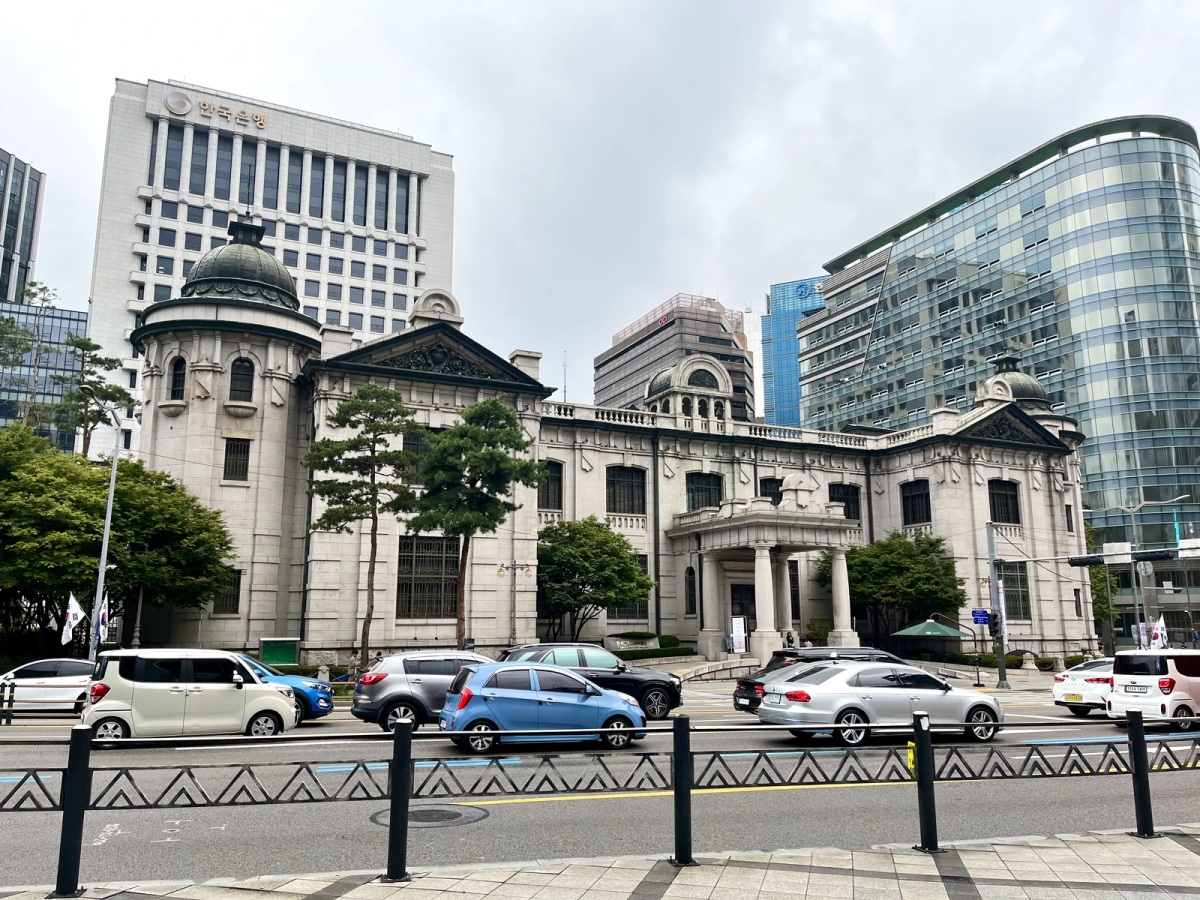
The Bank of Korea increased its gold investment by more than 40% in the third quarter, resuming a program it restarted after 13 years, but a sharp drop in international gold prices in the fourth quarter is estimated to have erased more than 32 billion won (approximately $23.9 million) from the holdings' value. With international gold prices down more than 16% from their August peak, the BOK says its plan to expand medium- to long-term gold exposure remains intact.
According to the BOK's third-quarter securities holdings report (Form 13F) filed with the U.S. Securities and Exchange Commission on the 15th, the Bank of Korea held 956,869 shares of the U.S.-listed gold exchange-traded fund SPDR Gold Trust (GLD) as of the end of September. That is up 277,104 shares (40.8%) from 679,765 shares at the end of the second quarter. The value rose by $114 million (45.5%), from $250.41 million to $364.41 million.
The problem is where prices went from there. The BOK's gold ETF closed at $355.45 in the U.S. market on the 13th of this month, 6.7% below the end-of-third-quarter value of $380.84 per share. Assuming the end-September holdings were unchanged, the value would fall to $340.12 million. In other words, $24.29 million (~32 billion won) vanished from price declines alone. Whether the position is at a profit or loss relative to the actual purchase cost, and by how much, is difficult to gauge from the disclosure alone.
Gold ETF prices did not decline steadily from the second quarter. The per-share value was $368.38 at the end of the second quarter and rose 3.4% through the end of the third quarter before turning lower. International gold prices climbed to $4,658.59 an ounce at the August 25 close before sliding to $3,884.77 on the 13th, 16.6% below the peak.
The additional purchases are part of a pre-established medium- to long-term gold investment plan. Lee Chang-heon, a team head at the BOK, said, "We set a target weighting for expanding gold-related assets this year, and we are buying the appropriate amount at the appropriate time accordingly," adding, "It is proceeding well according to the original plan." He said the underlying concept is ultimately to increase gold exposure and that the BOK will keep expanding it steadily over the medium to long term. The specific target weighting and the timeline for reaching it have not been disclosed.
The BOK's management target is not the weighting of gold ETFs themselves but total gold exposure spanning physical gold and gold-related financial products. Rather than fixing separate allocations to ETFs and physical gold, the BOK sets its target on overall gold exposure and uses investment vehicles according to market conditions and operational considerations.
The four ETFs the BOK reported to the SEC were worth a combined $4.35935 billion, up 12.2% from the previous quarter. GLD's share of that total rose 1.92 percentage points, from 6.44% at the end of the second quarter to 8.36% at the end of the third.
Preparations for buying physical gold are also under way. In August, the BOK announced a plan to buy gold that South Korean producers intend to export, at international market prices. The idea is to build a cooperative framework among South Korean producers, the Korea Exchange (KRX) and the Korea Securities Depository (KSD) to diversify purchase channels that have centered on overseas gold markets. The related regulations and operational preparations are expected to be largely completed after mid-December. Some observers expect purchases of South Korean-made gold destined for export to begin as early as next month.
The BOK had taken a cautious approach to gold investment since buying 20 tons of physical gold in 2013, but it resumed investing by adding gold ETFs in the second quarter of this year after Shin Hyun-song became governor. That marked a shift from the conservative management principles maintained since the tenure of former governor Kim Choong-soo. Because gold ETFs are classified as securities, an increase in holdings does not raise the physical gold holdings shown in foreign exchange reserve statistics. If purchases of South Korean-produced physical gold actually take place, the gold holdings statistics could change.
The same report also showed changes in equity ETF holdings. Holdings of the iShares Core S&P 500 ETF, which tracks the U.S. S&P 500 index, rose 17.6%, from 1,752,811 shares to 2,060,681 shares, while the Vanguard S&P 500 ETF rose 14.5%, from 1,923,442 shares to 2,203,142 shares. In contrast, the iShares Core MSCI International Developed Markets ETF, which invests in developed-market stocks outside the United States, fell 13.4%, from 11,259,397 shares to 9,752,666 shares. In short, the BOK shifted weight toward gold and U.S. large-cap stocks and reduced its share of non-U.S. developed-market equities.
Note: The Nov. 13 value is an estimate assuming end-of-third-quarter holdings were maintained.
Market analysts interpret the BOK's gold purchases as serving the goal of diversifying the currency and asset composition of its foreign exchange reserves rather than short-term profit and loss. Gold is a representative means of reducing the share of dollar-denominated assets, and the move aligns with a recent trend of central banks increasing gold's share of their reserves. However, with gold price volatility having increased, a cautious approach to the pace and scale of future purchases is expected to continue.
Once added, BigGo Finance appears first in Google Search Top Stories, so you get the broadest, most up-to-the-minute, and most comprehensive global financial news first.