- Key insight: Banks have invested $270 million in Project Faro
- Forward look: The next period is proving scalability and economic viability, according to Celent's Alenka Grealish.
Project Faro's bank-led stablecoin venture this week took a big step forward with a $270 million five-year funding commitment.
If the news sounds familiar it's probably because it is. Faro is one of several stablecoin ventures in various stages of development as banks consider how to adopt emerging digital assets that are still not widely used for payments or to perform other financial services.
Payment experts say the growing roster of group efforts are creating healthy competition, at least for now. "The short answer is no, there aren't too many stablecoin groups, but with a qualifier that it's over the next two years," Alenka Grealish, a senior research and advisory leader at Celent, told American Banker. "Beyond that, yes there are too many stablecoin groups."
Bank stablecoins
There are 21 banks in Project Faro, including Goldman Sachs, Citi, Banco Santander and Deutsche Bank. These banks have committed $270 million to fund the project over the next five years, according to Bloomberg. The four banks mentioned did not return a request for comment.
The project plans to launch a stablecoin in the first half of 2027, according to a September announcement, with other stablecoins linked to other currencies, including the Euro, in the future. Wells Fargo, Fidelity, UBS and Lloyds have also been tied to the effort. Faro is working on its stablecoin as at least one bank stablecoin consortium has gone live. Open Standard's OUSD stablecoin launched in October, bringing together more than 140 banks, fintechs, payment companies and crypto firms. Its stablecoin has attracted BNY, U.S. Bank, Huntington Bank, Citizens Bank, Cross River, The Bancorp and Pathward.
HSBC in late October launched RedCoin, a stablecoin in Hong Kong through HSBC's PayMe P2P network, covering about 3.3 million users. RedCoin is regulated by the Hong Kong Monetary Authority and backed by Hong Kong dollars.
"We're in the Cambrian period of market development with stablecoins demonstrating value and feasibility and thereby driving investment," Grealish said. "Heated competition pushes the art of the possible."
Getting ready
There is growing bank interest in stablecoins. Cross-border payment fintech Payoneer surveyed 265 senior payments, treasury and finance leaders at U.S.-based e-commerce marketplaces, platforms and enterprises with $100 million or more in annual revenue, reporting 97% are using, testing or still evaluating stablecoins. Within that group, 69% are actively supporting stablecoins in real operations.
The next period is proving scalability and economic viability, according to Grealish. "Few stablecoin initiatives will survive," she said. "The current market structure is already highly concentrated in Circle and Tether. The scaling winners will be those that support real world economy flows, abstract the blockchain, deliver a friendly user experience and provide battle tested cybersecurity and resiliency."
Tokenized deposits, a lower-risk, more closed alternative to stablecoins, are a bit more popular among banks, but tokenized deposits are not taking the place of stablecoin strategies.
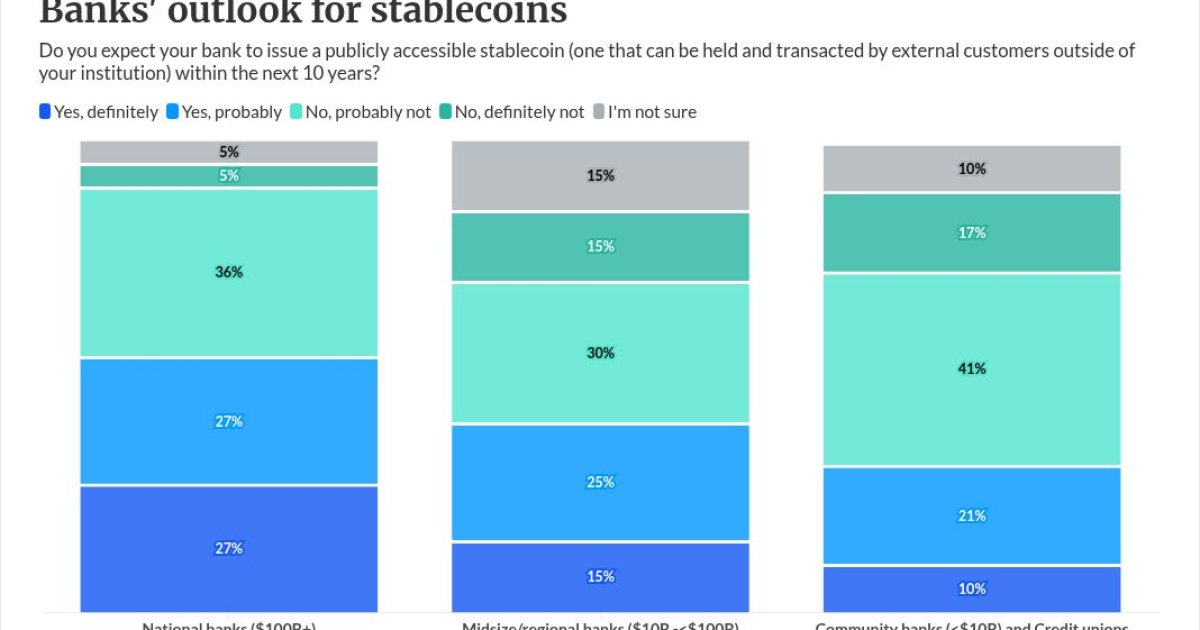
Twenty-four of the largest 50 banks have tokenized deposits "on their radar" as of the first quarter, up from 19 the prior quarter, according to American Banker research on digital assets. That compares to the 17 banks that have stablecoins on their radar, up from 15 in the fourth quarter of 2025.
"Having multiple, substantially interoperable stablecoin consortiums and individual issuers competing in the market is healthy," Eric Grover, a principal at Intrepid Ventures, told American Banker, adding that these models—each with different governance, participants, approaches to distribution, yield-sharing, target markets and incentives for use—are vying for share. "Their models will evolve based on market traction. Competition, with iterative enhancements driven by market feedback, will make most of them better."The banks are competing with fintechs such as Tether and Circle, which have had stablecoins in the market for several years.
Read more:
- Bankers swing to negative view on funding costs: Survey
- How agentic commerce is changing the customer experience
- Why the FTC and 8 states are suing payments fintech Toast
- $6B Binance heist provokes stablecoin freeze dilemma
"A single issuer like Tether has the advantage of capturing all the economics and maintaining greater control, which gives it speed and agility in the market," Grover said.
In contrast, a consortium like Open USD will inevitably move slower, but aims to achieve greater network critical mass by leveraging its 140-plus participants and sharing the lion's share of its economics with its participants that route, adopt, and distribute its stablecoins, according to Grover.
"While the analogs aren't perfect, in the 19th century, thousands of banks issued banknotes that interoperated through clearinghouses," Grover said. "Today, we have multiple—but not thousands of—competing electronic payment networks. There won't be a single winner, and some of the models recently announced or already launched will fail."