Seminar on "Stablecoin Innovation Becoming Reality: Challenges Following the Digital Asset Basic Act"
"Sound institutional frameworks are needed to manage risks in issuance and distribution"
"Only trustworthy won-denominated stablecoins will be able to cross borders"
Calls have emerged for institutional reforms to support the adoption of stablecoins in areas such as overseas remittances, payments, and trading in tokenized assets. The proposals include securing real-world use cases through cooperation between financial institutions and fintech companies, strengthening links with existing financial infrastructure, and establishing a legal basis and accountability framework to address risks such as money laundering.
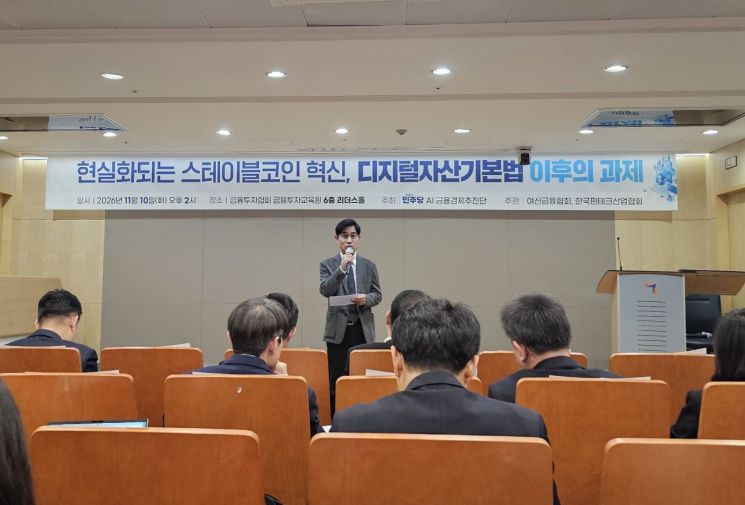
Korea Fintech Industry Association Chairman Kim Jonghyun delivers congratulatory remarks at "Realizing Stablecoin Innovation: Challenges After the Digital Asset Basic Act," held on the 10th. Reporter Lee Seunghyung
On November 10, the Democratic Party of Korea's AI Financial Economy Promotion Task Force held a seminar at the Financial Investment Education Institute in Yeouido, Seoul, under the theme "Stablecoin Innovation Becoming Reality: Challenges Following the Digital Asset Basic Act." Organized by the Credit Finance Association and the Korea Fintech Industry Association, the event was held to examine stablecoin-based financial innovation and use cases, and to discuss the institutional challenges involved in bringing digital assets into wider use.
In his congratulatory remarks, Kim Jonghyun, chairman of the Korea Fintech Industry Association, said, "Close cooperation between financial institutions and fintech companies is important." He added, "When the financial infrastructure and trust of financial institutions are organically connected with the technology and service capabilities of fintech companies, new business opportunities will emerge across a range of fields." He also stressed the need for "sound institutional frameworks that support the development of financial services while managing risks in the issuance and distribution processes."
The first presentation introduced cases in which stablecoins reduce the cost of financial transactions and are used for new services. Song Min-taek, a professor at Hanyang University, explained that "stablecoins can connect funds needed for remittances, payments, and investments at any time, and enable cross-border transfers of value and automatic payments based on predetermined conditions." He noted in particular that stablecoin use is taking shape in business-to-business payments and consumer transactions. Shorter transfer times can reduce the amount of money economic actors need to tie up as idle funds, improving the efficiency of fund management, he said.
Professor Song also outlined the potential use of stablecoins for merchant settlements. However, he said their actual competitiveness would depend on total costs and settlement speed, since payment service fees, blockchain transfer costs, and the cost of converting funds into Korean won all need to be considered.
Professor Song also noted that stablecoins could be used for trading tokenized assets and for automatic payments by artificial intelligence (AI) agents. "When an AI purchases data or content on a user's behalf, it can automatically pay for what it uses through a stablecoin wallet," he said, adding that "the responsibilities and risk management of AI agents need to be examined to enable these uses."
Jung Younggi, an attorney at Kim & Chang, speaks at “Stablecoin Innovation Becoming Reality: Challenges Ahead Following the Digital Asset Basic Act,” held on the 10th. Photo by Lee Seunghyung.
Jung Younggi, an attorney at Kim & Chang, then presented on the money laundering risks associated with stablecoins and ways to address them. While stablecoins offer advantages such as rapid cross-border transfers and direct peer-to-peer transactions, these same features can also expose them to abuse for money laundering or the movement of illicit funds. He explained that a legal basis and accountability framework are needed to manage risks not only at the issuance stage, but also during distribution and peer-to-peer transactions.
"Issuers should be designated as entities subject to anti-money laundering obligations, and their capabilities in areas such as risk assessment and compliance monitoring should be evaluated from the authorization stage," attorney Jung said. "For transaction freezes and blocks, issuers should be equipped with the necessary technology, while procedures to protect users should be established by law."
Hot Picks Today
- The Era of Getting 200 Million Won After 30 Years Is Over... A Japanese Bank's "Perpetual Department Head" Who Just Clocked In Cries Out
- Spain Hit by Its Worst Tragedy... Lee Kangin, Moreno and Real Madrid Join Soccer World in Mourning
- They Said, “Make It Your Home for Life” - Then Suddenly Kicked 200 Passengers Off... What Happened to the Around-the-World Cruise?
- "130 Rice Bowls Sold Out in a Day"... 'Unfiltered Face' Adds 8 Million Won to Night Market Sales: China's Bungeunwoo
Regarding cross-border transactions, he said reporting requirements for the overseas transfer and receipt of stablecoins should be linked to foreign exchange transaction reporting. He also proposed setting out the basic principles and legal basis in legislation, while specifying detailed standards in enforcement decrees and supervisory regulations, including risk-based review criteria and procedures for freezing transactions, so they can keep pace with technological change. "Anti-money laundering capabilities are a prerequisite for the adoption of won-denominated stablecoins," attorney Jung stressed. "Only trustworthy won-denominated stablecoins will be able to cross borders."
© The Asia Business Daily. All rights reserved. Unauthorized AI training and use prohibited.