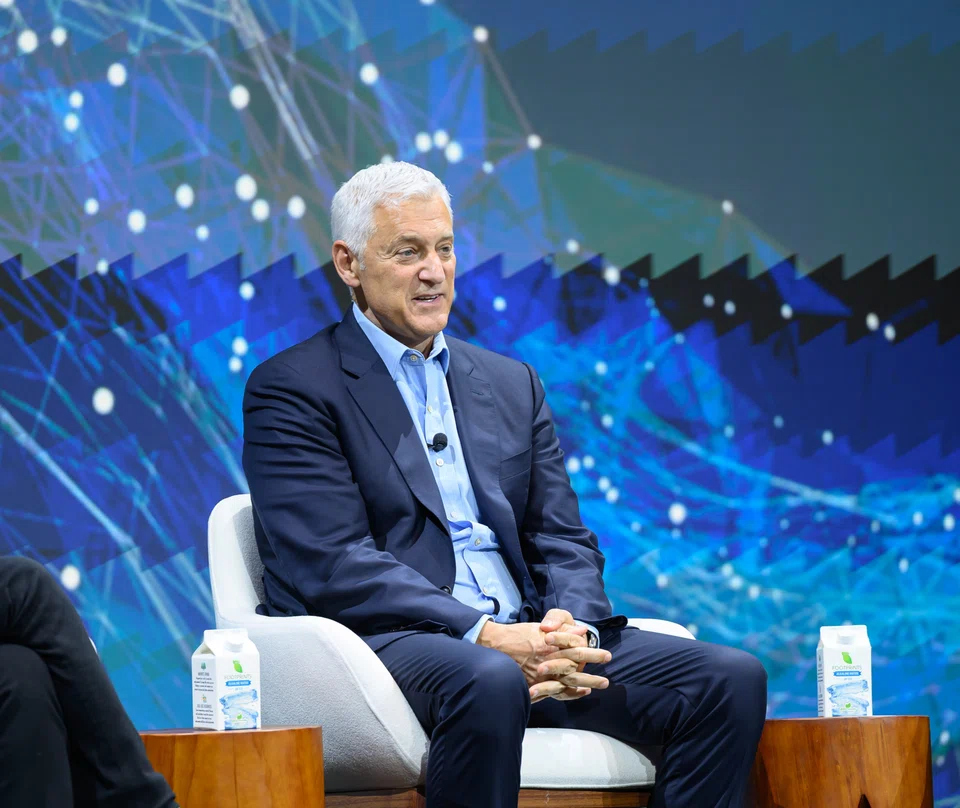

Standard Chartered Group CEO Bill Winters explains why trust, connectivity, and collaboration will shape the next phase of institutional digital asset adoption
THE financial industry is moving into a new phase of digital-asset adoption. The next phase will be defined less by the technology itself and more by whether digital assets can solve real financial challenges and connect effectively with the broader financial system.
“The biggest change is that the industry conversation has shifted from proving that the technology works to making real-world applications,” said Standard Chartered group chief executive Bill Winters. “For clients, the focus is increasingly on practical outcomes such as improving settlement, liquidity, collateral mobility and real time visibility and control.”
Winters speaks to The Business Times about what is driving this shift, the new opportunities for institutional clients and how banks must evolve to remain relevant.
Q. Digital assets have moved from experimentation towards wider institutional adoption and engagement in recent years. What has changed most significantly, and why does this moment feel different?
A. The biggest change is that the industry conversation has shifted from proving the technology works to making real-world applications. Clients are increasingly asking what problems digital assets can solve for their businesses, rather than focusing just on the technology. What also feels different is greater regulatory clarity in a growing number of markets across digital asset custody, trading and payments. This is driving banks and other regulated institutions to launch institutional grade offerings, which in turn is giving more institutions the confidence to participate. Another key development is the emergence of credible use cases involving digital money that are not just focused on crypto trading settlement.
Money is becoming a spectrum – it is no longer cash or deposits. Tokenised deposits, stablecoins and tokenised money-market funds, and wCBDCs are beginning to demonstrate how value can move more efficiently across networks, transforming treasury management, settlement and cross-border payments. As more assets are tokenised, the opportunity is to connect these assets with different forms of money and existing mainstream financial markets, rather than create a separate system.
Recent developments such as the issuance of HKDAP – the first regulated Hong Kong dollar-backed stablecoin – are examples of how regulated digital money can connect with tokenised assets to support practical applications in the real economy.
Powering Asean's Future 2026
ACCESS THE INSIGHTS
Q. How can this progress and evolution help businesses and investors?
A. First, some cryptocurrencies, especially bitcoin, are now being viewed as an investable asset class as part of a diversified portfolio.
Thus, providing access to this new asset class, while taking away the friction and uncertainty around custody and trading, is important to both our affluent and institutional investors.
Second, our corporate and financial institutional clients are looking for solutions to longstanding pain points around speed, capital efficiency, visibility and connectivity across fragmented financial systems. For instance, cash, assets and collateral are often held across separate accounts and market infrastructures, creating delays, operational inefficiencies and additional funding costs when moving them between entities or jurisdictions.
SEE ALSO
Standard Chartered looks beyond Formula 1 and football to promote art
Digital assets have the potential to address some of these inefficiencies by enabling value to move more seamlessly across networks, with greater speed, transparency and programmability.
However, the challenge is not simply putting assets onto a blockchain. It is about connecting and orchestrating activity across multiple networks, jurisdictions, currencies and market infrastructures. That is where banks have an important role to play.
Clients need trusted institutions that can help them navigate between traditional and digital finance by bringing together access, execution, custody, tokenisation and liquidity. The objective is to make the experience simpler for clients while enabling value to move safely and efficiently across markets.
Q. Where do you see the strongest potential for institutional scale over the next three to five years in this space, and what will drive it?
A. I see three key areas here – trust, orchestration and integration.
Trust: Banks provide the trusted infrastructure allowing clients to participate in digital-asset markets within established frameworks for governance, risk management, compliance, custody and liquidity.
Orchestration: The future is unlikely to be a single digital-asset network or a wholesale replacement of existing financial infrastructure. Instead, multiple payment systems, tokenisation platforms, stablecoin networks, market infrastructures and traditional banking rails will coexist. Banks will need to help clients navigate these environments and connect them so that value can move across the ecosystem safely and efficiently. Integration: Digital assets ultimately need to connect to trade flows, treasury operations, investment activity, suppliers, customers and financial markets. Scale will come when digital assets are embedded in everyday financial activity and deliver outcomes that clients value, rather than operating as a separate ecosystem.
Q. What can banks uniquely bring to digital assets, and where do they need to rethink traditional banking models?
A. Where banks need to rethink traditional models is in moving from being owners of closed infrastructure to becoming orchestrators and enablers of open, and interconnected ecosystems. Ultimately, the opportunity is not for banks to choose between traditional finance and digital finance. It is to connect the two. Banks will continue to perform their core functions, including safeguarding assets, providing liquidity, managing risk and connecting clients to markets, but they will increasingly need to provide these capabilities across both traditional and digital finance.
Q. Looking back over the last few years, what was the boldest bet your organisation made on digital assets that others questioned at the time?
A. Standard Chartered is not new to digital assets – we began exploring it and its use cases more than a decade ago, well before they attracted widespread institutional interest. As the market matured, we invested in building the capabilities, infrastructure and expertise needed to support institutional adoption.
Establishing SC Ventures is arguably the boldest move we made in this space, and this allowed us to invest in emerging technologies and develop new business models. Our early investment in Ripple in 2016, followed by the launch of institutional digital asset businesses such as Zodia Custody and Zodia Markets, helped us better understand the market. These investments were instrumental in helping us validate client demand, understand the market and to attract the right talent to help us develop the governance and controls needed to scale safely.
At the time, much of the institutional focus was on private, permissioned networks. Our ventures gave us the necessary experience to understand how the public blockchain infrastructure could serve our institutional clients. That experience is also informing how we build and connect our digital assets capabilities across the bank.
Q. What needs to happen for digital assets to become a permanent and trusted part of the financial system?
A. Trust and regulation must scale alongside innovation. Digital assets will become a permanent part of the financial system when clients, regulators and institutions have confidence in the governance, legal certainty, risk management and resilience that underpin them. Interoperability is also critical. The future is likely to consist of multiple platforms, stablecoin networks, payment rails and market infrastructures that need to connect and operate effectively with one another and with existing financial systems.
Stronger orchestration is important. Clients do not want to manage multiple wallets, networks, platforms and infrastructure providers. They want a seamless experience that connects access, execution, custody, tokenisation and liquidity management.
Ultimately, scaling digital assets will require more than technological innovation. It will require the development of trusted infrastructure, liquid markets and effective connections between different forms of money, assets and financial networks.
Q. Finally, what is one industry assumption that you think will be proven wrong over the next two years, and why?
A. I would say it is the idea that digital assets will achieve scale only if the entire financial system migrates onto a single network or adopts a common standard. This is not a winner takes all race.
Rather, it is the evolution of a broader financial ecosystem in which traditional and digital forms of finance will coexist and increasingly connect and converge. As commerce, assets, and payments move on-chain, banks, asset managers, digital asset firms, fintechs, and market infrastructure providers will all have a role to play.
The winners will not be those who try to do everything themselves, but those who can connect and orchestrate ecosystems and create trust at scale.
Common standards will remain important, but scale will depend on interoperability between the various forms of money, assets and systems. And everyone has a role to play in making it happen – no one bank, company or regulator can do it alone. The one thing that will remain constant is that clients will continue to navigate a rapidly changing world. They will need a financial partner they trust to work alongside them.
We want to be that partner, helping clients understand the change, connect to new opportunities and move forward with confidence.
For more insights on diverse opportunities in Asean, click here.
Decoding Asia newsletter: your guide to navigating Asia in a new global order. Sign up here to get Decoding Asia newsletter. Delivered to your inbox. Free.
Share with us your feedback on BT's products and services
TRENDING NOW
South-east Asia has lost Nvidia’s best salesman
Higher rates, weaker spending: Is the Philippines entering stagflation?
Who is Leo KoGuan, the Singapore-based billionaire backing Nvidia’s Jensen Huang?
Demand, tech capabilities position Apac and AI as Skyscanner’s next growth frontiers: CEO Bryan Batista