Meta Description: After Binance's $6.3B heist, businesses must rethink crypto banking. Separate custody, payments, and trading for safer treasury operations.
A $6.3 billion heist at Binance and the sudden departure of its CFO—announced November 7, 2026—are forcing corporate treasurers, DAO managers, and every business that relies on crypto banking to rethink how they safeguard digital assets. The breach is not just another exchange hack; it exposes a structural failure that affects any organization using a trading platform as a de facto business bank, and highlights the often-overlooked crypto exchange risk that comes with that shortcut. Purpose-built crypto banking platforms that separate custody, payments, and trading now move from optional to mandatory for serious treasury operations and institutional crypto safety standards.
Table of Contents
- What Just Happened: Binance CFO Exits After $6.3B Heist
- Why This Matters Now for Business Crypto Banking
- The Crypto Banking Landscape: A Quick Primer
- Security Gaps That Led to the Binance Hack (and Similar Breaches)
- What Businesses Should Demand from a Crypto Banking Partner
- Actions to Take Now: Protecting Your Organization’s Funds
- What to Watch Next: Regulation, Insurance, and Industry Standards
- Key Takeaways
- Further reading
What Just Happened: Binance CFO Exits After $6.3B Heist
What happened at Binance with the $6.3B heist and CFO departure?
In late October 2026, Binance disclosed a record $6.3 billion theft from the exchange—the largest crypto heist in history. Days later, on November 7,, 2026,, Reuters reported that CFO Kaiser Ng had stepped down after more than five years at the company, with Justin Yek named as the new finance chief (Global Banking & Finance Review). The leadership shake-up comes just a week after Binance acknowledged the breach, which sent shockwaves through markets and triggered a sell-off across major tokens.
While Binance has not released full technical details,, the timing leaves little doubt that the C-suite change and the heist are connected. For businesses that kept working capital on exchange wallets,, the event is a blistering reminder that exchange balances are always exposed—no matter how large or established the platform.
Why This Matters Now for Business Crypto Banking
Why does the Binance hack matter for businesses that use crypto banking services?
The heist matters because too many companies still treat exchanges as “crypto bank accounts,” ignoring the critical importance of crypto banking security. A startup,, a DAO,, or a Web3 project must constantly move funds between fiat and crypto for payroll,, vendor payments,, and liquidity management. Many opt to leave substantial USDC or ETH balances on exchanges to speed up trades and on‑ramps, effectively using Binance or similar venues as a crypto payroll and treasury hub. The $6.3 billion loss proves that this shortcut is catastrophic—a painful echo of the $133M hack that already demonstrated the dangers of exchange-based treasury models.
Regulators have long warned about this concentration of risk. The FDIC interagency statement on crypto-asset safekeeping stresses that custodial exchange platforms are not subject to the same safety and soundness standards as banks,, and the FS-ISAC has cautioned businesses to treat exchange hot wallets as high-risk environments. The Binance incident turns those abstract warnings into a concrete,, nine-figure crisis for any CFO or DAO signer who didn’t segregate treasury funds.
The Crypto Banking Landscape: A Quick Primer
What exactly is crypto banking and how does it differ from a regular bank or an exchange?
Crypto banking is not a single service; it’s the infrastructure layer that bridges fiat and digital assets for businesses.. A regular bank holds your dollars,, processes ACH,, and issues cards.. A crypto exchange lets you trade tokens, often storing your keys (and your funds) in pooled hot wallets.. Purpose-built crypto banking platforms sit in between: they give you fiat accounts (provided through banking partners), multi-signature crypto vaults, payment rails, and accounting integrations—all without requiring you to park large balances on an exchange for day‑to‑day operations..
Unlike an exchange, these platforms isolate crypto custody from trading. They use institutional‑grade wallet architectures, such as multi‑party computation (MPC) or hardware security modules,, and they segregate client funds from operational funds. A business can hold euros and USDC in the same interface, pay a contractor in USDC, and convert to dollars—all while the underlying crypto assets sit in independently verifiable, segregated wallets.
Security Gaps That Led to the Binance Hack (and Similar Breaches)
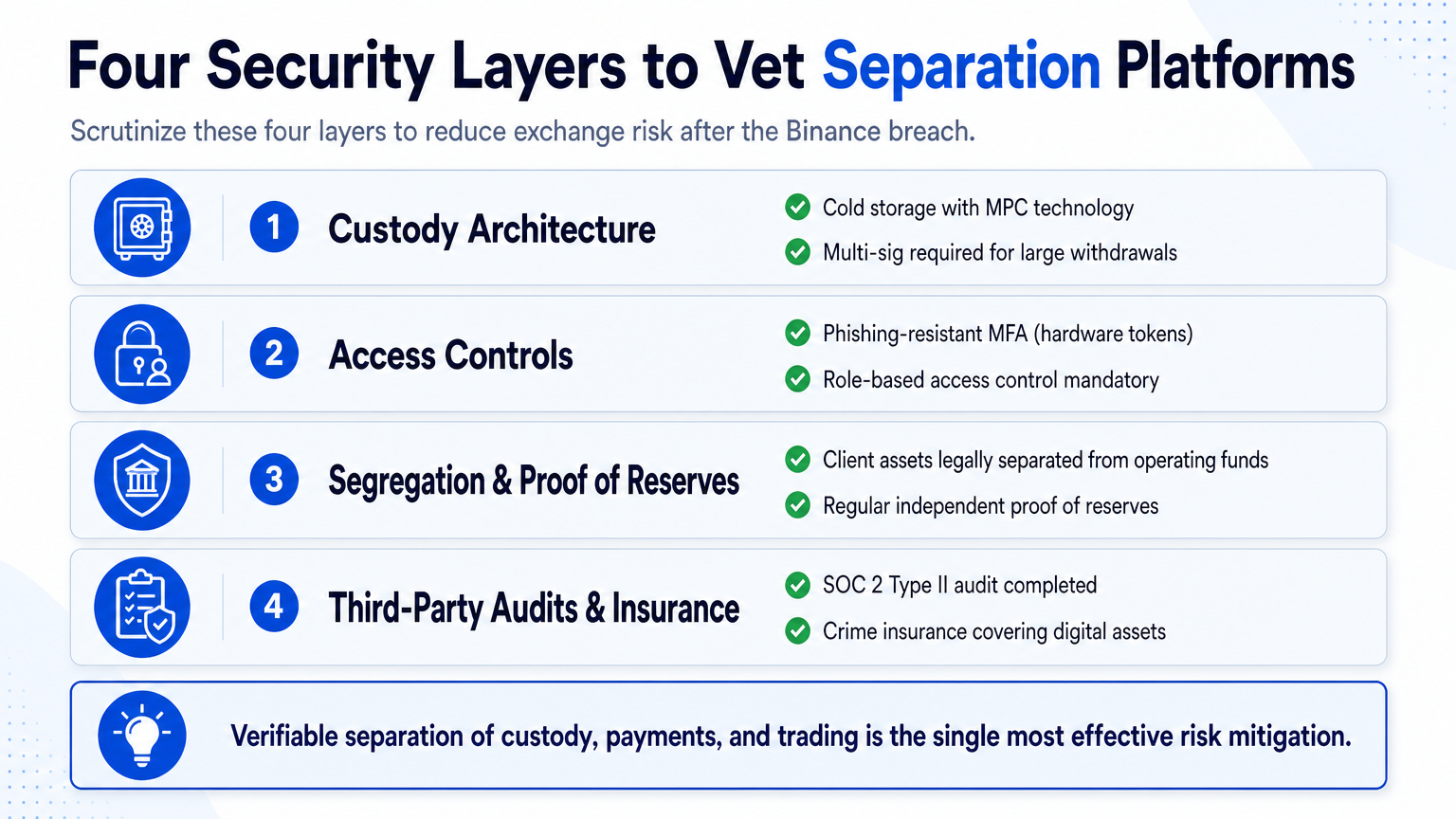
How can a business evaluate the security of a crypto banking platform after such a hack?
Though Binance has not disclosed the attack vector, analysis of past exchange breaches points to a handful of recurring flaws: hot wallet private keys stored in a single online location, insufficient multi‑sig controls, weak API authentication, and commingled customer funds. The CNB cybersecurity guide for cryptocurrency identifies these as high‑impact risks, and every business should now treat them as red flags.
With regulatory pressure mounting—as we explored in how Warren’s likely banking chair role reshapes crypto banking for business—a practical evaluation framework after the Binance heist must scrutinize four layers:
- Custody architecture – Are private keys held in cold storage with MPC (like Fireblocks), or does the platform rely on hot wallet systems? Is there a multi‑sig requirement for every withdrawal above a threshold?
- Access controls – Does the platform enforce phishing‑resistant MFA (hardware tokens, not SMS)? Is role‑based access (RBAC) mandatory, with distinct permissions for viewing, initiating, and approving transactions?
- Segregation and proof of reserves – Are client assets legally and operationally separate from the platform’s own funds? Can the platform produce an independent proof of reserves on a regular cadence?
- Third‑party audits and insurance – Has the custodian undergone a SOC 2 Type II audit or equivalent?? Is there a crime insurance policy that explicitly covers digital assets held in custody?
No platform is invulnerable, but demanding verifiable separation of custody,, payments,, and trading is the single most effective risk reduction move.
What Businesses Should Demand from a Crypto Banking Partner
Are there alternatives to holding large balances on exchanges for day‑to‑day business operations??
Yes.. Dedicated crypto banking platforms built for treasury management provide on‑chain custody without exposing your business crypto treasury to an exchange’s hot wallet. They give you fiat‑crypto integration—meaning you can pay a supplier in USDC and settle in euros—without ever leaving assets on a trading venue. The alternative is not a traditional bank that dabbles in crypto; it’s a neo‑banking platform that treats crypto-native security as foundational, not as an add‑on.. And as stablecoin payments adoption data shows, the ability to move between fiat and stablecoins seamlessly is becoming a core treasury requirement.
What features should a crypto banking platform offer to serve DAOs and corporate treasuries safely?
After a breach of this scale, the bar for “safe” rises sharply.. Any platform that claims to serve institutional or DAO clients must deliver at least these four capabilities, forming a genuine DAO banking solution that works for both corporate and decentralized treasuries.
Institutional-grade crypto custody (e.g.,, Fireblocks)
Custody should be built on industry‑leading MPC technology that never exposes a full private key online. Assets must be held in segregated on‑chain accounts, with withdrawal requests subject to time‑delays and independent review. Platforms like OneSafe, for instance, secure digital assets with Fireblocks and use a modern key‑shard architecture that eliminates single‑point‑of‑failure risks.
Multi-factor authentication and role-based access
Basic password protection is no longer acceptable. Phishing‑resistant MFA (hardware security keys) must be mandatory at signup, not optional. Every transaction above a configurable limit must require quorum approval from multiple signers with distinct roles. DAOs especially need customizable permission layers, so that a multisig signer cannot unilaterally drain the treasury.
Segregated accounts and transparent reporting
Client funds should never be commingled with the platform’s operating capital. Fiat sub‑accounts must be clearly separated in partner bank ledgers, and on‑chain balances must be verifiable via public addresses. Regular, unaudited “proof of reserves” is a minimum; audited attestations are the gold standard.
On/off-ramp without leaving assets on exchange
The platform must offer a direct fiat‑crypto bridge—converting USDC to dollars or euros inside the same interface—so that a business never needs to deposit onto a third‑party exchange just to handle payroll or supplier payments. This eliminates the exchange-as-bank risk entirely.
The bottom line: any crypto banking service that cannot demonstrate these four elements is not suitable for a corporate treasury, no matter how convenient its UI.
Actions to Take Now: Protecting Your Organization’s Funds
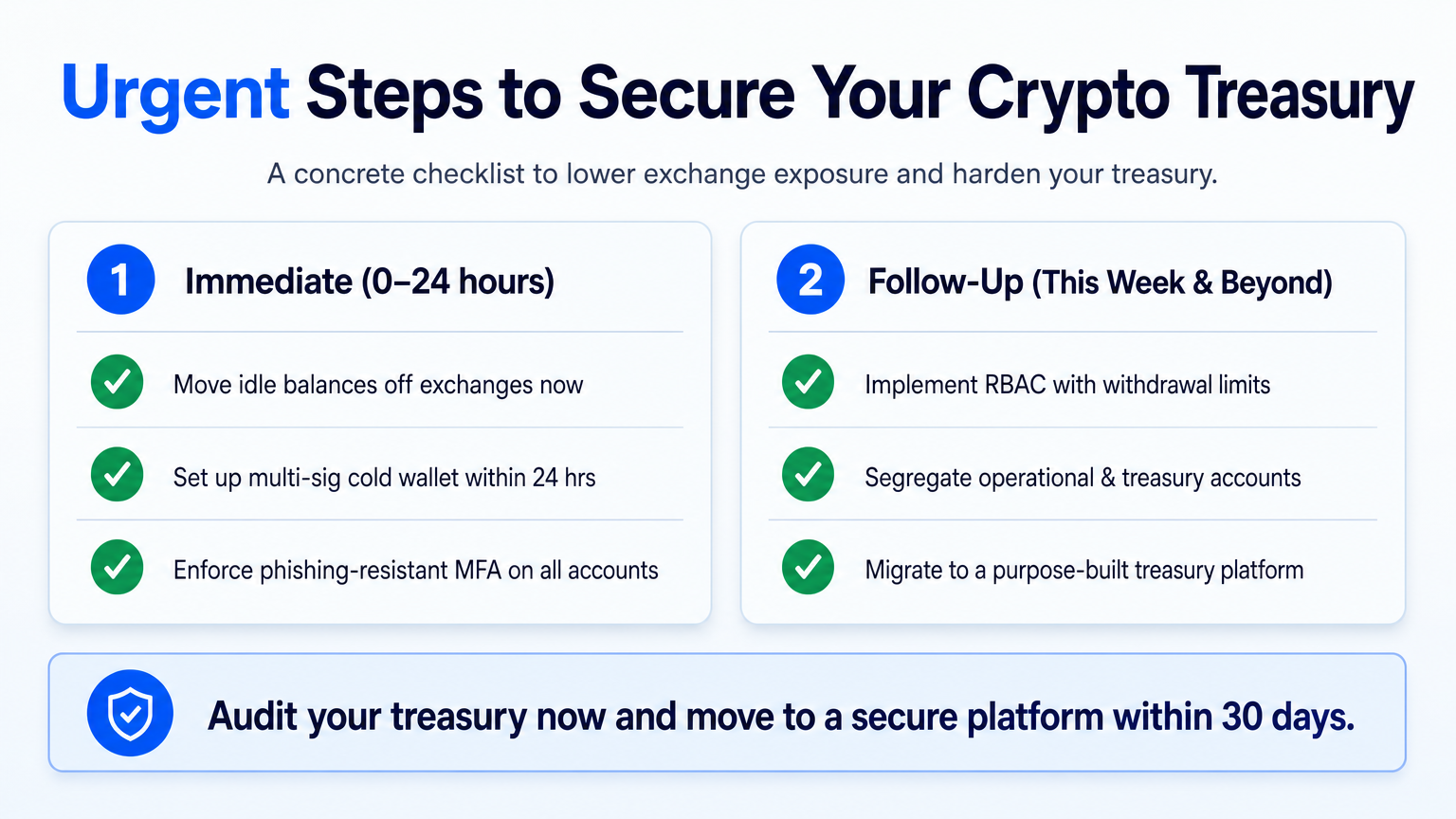
What immediate steps should a business take to protect its crypto and fiat assets?
The Binance heist demands an urgent audit. Here is a concrete checklist that every DAO, startup, or global business can use today to lower its exchange exposure and harden its treasury.
For DAO-managed treasuries, adding customizable governance permissions—so that a multisig council, not one admin, authorizes large payouts—is a non‑negotiable next step. Platforms like OneSafe offer the segregated accounts and on‑chain transparency that make this possible without building custom tooling.
What to Watch Next: Regulation, Insurance, and Industry Standards
The $6.3 billion Binance heist is almost certain to accelerate regulatory pressure. U..S. lawmakers and banking agencies have been signaling tighter oversight, especially for platforms that mingle custody with exchange operations. The FDIC interagency statement already warned that crypto custodians should implement “strong controls,” and the breach will likely push that guidance into formal rulemaking. Meanwhile, insurance underwriters are reassessing crime policies for digital assets; we can expect higher premiums and stricter requirements for segregated custody.
For businesses, the coming months will bring a clearer divide between compliant crypto banking providers and those that operate with exchange‑style risk models. The industry must also standardize what “proof of reserves” actually means—auditable, real‑time attestations are likely to become table stakes for any platform that holds customer funds.
Key Takeaways
- The Binance heist is the largest in crypto history and underscores the existential risk of using exchanges as business bank accounts, along with the heightened crypto exchange risk that demands immediate action.
- Purpose‑built crypto banking platforms that separate custody,, payments, and trading offer a structurally safer alternative for corporate treasuries, with crypto custody handled independently from trading functions.
- All businesses should immediately move idle exchange balances to segregated multi‑sig wallets and enforce phishing‑resistant MFA.
- Institutional‑grade crypto custody (like Fireblocks), role‑based access, and transparent reporting are now minimum requirements for any crypto banking partner.
- DAOs and Web3 startups should audit their treasury governance now—customizable permissions and segregated accounts are the only way to prevent a single‑point‑of‑failure disaster.
For businesses ready to move away from the exchange-as-bank model,, explore a platform built for the task.. Sign up for OneSafe to manage fiat and crypto assets with Fireblocks custody and multi‑factor security.
And to ensure your business stays informed with daily,, professionally written blog posts about crypto banking and treasury management,, Joyrise plans,, writes and publishes illustrated SEO articles to your Webflow blog every day—read your first article before you pay.
Further reading
Get started with Crypto in minutes!
Get started with Crypto effortlessly. OneSafe brings together your crypto and banking needs in one simple, powerful platform.
