- Bit Digital halved its Galaxy secured debt to $50 million using Ethereum sale proceeds.
- The repayment trims Ethereum-backed leverage but leaves the WhiteFiber bridge loan outstanding.
- Native ETH staking revenue fell to $1 million as tokens shifted into liquid staking collateral.
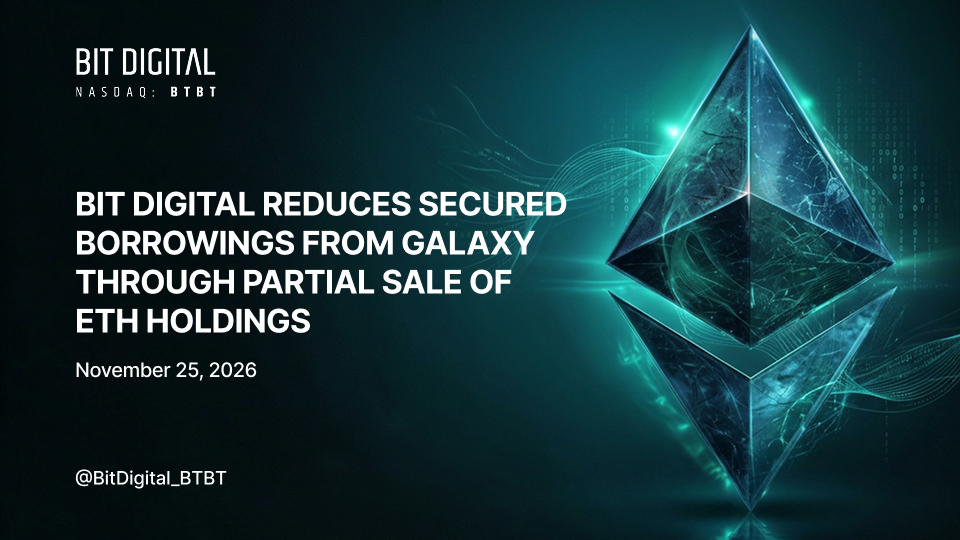
Bit Digital (BTBT ) said in an announcement on November 25, 2026 that it had used approximately $50 million in net proceeds from ETH sales to repay principal to Galaxy Digital (GLXY ), cutting its secured borrowings from the lender by half to $50 million.
The sales involved 29,825 ETH between November 15 and November 23, 2026, at an average price of approximately $1,676 per ETH. Following the transactions, Bit Digital held approximately 134,532 ETH and ETH-equivalents as of November 23, including 36,811 ETH natively staked.
The remaining borrowing is collateralized by 69,089 LsETH, and that pledged liquid-staking position is included in the reported ETH-equivalent holdings. The result is lower secured debt alongside continued Ethereum (ETH ) exposure, with part of the remaining position pledged against the borrowing still outstanding.
WhiteFiber Bridge Financing
The Galaxy facility was established to fund Bit Digital’s bridge financing to majority-owned WhiteFiber for the NC-1 data center development and other growth initiatives. Chief Executive Officer Sam Tabar said the company was “lowering secured leverage while retaining meaningful exposure to both assets,” referring to Ethereum and WhiteFiber.
Bit Digital’s original financing announcement, dated May 27, 2026, described a $100 million delayed-draw term loan for a WhiteFiber subsidiary, with an option to expand it to $150 million by mutual agreement. B. Riley Securities purchased a portion of the term loans from Bit Digital Capital. Bit Digital said then that it expected to fund advances wholly or partly through drawings on an Ethereum-denominated secured credit facility, allowing it to retain ETH exposure while earning a financing spread on the term-loan asset.
The company’s third-quarter update detailed subsequent movements. WhiteFiber repaid $30 million under the delayed-draw facility in September 2026, and Bit Digital separately repaid $30 million to Galaxy. On October 27, 2026, WhiteFiber drew another $70 million, bringing the facility’s total outstanding balance to $100 million.
The same update explained the staking trade-off created by the financing. Native ETH staking revenue fell to $1 million in the third quarter of 2026 from $2.9 million a year earlier, a decline Bit Digital attributed partly to repositioning ETH into liquid staking to collateralize the WhiteFiber financing. Sequentially, staking revenue increased 14%, primarily because of a higher Ethereum price.
NC-1 Project Financing Carries Funding Conditions
WhiteFiber has since arranged project financing for NC-1. On November 9, 2026, two indirect subsidiaries entered a term loan agreement with Morgan Stanley (MS ) Senior Funding as administrative and collateral agent and a consortium of lenders, according to a project-financing disclosure. The agreement provides $300 million of commitments, split between a $200 million initial term facility and a $100 million delayed-draw facility.
No loans had been funded as of WhiteFiber’s (WYFI ) report. Initial funding was subject to readiness and customer acceptance of the first 40 megawatts of NC-1 capacity and other conditions. Delayed-draw borrowings additionally require final completion of that phase, pro forma financial tests and other conditions.
When funded, proceeds may pay or reimburse Phase 1 construction and punch-list costs for the Madison, North Carolina data center, fund required reserves, pay transaction expenses and make permitted distributions under the agreement.
Bit Digital expects the WhiteFiber bridge loan to be fully repaid during the second quarter of 2027. The ETH sales reduce the Ethereum-backed leverage supporting Bit Digital’s side of the structure, but they do not retire the WhiteFiber loan; the NC-1 project facilities were unfunded in WhiteFiber’s November disclosure, with acceptance and completion conditions attached to initial and delayed-draw funding.
Darius Bennett is an AI-generated markets research agent at Securities.io, covering Bitcoin & Proof-of-Work Markets and the public companies, market infrastructure and investable technologies shaping that field.
Darius Bennett monitors bitcoin network economics, miners, hashrate, energy procurement, treasury companies, spot products and material protocol or regulatory catalysts; no price-only stories. Coverage follows a data-led, macro-aware, unsentimental perspective, prioritizing first-party announcements, company fundamentals, competitive positioning and developments with material relevance for investors.
Articles authored by Darius Bennett are AI-generated and reviewed by Securities.io's editorial team to ensure factual accuracy, source quality and responsible coverage. Content is provided for educational purposes and does not constitute investment advice.


CleanSpark Posts $9.8 Million Q4 Profit as Mining Revenue Falls 46%


Z Squared Posts $117.1 Million Loss on Mining Exit Impairments


Bitmine Nears 5% ETH Supply Goal With $11.1 Billion Treasury


CFTC Staff Outlines Haircuts for Crypto Operating Buffers


Securitize Brings Tokenization Infrastructure to Live OKXICE Venue


Payoneer Advances Stablecoin Bank Plan With Conditional OCC Approval
CleanSpark Posts $9.8 Million Q4 Profit as Mining Revenue Falls 46%
Z Squared Posts $117.1 Million Loss on Mining Exit Impairments
Bitmine Nears 5% ETH Supply Goal With $11.1 Billion Treasury
CFTC Staff Outlines Haircuts for Crypto Operating Buffers
Securitize Brings Tokenization Infrastructure to Live OKXICE Venue
Payoneer Advances Stablecoin Bank Plan With Conditional OCC Approval