Home » News » Crypto News
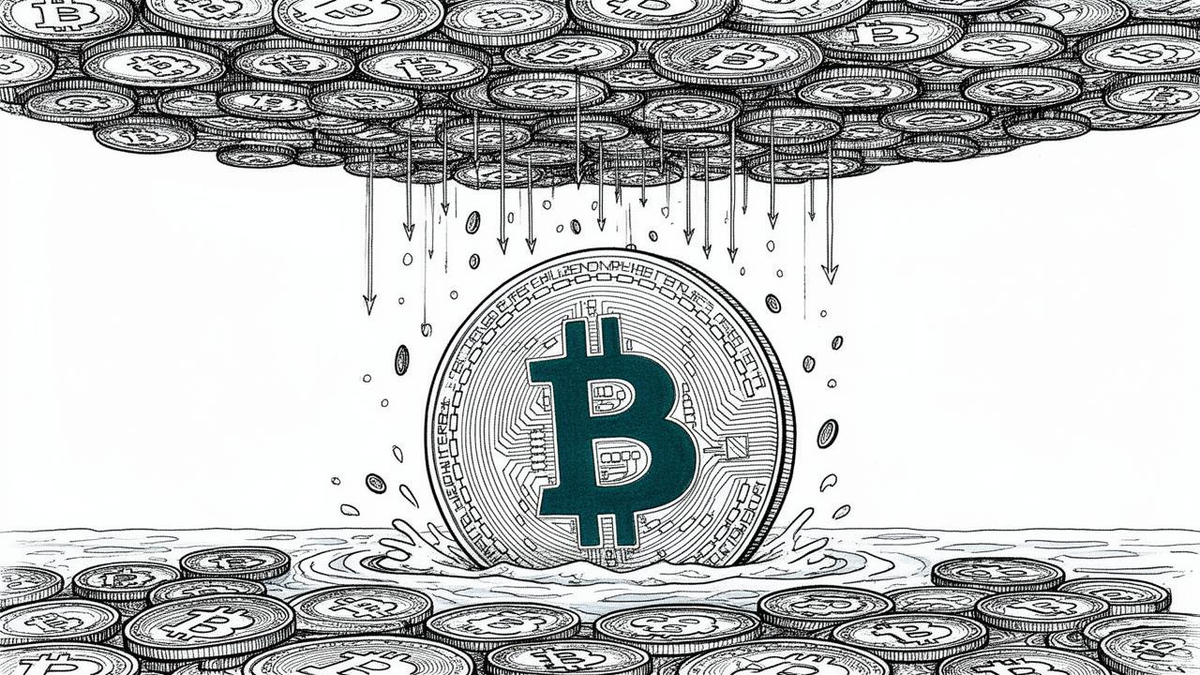
The decrease in the number of wallets holding funds revives questions about the behavior of retail investors. In less than a month, Santiment recorded nearly 109,000 fewer non-empty addresses. Some analysts mention a possible bitcoin capitulation, but the figures do not all tell the same story. Between differences in measurement, platform usages, and the arrival of Telegram wallets, these data require careful reading before any conclusion on the current market today.
In Brief
- The number of non-empty Bitcoin wallets decreased by nearly 109,000 in less than a month, according to Santiment.
- Santiment estimates that retail disengagement could signal a future market recovery.
- Nearly 2.85 million Money wallets have been created on Telegram, but only 6% hold a balance.
- Despite the launch of the Telegram wallet, GRAM lost 25% in one month, compared to 11% for BTC.
A Drop in Bitcoin Addresses That Draws Attention
Santiment analysts have observed a decline in the number of BTC wallets with a balance since mid-October. It reached 59.99 million on October 16, before losing nearly 109,000 units by November 10. This decrease represents less than 0.2%. The decline remains limited at this stage. Santiment speaks of retail disengagement without concluding a decline in network utility.
This movement may reflect the reactions of retail investors. When prices fall, some holders consolidate their positions or empty their wallets. Fear can also lead individuals to reduce their exposure. A drop in addresses does not prove that all these users sell or exit the market. Statistics cannot track each individual decision.
Santiment even proposes a potentially positive reading of this development. According to its analysts, retail capitulation has often preceded market recoveries. The signal would become more encouraging if the number of wallets continued to decrease while prices stopped falling. This combination could indicate that fear-driven selling is weakening. Price behavior thus remains a key factor.
Bitcoin Data Diverges According to Platforms
Santiment is not the only provider tracking addresses with a balance. Coinglass also measures this indicator, but its results differ significantly. The platform recorded 57.3 million non-empty wallets on October 17. This total is 2.7 million less than that of Santiment. Both services thus start from different bases. Their methods can explain part of this gap.
The recent trend observed by Coinglass also contrasts with that of Santiment. As of November 8, the number of addresses had decreased by only 0.04%. Over thirty days, it even showed an increase of 0.1%. These variations remain small but change the interpretation. The choice of source thus modifies the indicator’s reading.
Many investors buy their assets on centralized platforms and hold them directly on these services. Others gain market exposure through exchange-traded funds. In both cases, they do not need a personal wallet on the blockchain. The number of non-empty addresses therefore does not represent all bitcoin holders.
Telegram Multiplies Wallets, but Few Are Funded
Telegram announcements also illustrate the gap between wallet creation and real adoption. On November 9, Pavel Durov stated that more than 700,000 money wallets had been created in 48 hours. The total later exceeded 930,000 creations in the same period. Telegram then had nearly 2.85 million wallets. This increase does not mean every account holds assets.
According to GRAM Explorer, only about 178,000 wallets showed a balance. This represents nearly 6% of recorded accounts. These wallets together held 1.73 million GRAM, formerly called Toncoin. Their value reached 1.9 million dollars. Each funded wallet contained on average 9.7 GRAM, or 11 dollars.
Activity on the chain nevertheless increased during this period. On November 9, Telegram wallets executed more than 675,000 transactions. This volume exceeded the previous day by 59%. However, GRAM Explorer does not provide any history of funded wallets. These data therefore do not measure the growth of funded accounts nor their use of bitcoin. The distinction between technical access and financial activity remains essential.
Created Addresses Do Not Correspond to New Users
TON documentation explains the service’s operation. Telegram displays the wallet menu when the app activates this option for an account. A user can receive GRAM without opening their wallet. The service also supports Telegram collectibles, like gifts and usernames. Its contract also receives other TON tokens.
A created wallet is not necessarily actively used. An account can remain empty, while a user may receive assets before even opening the interface. The figures from Durov and GRAM Explorer mainly measure deployment and initial funding. They do not reveal how many people actually adopt this solution.
The same caution applies to Bitcoin address statistics. More than 200,000 new addresses appear daily according to Look Into Bitcoin data, without representing as many new investors. The network generally generates a new address for each transaction. One person can control several. This practice protects privacy and complicates counting bitcoin users.
Market Performance Relativizes On-chain Signals
Since the beginning of the year, the number of non-empty BTC wallets has increased by nearly 4%. This rise contrasts with the decline noted by Santiment since mid-October. A variation over a few weeks is not enough to establish a trend. A longer period would better contextualize this movement. The data must also be considered in light of bitcoin prices and other network activity measures.
Telegram still has significant growth potential. Telegram has over one billion monthly users, but less than 0.29% have a Money wallet. The service was offered to a restricted group at the end of August 2026, then opened more broadly on October 9. Ultimately, about 60 million users could theoretically have a funded wallet.
This expansion has however not led to a GRAM recovery. BTC lost 11% in one month and 30% in one year. Over the same periods, GRAM fell by 25% and 49%, respectively. Since access was widened, the token has dropped more than BTC. Its 5% rebound on November 10 does not erase losses.
The drop in addresses is therefore not sufficient to confirm a general bitcoin capitulation. Gaps between platforms, purchases via intermediaries, and new addresses limit this indicator. Its evolution must be compared to prices and other activity data. A persistent decrease in wallets with stable prices could signal a sales exhaustion. A new price drop, however, would not confirm a lasting bottom.
Maximize your Cointribune experience with our "Read to Earn" program! For every article you read, earn points and access exclusive rewards. Sign up now and start earning benefits.
Journaliste et rédacteur web passionné par l’univers des cryptomonnaies et des technologies Web3. J’y traite les dernières tendances et actualités afin de proposer un contenu de haute qualité à un large public du secteur.
The views, thoughts, and opinions expressed in this article belong solely to the author, and should not be taken as investment advice. Do your own research before taking any investment decisions.