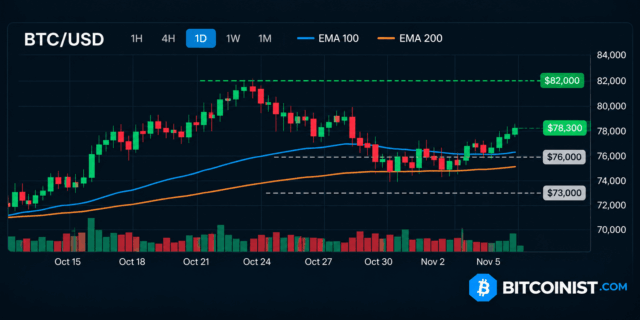
Bitcoin pushed back above $80,000 on Thursday, climbing out of a seven-week trough as fresh money flowed back into U.S. spot Bitcoin funds and a wave of forced short covering added fuel to the move.
The largest cryptocurrency traded near $80,320 in afternoon dealings, up more than 3% over 24 hours, after touching roughly $75,600 during the U.S. midterm election results. It briefly cleared $81,000 before settling around the $80,000 line. Ethereum advanced almost 6% to about $2,425, XRP added 3% to $1.31, Solana rose 4% to $96 and BNB gained 2% to near $710. Zcash led the majors with a gain of more than 7% to nearly $1,320 on about $1.2 billion of turnover.
The turn in institutional flows was the first piece of the puzzle. The twelve U.S. spot Bitcoin ETFs pulled in a combined $74.6 million on November 4, according to Farside Investors, snapping a three-session run of redemptions that had drained about $1.16 billion from the group. Fidelity's FBTC did most of the heavy lifting with $236.7 million of new money, its biggest daily haul in the recent stretch, while ARK Invest's ARKB took in $19.9 million and Bitwise's BITB added $15.2 million. BlackRock's IBIT, the largest of the funds, went the other way with $201.2 million of withdrawals, keeping the picture mixed.
The three prior sessions had been brutal. Investors pulled $643.2 million on October 30, $398.6 million on November 2 and $115.6 million on November 3, with IBIT accounting for the bulk of the damage. The retreat began the session after disclosure of a $6.3 billion Binance theft, which rattled confidence in exchange custody arrangements.
Note: Figures in millions of U.S. dollars, per Farside Investors. Grayscale Mini Trust did not appear among the largest reported flows on November 4.
What turned a slow bleed into a sharp rally was positioning. Roughly $378 million of bearish crypto bets were liquidated within a single hour as prices pushed higher, and total liquidations across the market approached $747 million in that window, according to CoinGlass. Short liquidations happen when exchanges forcibly close leveraged wagers against an asset, and the resulting buybacks amplify the upward move.
Broader markets cooperated. Democrats won control of both chambers of Congress, an outcome that initially unsettled crypto traders because the new majority could take a harder line on pending digital asset legislation. The new Congress does not take office until January 3, leaving the policy consequences months away and largely undefined. Equity investors looked past that: the S&P 500 rose about 1.6%, oil fell sharply, and a softer dollar alongside lower Treasury yields fed demand for risk assets.
On the charts, Bitcoin is trading just above its middle Bollinger Band at $80,273.86, a level that often serves as a short-term trend gauge. The Relative Strength Index has recovered to 51.28 from a moving average of 41.87, a sign that buying momentum has improved without yet looking stretched. Immediate resistance sits between $81,300 and $82,000, with the upper Bollinger Band near $84,240 beyond that. Support begins at the middle band, followed by the lower band around $76,308.
"The way $BTC has absorbed all the bad news over the past week, it's clear the bottom is in," said the crypto analyst known as Ted on X, adding that he sees only a 16% probability of a new all-time high by July 2027, with a record more likely later that year. The estimate is his own and comes without an accompanying probability model.
Not everyone is convinced. CryptoQuant contributor CryptoZeno argued that the market cycle has yet to reach the conditions that have historically marked a durable low. The Bitcoin Cycle Extremes Index has slipped to 15.8% on a 30-day moving average, placing the market in what he calls a "Watch / Mild Pressure" zone, where speculative activity has cooled but the correction has not been confirmed as finished. His Cycle Extreme Oscillator remains below the 1.0 threshold that accompanied stronger phases of past cycles. He said both gauges would need to recover on a sustained basis before the evidence would point to improving conditions.
The stakes for the ETF channel are straightforward. Monday's $115.6 million of redemptions amounted to less than 0.4% of Bitcoin's $31 billion in daily spot volume, a sum exchange and over-the-counter buyers can absorb without much trouble. That gap between fund flows and price action helps explain why Bitcoin recovered even while institutions were still pulling money. A single fund complex accounting for nearly two-thirds of the outflow is also a narrower signal than a broad exit across all twelve products, and several funds finished the three sessions flat or in positive territory.
Attention now shifts to the U.S. employment report due Friday. A strong reading would keep the Federal Reserve cautious about rate cuts and test the recovery thesis, while a soft print could reinforce the risk-on tone that followed the election. For the funds specifically, the test is whether flows stay positive. If they do while Bitcoin holds above $78,000, the three-day redemption streak will look like a post-hack overhang that has cleared. If redemptions resume alongside a retest of the mid-$75,000s, the market will have to revisit the assumption that spot demand can keep soaking up institutional selling.