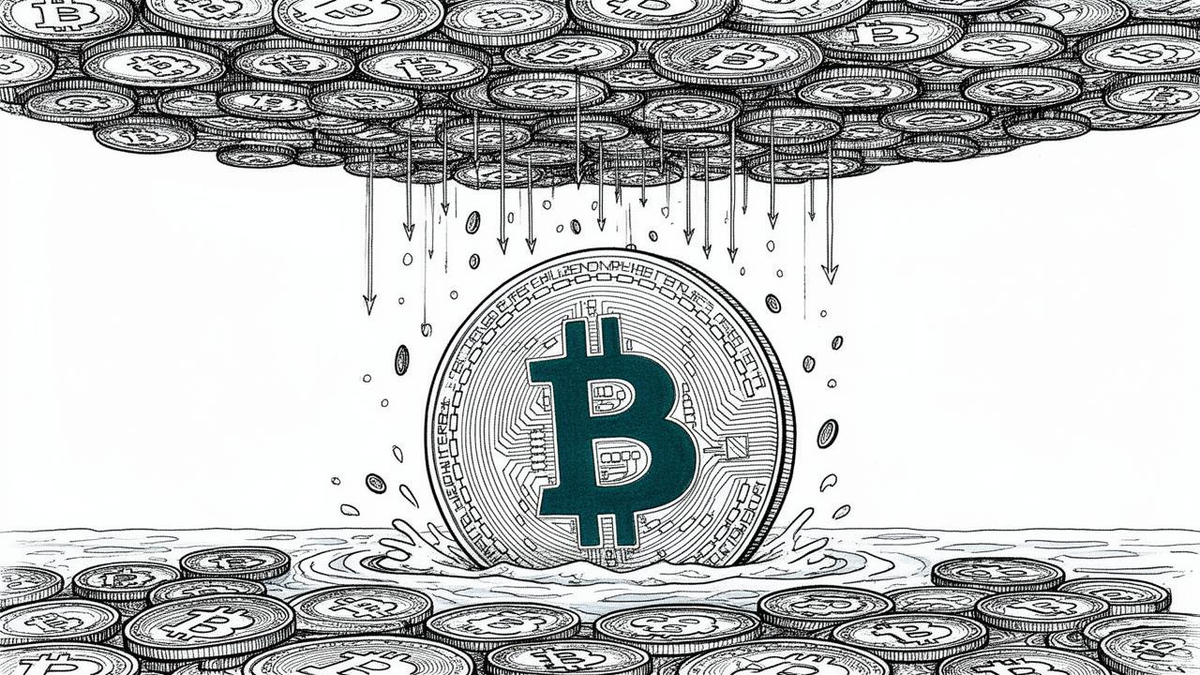
Bitcoin prices plummeted below $73,000 after US inflation exceeded forecasts, raising concerns that the Fed will continue to raise interest rates at its December meeting.
Bitcoin prices continued to face strong selling pressure, at one point falling below $73,000 , after US inflation data showed higher-than-expected figures for the third consecutive month. According to Decrypt, this development dealt another blow to the cryptocurrency market, which was already struggling with a prolonged downturn and a wave of investor withdrawals.
Bitcoin is unlikely to recover.
According to data just released by the U.S. Bureau of Labor Statistics (BLS), the consumer price index (CPI) in October rose 0.4% from the previous month, higher than economists ' forecast of 0.3%.
Meanwhile, the core CPI (an index excluding food and energy prices) rose 0.3%, exceeding the forecast of 0.2%. This also marks the third consecutive month that this index has recorded a similar increase.
Although headline inflation has cooled from its 0.6% increase in September, the actual developments are still not enough to satisfy investors, who expected price pressures to ease more quickly.
Both the overall CPI and core CPI exceeded forecasts by 0.1 percentage points, reinforcing the likelihood that the Federal Reserve (Fed) will continue to maintain a tight monetary policy.
Prior to the data release, Bitcoin was trading around $74,200 . However, immediately after the report was released, the world's largest cryptocurrency quickly plummeted to around $73,525 .
Although it later recovered somewhat to the $74,000 region, Bitcoin remained under selling pressure.
Bitcoin faced strong selling pressure following US CPI data. Photo: CoinMarketCap.
The negative trend also spread to other cryptocurrencies. Ethereum at one point dropped to nearly $2,040 , while a number of major altcoins weakened simultaneously.
Notably, within just one hour of the inflation data being released, approximately $178 million worth of leveraged long positions in the cryptocurrency market were liquidated.
Liquidation occurs when exchanges automatically close margin positions because investors' collateral is no longer sufficient to sustain the trade. These forced sales can further drive prices down, thereby triggering further chain liquidations.
In fact, Bitcoin had a difficult trading week before the CPI report was released. In the last 7 days, the cryptocurrency lost approximately 4.5% of its value.
Meanwhile, spot Bitcoin ETFs in the US continued to record net outflows of $201 million in the first trading session of the week, extending the selling pressure that had been present earlier.
Inflationary pressures have not yet eased.
The latest inflation data is raising concerns about the Fed's monetary policy outlook, a factor that significantly impacts cryptocurrency market movements.
Typically, high inflation leads central banks to either maintain high interest rates or continue raising them to control prices.
When government bonds and cash assets offer attractive yields, investors have less incentive to hold volatile assets like Bitcoin, which do not generate interest income simply from holding them.
In addition, rising borrowing costs are also narrowing the amount of money available for speculative investment activities.
Notably, the October CPI report was released just hours after Fed Governor Christopher Waller made hawkish remarks about interest rate direction.
Speaking in London, Waller said he supported raising interest rates by another 0.25 percentage points at the December meeting even as inflation showed signs of improvement.
The official also warned that if core CPI continues to rise by 0.3%, the Fed may need to consider a more aggressive adjustment.
I believe that raising the policy interest rate by another 50 basis points should be considered at the December meeting.
Fed Governor Christopher Waller
I believe that raising the policy interest rate by another 50 basis points should be considered at the December meeting.
Fed Governor Christopher Waller
The core CPI figures for October were subsequently released and reached the level that Mr. Waller had mentioned.
According to Reuters , by mid-morning, financial analysts had raised the probability of the Fed raising interest rates by 0.5 percentage points in December to nearly 15%. However, a 0.25 percentage point increase was still considered significantly more likely.
The bond market reacted quickly to these developments. The yield on 2-year US Treasury bonds, which is sensitive to Fed policy expectations, recorded its sharpest increase since April 2025.
At the same time, the US dollar appreciated, while the US stock market opened in the red.
For the cryptocurrency market, these current developments are nothing new.
In October, Bitcoin also plummeted after the September inflation report showed higher-than-expected figures. The sell-off then continued as expectations of a Fed interest rate hike increased.
However, the current situation is somewhat more unfavorable as the price of Bitcoin has fallen significantly compared to last month, while demand from institutional investors is beginning to show signs of weakening.
The continued rise in US Treasury yields could make a sustainable recovery for Bitcoin more difficult, unless inflation cools or investor risk appetite improves.
According to the schedule, the Fed will hold its final policy meeting of 2026 on December 8-9.
Meanwhile, the next CPI report is scheduled for December 10th. This means the Fed will have to make its December interest rate decision without having the November consumer inflation data.