TradingKey - Defying the bearish PCE shock, Bitcoin surged 3% on progress toward strategic Bitcoin reserve legislation, with short-term targets looking up to $65,000.
On November 25, Eastern Time, Bitcoin (BTC) showed strong resilience against the bearish shock of higher-than-expected U.S. October Personal Consumption Expenditures (PCE) inflation. After briefly dipping into the $57,300 range intraday, it staged a rapid V-shaped reversal, rebounding about 3% on the day to climb back above the $60,000 round-number mark. As of press time, Bitcoin was trading at $60,902.
The October PCE price index released by the U.S. Bureau of Economic Analysis (BEA) rose 3.8% year-over-year, while core PCE climbed 3.3% year-over-year, exceeding market expectations of 3.2% and further reinforcing expectations that the Federal Reserve (Fed) will maintain tight monetary policy or even hike rates in December. Immediately following the data release, Bitcoin briefly came under pressure and fell to $57,000 before quickly rebounding and strengthening.
Bitcoin's rally in the face of bearish news was primarily driven by the U.S. Congress formally advancing 'Strategic Bitcoin Reserve' legislation. The U.S. House Financial Services Committee officially reported H.R. 8957, the American Reserve Modernization Act of 2026, to the full House and placed it on the legislative calendar, qualifying it for a floor vote.
The bill aims to formally codify into federal law the 'Strategic Bitcoin Reserve' established by the Trump administration via executive order. It explicitly stipulates that for at least 20 years after the act takes effect, the U.S. Department of the Treasury may not sell, exchange, auction, or dispose of the Bitcoin in the reserve for any purpose; after the 20-year lockup period expires, it may sell no more than 10% every two years.
Although the bill currently lacks provisions for additional fiscal appropriations to purchase Bitcoin, and completing bicameral passage before Congress adjourns remains challenging, the 20-year lockup directly eases market concerns over long-term supply from the U.S. government selling confiscated Bitcoin on the open market. According to CoinGlass data, the U.S. government currently holds nearly 330,000 BTC, ranking second globally behind only Strategy.
Bitcoin currently sits at the crossroads of a bull-bear tug-of-war among macroeconomic tightening, positive legislative tailwinds, and an oversold technical rebound. If bulls can decisively hold above $60,000 through late November, the short-term rebound target will point directly toward the $65,000 range, a critical level that will determine whether this bounce can evolve into a trend reversal.
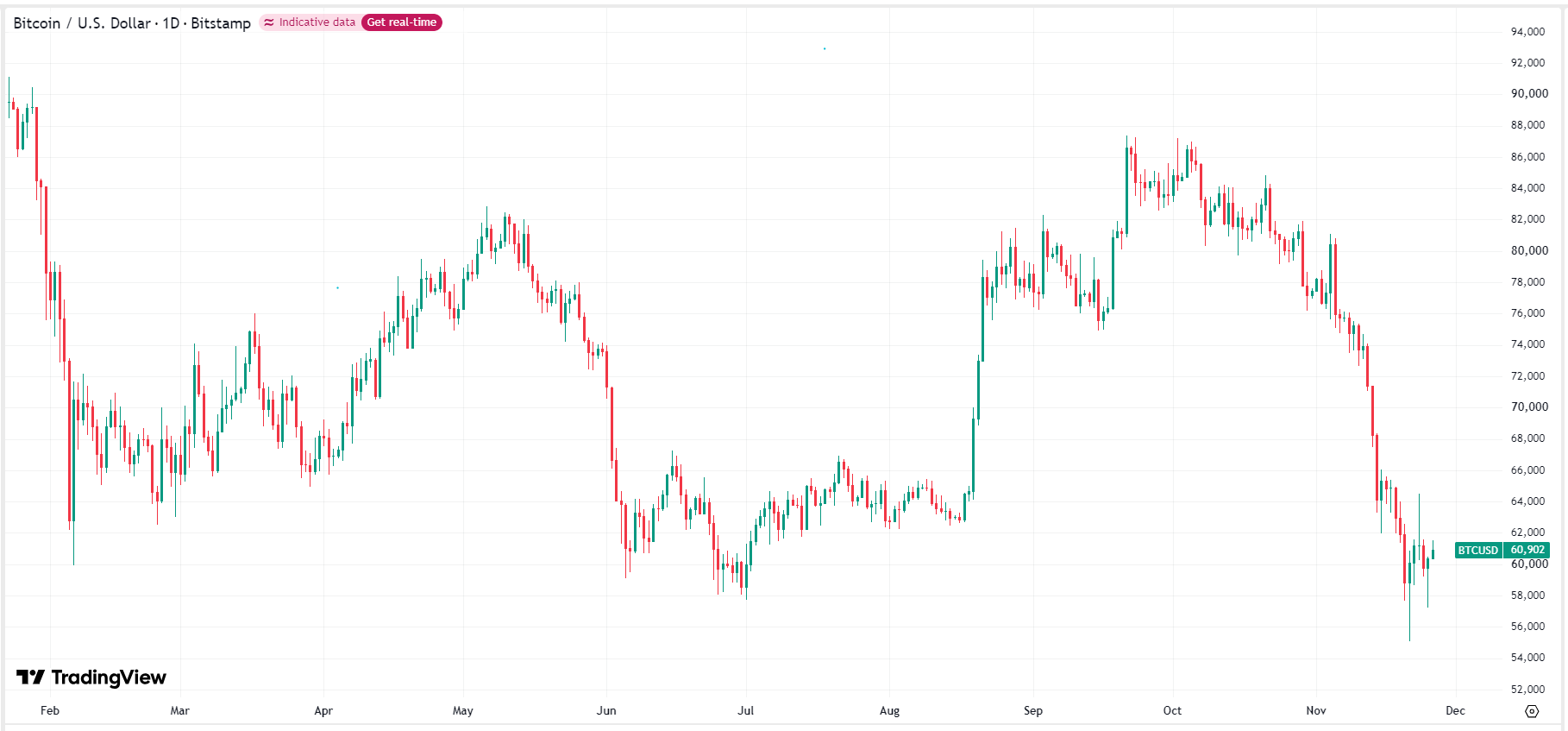 Bitcoin price chart, source: TradingView