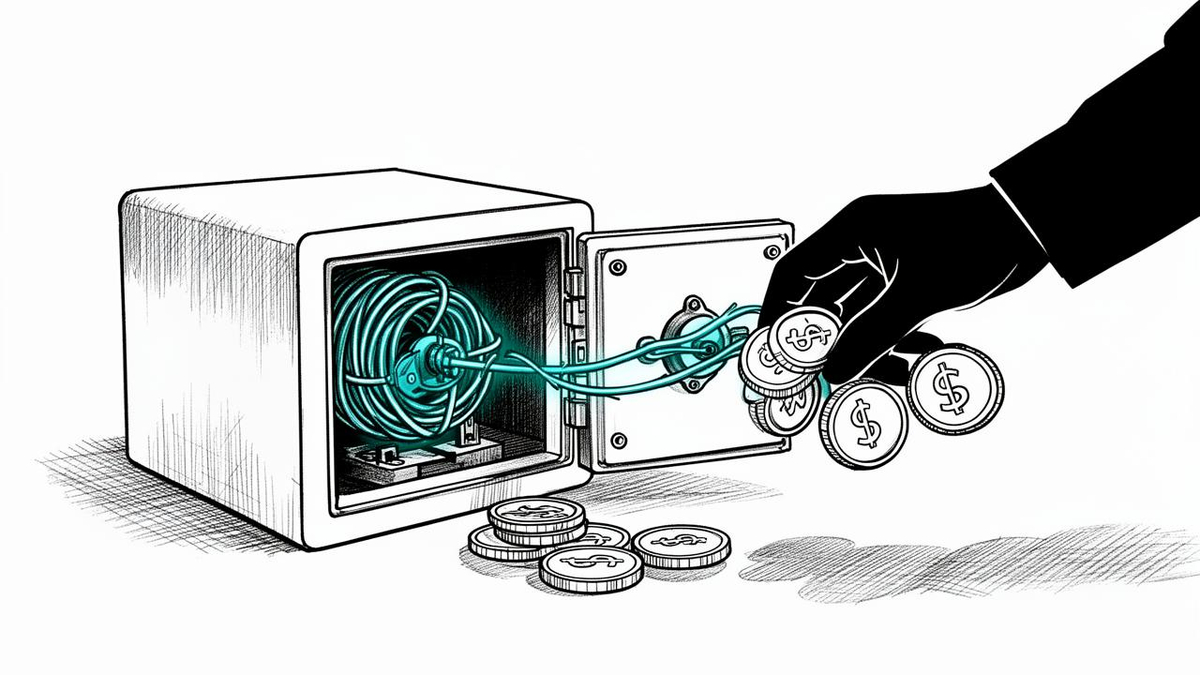
A Bitcoin Core contributor has floated a plan to make stealing bitcoin with a future quantum computer a losing trade: anyone who tries would have to put up their own coins as collateral, which the coins' rightful owner could then seize.
Cory Fields, who works on Bitcoin's software at MIT's Digital Currency Initiative, laid out the idea on the bitcoin-dev mailing list on Wednesday. He calls the mechanism "quantum landmines" and describes it as a deterrent rather than a fix for the underlying cryptography.
The concern it addresses is that Bitcoin uses elliptic curve cryptography to protect private keys, and some early transaction formats published public keys on the blockchain from the start. A sufficiently powerful quantum computer could, in theory, derive the matching private key from an exposed public key. No machine capable of that exists today, and no such mechanism operates on Bitcoin now.
Under Fields' example, moving 1 BTC out of a vulnerable wallet would require the spender to supply another 1 BTC from a quantum-safe wallet. Both amounts would be locked for a waiting period, which he suggested could run about 30 days.
Before quantum attacks become practical, a genuine holder could create a separate quantum-safe "landmine" containing a hidden proof of ownership. If a thief later tried to drain the vulnerable coins, the owner could reveal that proof during the waiting period, reclaim the bitcoin and collect the attacker's collateral as a penalty. The attacker would have no way of knowing in advance which wallets were booby-trapped.
"However, Alice notices the transaction in the meantime," Fields wrote in the post, sketching how a legitimate owner would recover her funds and take the collateral.
The scheme gives holders an incentive to plant traps early, since a successful defense would leave them with more bitcoin than they started with. But it only works for owners who still control their keys, which excludes coins widely believed to be lost, including those tied to Bitcoin's pseudonymous creator, Satoshi Nakamoto.
To cover dormant wallets, Fields sketched an auction system in which participants stake hidden bids against vulnerable holdings before any attack occurs. If a quantum thief strikes, the bids are revealed after the ownership-proof window closes, and successful bidders could claim portions of the attacker's collateral. In one version, the vulnerable coins would be destroyed if an eligible bid kept the attacker from retaining them.
He credited Neha Narula, director of the MIT Digital Currency Initiative, with suggesting a variant in which competing bidders face financial penalties. Neither auction design guarantees that an original owner recovers anything; the aim is to make theft expensive enough to deter it.
The collateral requirement cuts both ways. Bitcoin's ledger cannot distinguish between a legitimate owner and an attacker who has derived the same private key, so an honest holder moving coins out of an old wallet would face the same demand. Someone whose entire balance sat in an early address would need to acquire matching funds before moving it.
"The purpose of this post is just to introduce the ideas as thought experiments," Fields wrote, adding that he had not specified the software changes needed to carry them out.
Implementation would first require quantum-safe transaction outputs and new consensus rules governing vulnerable coins. Fields left several design questions open, including collateral ratios, auction deadlines, penalties for losing bids and the conditions under which coins could be destroyed.
The proposal lands amid a broader push within the industry to prepare for quantum risk. Coinbase urged developers in October to start planning, warning that migrating existing wallets could take several years. Research from Fireblocks has flagged exposed public keys as a major exposure, estimating that millions of BTC sit in potentially vulnerable addresses. BitMEX has separately proposed restricting older wallets only after evidence of a successful quantum attack.
Market reaction was muted. There is no indication the mailing-list discussion has moved bitcoin's price or trading volumes, and the debate is technical and developer-focused rather than market-driven. Longer term, however, the attention to quantum risk could shape custody practices, particularly at institutions holding large reserves, and prompt wallet providers to review how addresses are managed.
Key elements of the proposal:
Note: Details are drawn from Fields' mailing-list description and remain unresolved design choices.
Bitcoin's decentralized governance means any change of this scale would typically take years of debate and testing before activation. For now, the landmine idea is one entry in a growing file of proposals that developers are weighing well before the threat becomes immediate.