Bitcoin slid to around $73,600 on Tuesday after U.S. consumer prices rose faster than economists had expected in October.
Inflation beats forecasts
The Consumer Price Index rose 0.4% in October on a seasonally adjusted basis after climbing 0.6% in September, the U.S. Bureau of Labor Statistics reported.
Economists polled by Dow Jones had expected a 0.3% gain for the headline figure and 0.2% for core prices.
Core CPI, which strips out food and energy, instead rose 0.3%, matching its pace in September and August.
Shelter rose 0.3% and accounted for over thirty percent of the monthly increase, while the energy index added 0.7% following a 5.2% jump in September.
The BLS did not publish 12-month changes, since it could not collect survey data for October 2025 during the government shutdown.
Bitcoin and stocks slide
Bitcoin added to its early losses after the print, dipping about another 1% to $73,600.
Stock index futures turned lower as well, with the Nasdaq 100 down 1.15% and the S&P 500 off 0.5%, while the 10-year Treasury yield rose 6.5 basis points to 4.93%.
The selloff followed a weak day for fund flows, as U.S. spot bitcoin ETFs lost $201 million on Monday, led by $213.2 million of outflows from BlackRock’s IBIT, which has now posted seven straight sessions of redemptions.
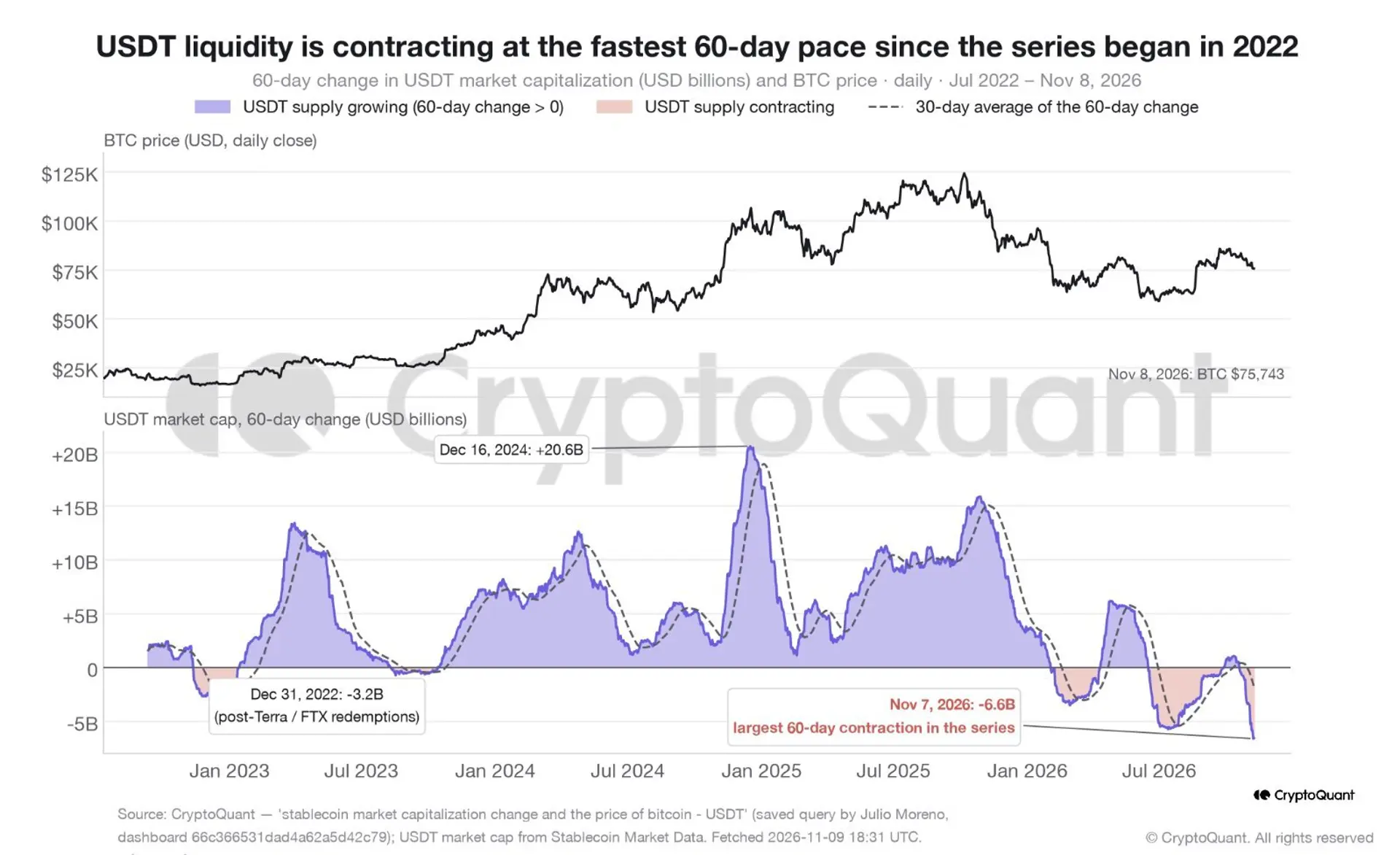
Bitcoin was also trading below the short-term holder cost basis, which CryptoQuant put at $75,691 on Monday.
Waller backs a December hike
Rate expectations had already climbed before the data after Fed Governor Christopher Waller spoke at the Bank of England Watchers Conference in London, where he said:
“While I am hoping for an improvement over September, even if this occurs, I would still support a 25 basis point increase in the FOMC’s policy rate at our December meeting.”
“While I am hoping for an improvement over September, even if this occurs, I would still support a 25 basis point increase in the FOMC’s policy rate at our December meeting.”
He left the door open to a larger move, adding:
“However, if inflation comes in substantially higher than I expect, more robust action by the FOMC may be called for.”
“However, if inflation comes in substantially higher than I expect, more robust action by the FOMC may be called for.”
Waller also pointed to September’s PCE index, which rose 0.5% month-on-month and 3.7% year-on-year, saying:
“Let’s just say it. September’s inflation data were bad. There was no silver lining.”
“Let’s just say it. September’s inflation data were bad. There was no silver lining.”
Following the speech, odds of a 25-basis-point hike in December jumped from 76.3% to 96.3%, according to CME Group’s FedWatch Tool.