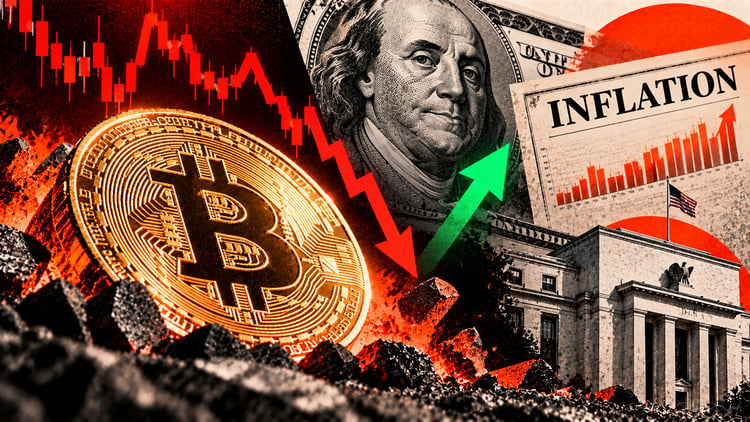
Bitcoin fell below the $60,000 mark during Asian trading hours on November 24, fully erasing gains from the prior session that had been driven by Nvidia Chief Executive Officer Jensen Huang's return to the company. The cryptocurrency touched an intraday low of about $59,668, down roughly 7.5% from its November 23 high of $64,500. It has lost about 25% over the past 30 days and is now halved from its all-time high of $126,000 set in October 2025.
The sharp selloff has reignited debate over where the bottom lies. In a note to clients dated November 24, Galaxy Research head of research Alex Thorn formally retracted his October 26 call that "Bitcoin's bear market ended in June." He said the technical argument underpinning that report "no longer holds" and that the bear market "is likely not over."
Technical Signal Fails, Galaxy Admits Error
In its October report, Galaxy treated the 200-week moving average as a floor and the 50-week moving average as a ceiling, citing Bitcoin's September reclaim of the 50-week line—ending a record 44 consecutive weeks below it—as core evidence the bear market was over. The situation has since reversed sharply: in the week ended November 8, Bitcoin closed back below the 50-week moving average; in the week ended November 15, it broke below the 200-week average; on November 20 it touched an intraday low of $57,661, already below the July 1 low of $57,740; and on November 21 it slid further to $55,100.
As of the November 22 close, Bitcoin stood at $61,104, just 4.4% above the June 30 closing low of $58,525. Thorn noted that of 13 instances since 2011 in which Bitcoin reclaimed the 50-week moving average, only two were followed by a close below the prior swing low—both during the 2021-2022 bear market, with stays below the average lasting just one week and 12 weeks respectively. September's reclaim ended a 44-week stretch, an unprecedented combination. He acknowledged the signal had never been tested in a "shallow low" scenario.
The report offered a key observation: after Bitcoin closes below an "established low" that has held for at least 60 days and from which it had bounced at least 20%, the final low in the past seven bear market cases was at least another 17% lower, with a median decline of 52%. Applied to the June low of $58,525, that implies levels of roughly $48,500 and $28,200.
Thorn's conclusion: in terms of time, this bear market is already late-stage; in terms of depth, it remains early. November 22 marked the 412th day since the October 6, 2025 all-time high, exceeding the 163-to-406-day range of the previous four bear markets. Yet the 53% decline pales against past drawdowns of 77% to 93%, and Bitcoin has not closed a single day below its realized price of $53,205—while every prior bear market spent at least 140 days below that level. Of the 13 bottom signals Galaxy tracks, only two have been triggered.
U.S. Buyers Absent, Mass ETF Exodus
A report published the same day by on-chain data firm Glassnode pointed in the same direction. The firm said selling accelerated markedly after the $62,000-$66,000 cost-basis band was lost, with prices back at summer lows, and that "the absence of U.S. buyers" was the key factor. Over the past 20 trading days, U.S. spot Bitcoin ETFs saw net outflows of $4.3 billion (about NT$140 billion), one of the largest outflow episodes since launch; over the past 30 days, aggressive takers on Coinbase have been heavy net sellers while Binance has been roughly flat.
ETF bleeding was especially severe in late November. Citing CoinGlass data, Forbes Japan reported that U.S. spot Bitcoin ETFs saw net outflows of $569.7 million (about NT$19 billion) on November 23 alone, the fifth consecutive business day of outflows, with BlackRock's iShares Bitcoin Trust accounting for $509.3 million (about NT$17 billion) of that. Over the five business days, outflows totaled roughly NT$78 billion (about $2.4 billion), with BlackRock's product contributing $1.95 billion (about NT$64 billion).
In a November 24 analysis, 21Shares traced the start of the correction to the October 29 Binance hack. The incident, totaling $6.4 billion (about NT$210 billion), had limited direct impact—Bitcoin fell just 5.1% in two days and had nearly recovered all losses by November 4. The real problem was liquidity withdrawal: stablecoin supply shrank by $10.7 billion (about NT$350 billion) after the hack, the largest 18-day decline since the Terra collapse in 2022; from October 30 to November 13, U.S. spot Bitcoin and Ether ETFs saw combined outflows of $3.9 billion (about NT$130 billion).
The report also broke down the role of leverage. From November 11 to 14, Bitcoin fell another 13.5% to $63,821, mainly due to forced liquidations of leveraged longs. In the week ended November 15, total crypto market liquidations reached $5.8 billion (about NT$190 billion), with longs accounting for 81%; in Bitcoin futures alone, $1.6 billion (about NT$53 billion) of long positions were liquidated from November 12 to 14. 21Shares believes most of the leverage accumulated since the hack has been cleared, which could limit further liquidations but does not guarantee a reversal.
Capitulation Emerges, Bottom Signals Diverge
Glassnode observed that realized losses are the heaviest since the FTX collapse, options traders are the most bearish since 2022, and nearly 90% of long leverage above the realized price has been flushed out. The firm views this as bullish because forced selling is nearly exhausted, but cautioned that such capitulation spikes have sometimes appeared near lows and sometimes come early, with prices falling further afterward.
21Shares was more explicit about recovery conditions: Bitcoin must attract fresh inflows and reclaim the $73,000-$75,500 range, contingent on simultaneous improvement in ETF flows and stablecoin reserve rebuilding. On the downside, the $53,250 realized price is the threshold to watch closely.
Market breadth is also weak. Ether (ETH), the second-largest cryptocurrency by market value, fell more than 8.5% from its November 23 high to $1,683.55; major coins including BNB, XRP and SOL declined in tandem. Bitcoin's market share has slipped below 60% to 58.6%, but The Motley Fool noted the driver this time was fear rather than greed—total stablecoin supply shrank by $13.6 billion (about NT$450 billion) in November, capital did not rotate into altcoins, and the altcoin season index stood at just 57, well below the 75 that signals genuine rotation.
Equity-market correlation warrants caution. Glassnode noted that Bitcoin's correlation with the Nasdaq 100 has risen to its highest since September 2022, and over the past 60 trading days Bitcoin has risen less when the index gained and fallen more when it declined—a pattern that historically has been followed by lower prices 60 days later about two-thirds of the time. On November 23, the Nasdaq Composite jumped 6.51% as Nvidia shares surged 31% in a single day; Bitcoin rose about 5% in sympathy but returned to its starting point within six hours. On November 24, U.S. stock futures turned lower, with Nasdaq 100 futures down 1.83%.
Below is a summary of key observations from major institutions on the outlook:
Note: Price levels and indicators are compiled from reports published by each institution around November 24; Bitcoin closed at $61,104 on November 22.
Three Signals to Watch
The Galaxy report flagged three things to monitor: whether the June low holds on a closing basis (daily close of $58,525, weekly close of $59,517); whether investment advisers and wealth management platforms continue to add Bitcoin ETPs; and whether the two-year Treasury yield falls back toward the federal funds rate. The two-year yield currently sits 0.88 percentage points above the fed funds rate—narrower than the 1.11-point peak on September 16 but still above the 0.51-point gap at the June low.
Thorn also reviewed the timing of the October report: it came three days before the Binance hack, eight days before Democrats' better-than-expected midterm sweep, and 17 days before Jensen Huang stepped down as Nvidia CEO. "The timing was unfortunate, but we stand by that analysis," he wrote. This time, however, he chose not to wait for the December 8 observation window to close: "We won't wait until then."
For investors, two sets of signals are pulling in opposite directions. Mean-reversion believers see leverage flushed out, sentiment extremely bearish and capitulation underway; trend followers see lower prices ahead. Galaxy's conclusion may be the most blunt: until either time or depth gives way, the market will be judged by weekly closes rather than headlines.
Once added, BigGo Finance appears first in Google Search Top Stories, so you get the broadest, most up-to-the-minute, and most comprehensive global financial news first.