The views expressed in this article are those of the author and do not necessarily reflect the position of CoinGeek.
TL;DR: A week in Boyle, County Roscommon, Ireland, in November 2026 convinced Kurt that BSV adoption depends on builders with long time horizons, not speculators. Inflation has trained most people to treat anything scarce, including Bitcoin, as a store of fiat value. The locals he met instead saw BSV as a tool for fast, low-cost, private commerce, and they understood it quickly.
Key Takeaways:
- Inflation pushes people to treat crypto as speculation because it rewards asset holders over wage earners.
- Builders in Boyle, Ireland, were drawn to BSV for payments that settle in seconds for a fraction of a cent, with data and identity on the same ledger.
- BSV adoption spreads person-to-person through localism, discipline, entrepreneurship, and long-term focus.
“Good people get it.”
That’s the phrase I brought home from the first full week of November 2026, which I spent in and around Boyle, a small town in County Roscommon, Ireland. It has been stuck in my head ever since I got home, sitting on my shoulder like a parrot that only learned one line. I think it’s true. I also think it explains why most of the world still looks at BSV and sees just another lottery ticket.
It’s a little sad to say, but plenty of people want to putter around their lives, pay their taxes, watch some sportsball on the weekend and get through the day, or the week if it’s a good one. There is no bigger vision, no cathedral going up in the back of their minds, no tree being planted so the children can harvest the fruit… Pessimistic in tone, yes, but this is not a criticism. Those are my neighbors, and a lot of them are wonderful people who would help you move a couch on short notice. But it is the reason so many folks look at “crypto” exactly the way they look at everything else: a number on a screen that either goes up or doesn’t.
Everyone wishes they had bought a house when rates were lower. Everyone wishes they had held on to their Pokémon cards. Everyone wishes they had bought a Rolex before 2020, and Bitcoin before 2017.
Why?
Nobody regrets missing the house because they wanted to raise a closer family in a warm home. Nobody is crying over that binder of cards because they miss playing Pokémon. Nobody regrets passing on the Rolex because they longed to tell time with a nice mechanical watch, and almost nobody regrets missing Bitcoin because they wanted to build a business that leverages it. Every one of those regrets is about the same thing: more fiat value in their lives.
Is that their fault?
Mostly, no.
Inflation turns everything scarce or desirable into an asset, and it almost exclusively rewards asset holders over the average wage slave living paycheck to paycheck.
When the money melts in your pocket, you learn to grab anything that might melt slower: trading cards, watches, houses that used to be homes. People are responding rationally to broken money, and the speculative circus around crypto is mostly that same rational response wearing a hoodie or a JPEG. I’ve spent years criticizing that circus, but the people caught up in it are not dumb. They’re doing exactly what the system trained them to do, for better or worse.
Once you see it
So why did the folks in Boyle get it?
Two ingredients, as far as I could tell.
First, the people I met want to build things that cannot be built any other way, which in plain terms means fast, reliable, private commerce: payments that settle in seconds for a fraction of a cent, with data and identity riding on the same ledger as the money. What got them excited, and it got them excited fast, was everything that could be built with it.
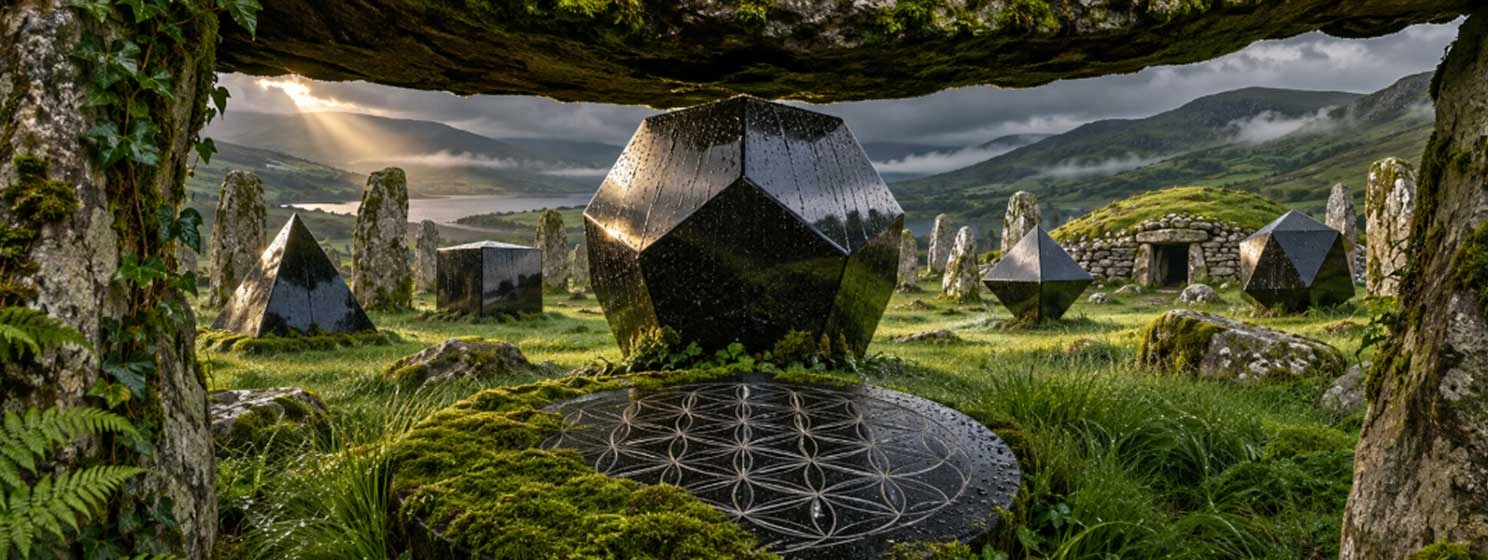
Second, they think in horizons longer than their workweek. Much longer. They carry a big vision of a future where the facade of modernity washes away, leaving behind the power of legacy, lifestyle, hard work, and family and community structures that actually bear weight. That isn’t a fantasy over there, either. Boyle Abbey has been standing in town, ruined and stubborn, since the twelfth century, and if you head a short drive north into the Bricklieve Hills of South County Sligo, you reach the Carrowkeel passage tombs, built in the fourth millennium BC. This is a country where people stacked stone five thousand years ago, and it is still standing…
You think about time differently with a twelfth-century abbey in town and five-thousand-year-old tombs a short drive up the road, and when you work with your hands as much as you work with a keyboard.
Seen in those terms, BSV looks a lot less like the “investment opportunity” the rest of crypto keeps pitching from a conference stage with a fog machine, and a lot more like a high-leverage tool for building abundance and real economic value. A plow, not a scratch-off. That’s why it excited them the moment they saw it, and they all kept saying the same thing: “once you see it, you can’t unsee it.”
I came home grateful for people like that: builders, as patient as their stones, and rooted deep in the place they live.
Somebody is already typing it into my replies on X: isn’t that an awful lot to hang on one little town in Roscommon?
Maybe. But I don’t think Boyle is special because it’s Irish, or old (though it is both). I think it’s early. 9/11, the global financial crisis, the global pandemic, and a whole generation of war have shown more and more people that the fiat system is not sustainable. Globalism is not sustainable. Every one of those shocks sent another batch of ordinary folks out looking for something that holds still longer than a news cycle, a football season, or a presidential administration. Ultimately, nothing is sustainable if we try to thrive without a side-quest in BSV that becomes the mainstream over time. Any gamer can tell you how that goes: the side-quest is where you find the gear that wins the whole game.
The lessons from Boyle are the old ones, and they travel well: localism, discipline, entrepreneurship, and a longer focus. You can’t download those values, and no exchange will ever list them. They get exported across a table, over a coffee or a pint, by somebody who already sees it sitting with somebody who doesn’t yet.
So be one of those people, and bring one more.
Pick the thing you would build if you were thinking in decades instead of quarters, find the good people near you, and show one of them. Then let them show one more.
Good people get it… one person at a time.
FAQs:
What is BSV used for?
BSV is a blockchain built for commerce. Payments settle in seconds for a fraction of a cent, with data and identity recorded on the same ledger.
Why do most people see crypto as a gamble?
Inflation erodes savings, so people chase assets that might hold value. Many treat crypto as a number that either goes up or doesn’t.
How does inflation affect how people view Bitcoin?
Inflation rewards asset holders, so many see Bitcoin like houses or watches: a bet on rising fiat value, not a tool to build with.
Why did people in Boyle, Ireland, get excited about BSV?
They wanted fast, private, low-cost payments and think in decades, not weeks. That made BSV look like a practical tool, not an investment.
Where is Boyle, Ireland?
Boyle is a small town in County Roscommon, home to 12th-century Boyle Abbey. The Carrowkeel passage tombs sit a short drive north in County Sligo.
This opinion piece is published to encourage discussion. The author’s views are their own and do not constitute legal, procurement, or policy advice, nor do they represent the positions of CoinGeek or its partners.
Related articles
Watch: Bitcoin’s Security Model at Scale
Kurt Wuckert Jr
Kurt Wuckert Jr. is the Chief Bitcoin Historian, covering Bitcoin history, Bitcoin mining, the BSV blockchain, and Satoshi Nakamoto since 2020. In Bitcoin since 2012, he has published more than 260 articles at CoinGeek and interviewed Peter Schiff, Scott Galloway, and Ben McKenzie on his shows. He co-founded GorillaPool in 2021 and Open Protocol Labs in 2023. He is cited in two major-publisher Satoshi Nakamoto books, “The Mysterious Mr. Nakamoto” and “Hero/Villain,” and has appeared on Fox Business.