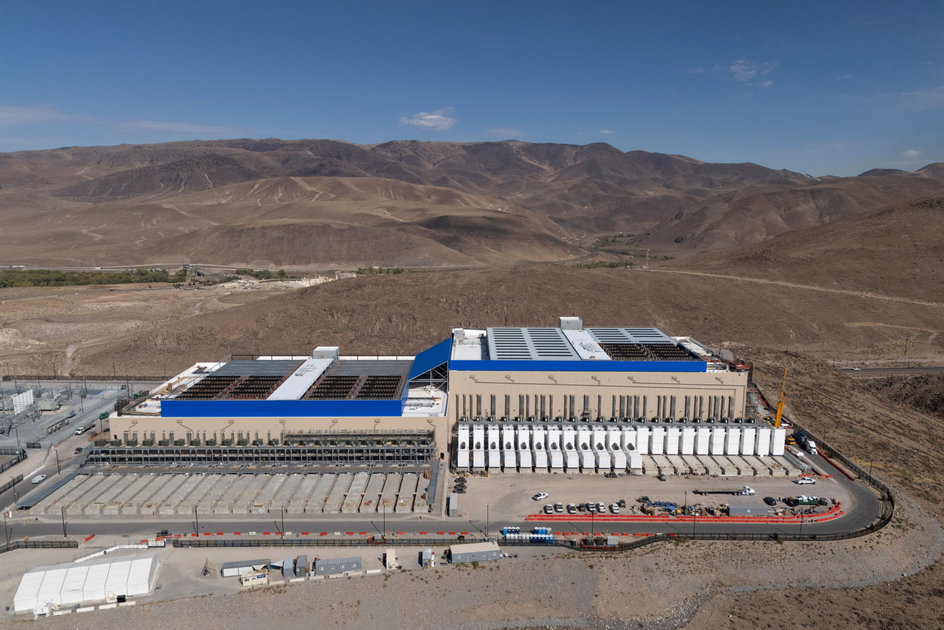
Bitcoin mining companies that pivoted to AI data centers to avoid crashing cryptocurrency prices and declining mining profitability are now facing new hurdles: extreme volatility in the AI market and financial distress. While they once enjoyed a surge in stock prices by leveraging their power access to meet AI infrastructure demand from big tech, those gains are being rapidly corrected amid skepticism over AI investment profitability and debt burdens caused by high interest rates. Consequently, the industry is facing mounting financial pressure, leading some firms to sell off large amounts of their Bitcoin holdings to fund infrastructure development.
Entering the AI Market to Avoid Crypto Risks, Firms Now Face Volatility Greater Than Bitcoin
The Wall Street Journal (WSJ) reported on the 3rd (local time) that Bitcoin miners, having shifted toward AI infrastructure—the biggest topic on Wall Street—to escape the cryptocurrency market slump, are now encountering market shocks as severe as those in the crypto sector.
The CoinShares Bitcoin Mining and Digital Power ETF, a key industry benchmark, surged 72% throughout 2025 on the back of the intense AI boom, but has fallen 23% so far this year. This fund includes emerging cloud (neocloud) companies like CoreWeave and Nebius, as well as Bitcoin miners transitioning into data centers such as Core Scientific and CleanSpark, exposing it to the recent correction in AI-related stocks.
Ben Gagnon, CEO of Keel Infrastructure (formerly Bitfarms), commented on the market situation: "It’s surprising that the market we came to after leaving Bitcoin can have even more volatility than cryptocurrency."
Debt Burdens and Elon Musk’s Warning: Deepening Corrections Amid AI Bubble Concerns
The downward trend in stock prices across the technology sector has dealt a direct blow to emerging cloud infrastructure providers. Excessive debt and rising borrowing costs appear to be the key factors holding these companies back.
Skeptical views from prominent figures in the industry are also dampening investor sentiment. Elon Musk recently pointed out on the social media platform X that companies without actual revenue bases beyond AI data centers are effectively being excluded from the debt market. "This means over 200 emerging cloud companies will experience massive culling and restructuring," Musk warned, adding that "only a small number will survive."
Initially, Bitcoin miners turned to AI data centers to overcome reduced rewards from the quadrennial halving, worsened profitability due to intensifying mining competition, and declining values of their Bitcoin holdings. CoreWeave, which transitioned from Ethereum mining to AI and attracted investment from Nvidia, is considered a representative success model that triggered the shift among followers.
Mining facilities already possessed large-capacity power infrastructure and flexible power supply agreements, giving them an advantageous position over traditional data centers, which struggle to secure new sites. As major hyperscalers like Alphabet, Amazon.com, Meta Platforms, and Microsoft, along with key customers like Anthropic, invested hundreds of billions of dollars in AI facilities, miners holding power rights quickly signed lease agreements, driving up their stock prices.
Stock Price Plunge Amid Profitability Doubts and Power Backlash: Challenges in Financing
However, the market atmosphere shifted abruptly as doubts emerged over whether the massive capital expenditures by big tech would lead to actual profitability. Concerns have been exacerbated by delays in data center construction, intensifying competition, and the burden of debt repayment in a high-interest rate environment. CoreWeave, once considered a leader in the business transition, has seen its stock price fall 25% this year amid sell-offs across its equity and debt.
Furthermore, AI data centers, which consume vast amounts of electricity and water, are facing backlash from local residents and environmental groups, mirroring the situation during the past expansion of cryptocurrency mining sites.
Financial results vary depending on the data center transition model. Companies that have completely exited cryptocurrency mining may have simpler market valuations due to their clearer business structures, but they struggle to secure internal funds for facility construction because the daily cryptocurrency revenue has stopped. Keel Infrastructure, which closed its U.S. mining facilities entirely, expects revenue to begin next year once three new data centers are completed and commercial procedures are finalized; its stock price has fallen 6.8% this year.
As conditions for raising capital for AI infrastructure expansion have worsened, the trend of selling off held cryptocurrencies to cover costs has become clear. According to John Todaro, an analyst at Needham & Co., publicly traded miners sold a record-high 48,900 Bitcoins in the first half of this year alone. Todaro analyzed that as securing funds becomes increasingly difficult, companies will continue to dispose of their Bitcoin holdings to finance the development of unstarted sites and capital expenditures.
On the other hand, some companies, such as CleanSpark, have chosen a compromise of operating existing mining facilities to secure cash until data centers are completed and power is converted. CleanSpark, which holds over $1 billion in Bitcoin, has seen its stock price fall 19% this year, but CEO Matt Schultz stated that they are using Bitcoin mining as a means to secure large-scale power and as a reserve asset.
Copyright © JKN. Unauthorized reproduction or redistribution prohibited.