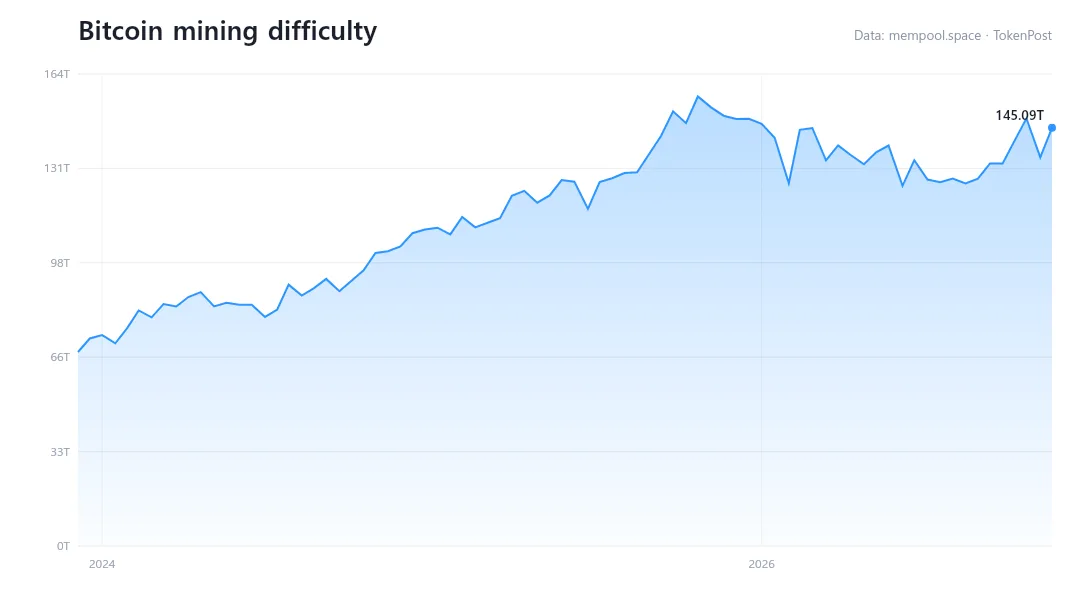
Bitcoin mining difficulty rose 7.61% to 145.09T, its 12th upward adjustment of 2026, as network hash rate increased.
The adjustment took place at block height 977,760, according to Bitcoin network data.
Of the 24 difficulty adjustments this year, 12 have been increases and 12 have been decreases.
Bitcoin automatically adjusts mining difficulty every 2,016 blocks, or about two weeks, in response to changes in computing power to keep average block production near 10 minutes.
A higher difficulty means miners need more computing power to compete for Bitcoin rewards, raising the computational effort required to attack the network.
The network hash rate was 1,036.15 EH/s, up from 1,016.31 EH/s a week earlier. The weekly average was 1,028.44 EH/s.
Hash rate measures the computing power committed to the network and indicates the level of mining activity. It can decline when miners shut down operations because of lower revenue or higher operating costs.
The average block time was 9 minutes and 20 seconds.
The next adjustment, expected in about 14 days and 11 hours at block height 979,776, is projected to lower difficulty by 5.62% to 136.94T.
Enna Lee
Enna Lee reports on investing and digital-asset markets for TokenPost. Send corrections or tips to [email protected].