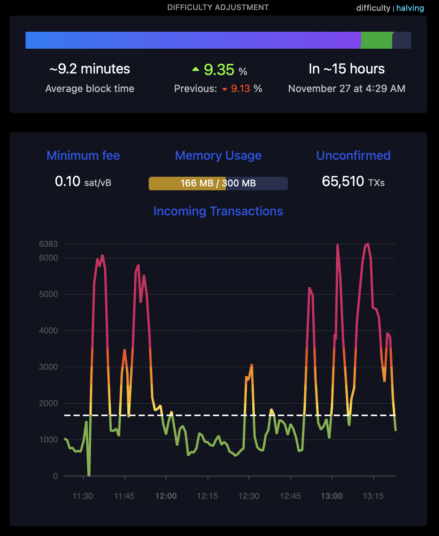
Bitcoin mining difficulty is set to rise about 9% on November 27, from 134.82 trillion toward 147 trillion, reversing much of the 9.13% cut on November 14 and tightening competition for block rewards while BTC trades below previous highs.
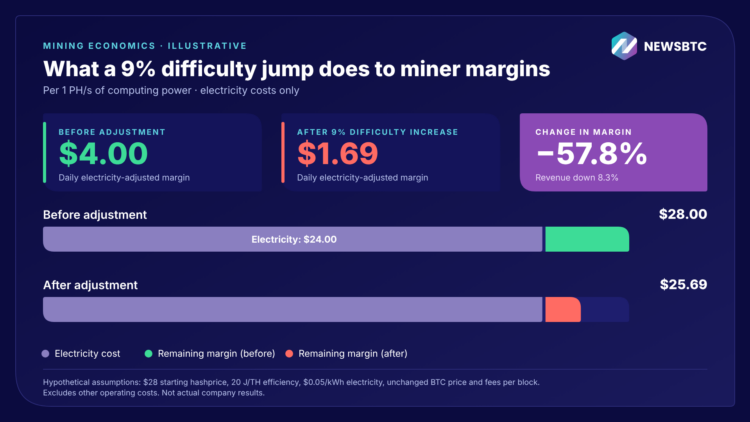
- A 9% difficulty increase reduces expected BTC output per unit of hashrate by roughly 8.3%. Hardware performance stays constant, but the network demands more work per block.
- At about $28 daily revenue per PH, a fleet at 20 J/TH with $0.05/kWh power sees electricity-adjusted margin fall from about $4 to under $2 per PH if BTC price and fees stay flat after the difficulty jump.
- Impact is uneven: efficient operators with cheap energy remain viable, while older, less efficient fleets with higher costs may shut down machines or repurpose infrastructure.
- Difficulty increases alone do not prove higher miner BTC selling: on-chain miner balances, exchange flows and public treasury reports provide clearer evidence.
Bitcoin difficulty adjusts every 2,016 blocks to keep average block time near ten minutes. Faster block production pushes difficulty up, slower production pushes it down. The November 14 adjustment lowered difficulty by 9.13%, temporarily raising BTC output per unit of hashrate. The upcoming adjustment at block 977,760 is projected to reverse much of that change, signaling that blocks have recently been mined faster than the target rate.
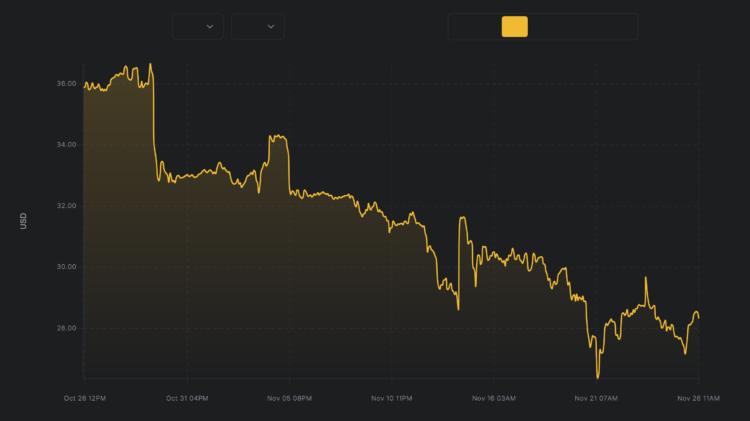
Hashprice And Miner Profitability
Hashprice measures expected daily revenue per unit of hashrate and combines BTC price, network difficulty and fee income. It is a direct profitability indicator for mining hardware. Recent data shows hashprice near $28 per petahash per day.
With 20 J/TH efficiency and $0.05/kWh power, one PH of continuous hashrate consumes roughly $24 of electricity daily. At $28 of gross revenue, the electricity-adjusted margin is about $4 per PH before other costs. If difficulty climbs 9% while BTC price and fees are flat, revenue falls to around $25.69 per PH, compressing that margin to under $2.
Because difficulty changes apply uniformly, operators with low-cost power and efficient hardware can stay profitable, while those with high-cost electricity, older machines or expensive financing may choose to shut down part of their fleet.
Shifting Business Models And Diverging Economics
Some large Bitcoin mining firms are reallocating data center capacity and power contracts to artificial intelligence or other high-performance computing services. Their access to sizeable energy supplies and infrastructure provides alternatives to pure BTC mining that smaller operators may lack.
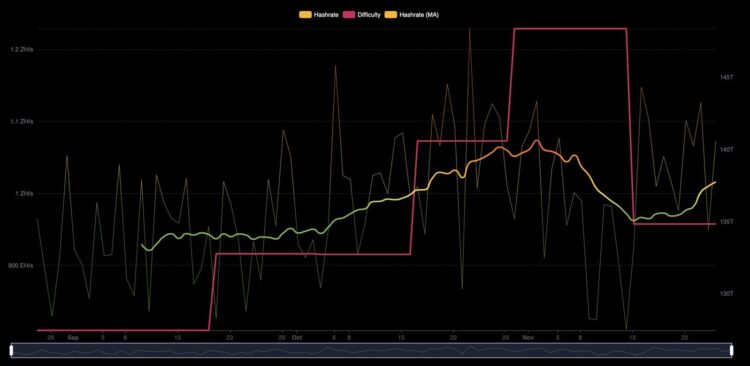
The projected difficulty increase indicates that aggregate hashrate has been strong enough to accelerate block times, so mining activity persists. The main change is widening dispersion in profitability: operators with cheap energy and efficient ASICs face different conditions than those with aging fleets and costly debt. Rising difficulty highlights these differences rather than rendering the entire sector unprofitable.
Miner Selling And Market Impact
Tighter margins raise the possibility that some miners will sell more BTC to cover operating costs or debt, since expenses such as electricity cannot be paid with uncertain future rewards. At the same time, some firms hold significant BTC treasuries, others sell production systematically, and many can cut costs, power down unprofitable rigs or seek external financing instead of increasing BTC sales.
Difficulty changes do not reveal miner selling behavior directly. More reliable indicators: on-chain miner balance trends, miner-to-exchange transfer volumes and public treasury disclosures. After the next adjustment, hashprice and total network hashrate will show how miners are reacting.
Bitcoin’s protocol continues to adjust difficulty to stabilize block times without reference to individual miner profitability. Hardware that becomes uneconomic is removed by operators, while the network maintains its target issuance and security parameters.
Authors credited by the source: Tomás Rivas
Published by Holder based on an external source.