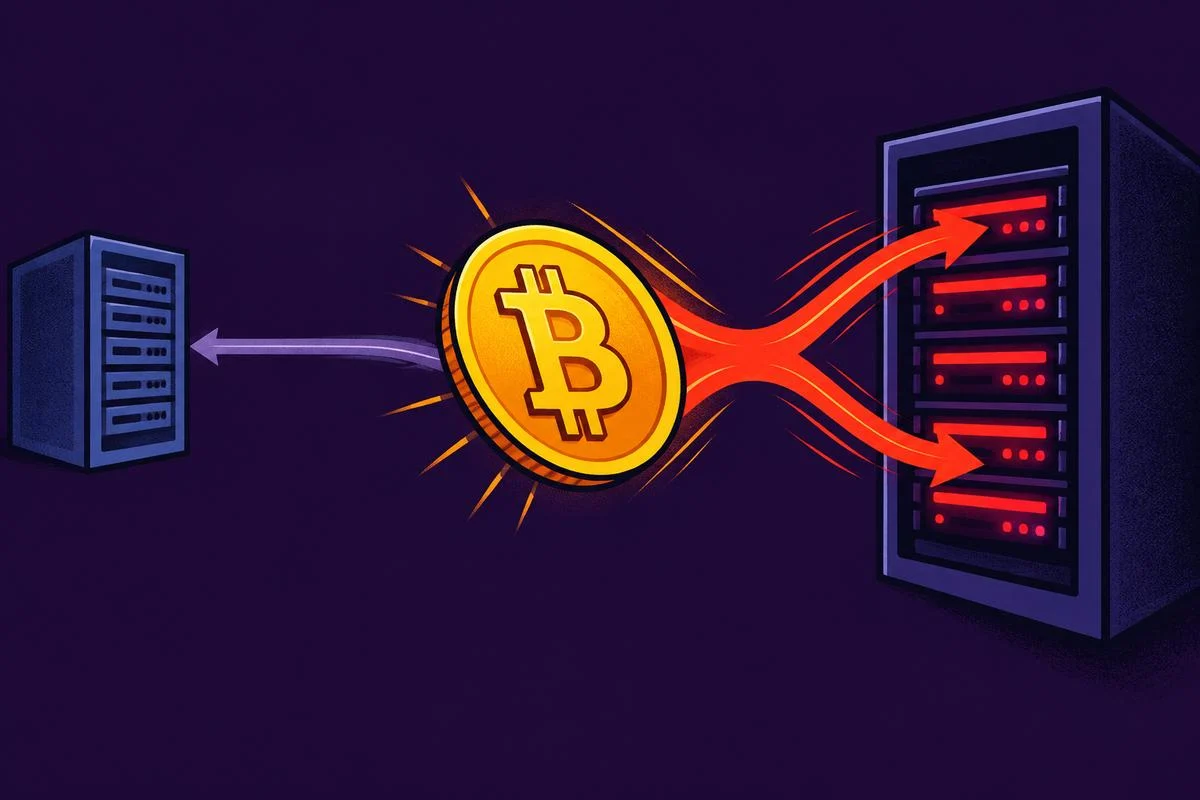
The Bitcoin mining hijacking attack used forged BGP routes to divert hashing power without breaching miners or pools, highlighting security gaps.
Article produced with artificial intelligence systems and published under the editorial responsibility of Amelia Tomasicchio. How we work
A Bitcoin mining hijacking attack redirected more than 1,000 mining sites to an impostor server at once on November 20, 2026—without breaching the miners or their pools, Braiins said on November 25. The attackers used forged internet routes to divert computing power while mining equipment appeared to operate normally.
Summary
Key takeaways
- Braiins recorded November attacks in Latin America and Europe.
- The European episodes diverted as much as 1.9 EH/s each.
- Certificate verification and route validation blocked different parts of the attack.
Braiins, which operates Braiins Pool and develops mining firmware, said the attacks remained active when it published its report. Its own systems were not compromised, and its pool accounts, balances and payouts were unaffected.
Bitcoin mining hijacking attacks spread through forged routes
Braiins counted 19 episodes between November 7 and November 12, concentrated in Latin America, particularly Brazil and Argentina. Each diverted between 36 and 174 petahashes per second, or PH/s.
Four further episodes on November 20, mostly in Europe, diverted between 0.6 and 1.9 exahashes per second, or EH/s, and affected 1,050 to 1,600 sites each. Braiins described the episodes as short and wrote: “We interpret this as testing the waters.”
The November 20 rerouting exploited Border Gateway Protocol, or BGP, through which networks exchange traffic-routing information. An attacker advertised a 256-address portion of a pool provider’s 4,096-address block. Networks preferred that narrower route, so miners reconnecting to the same IP address reached an attacker-controlled server instead.
Plain-text Stratum V1 left miners unable to verify servers
Stratum V1, the protocol many miners use to communicate with pools, sends information without encryption or server authentication. That allowed miners to connect to impostor servers without detecting the substitution, Braiins said.
A recording made by a miner in Brazil on November 16 showed a server accepting any login and passing along genuine jobs from another large public pool. The resulting work went to the attacker’s account at that pool. The machines appeared healthy, but the pool dashboard registered zero.
Braiins had warned about this exposure in 2020. When it checked on November 23, most large mining pools still offered only unencrypted Stratum V1 connections.
Firmware tests exposed a gap between encryption and verification
Braiins tested seven firmware implementations on November 20 and November 23. Braiins OS 26.11 rejected every invalid certificate, while two other widely used implementations supported TLS encryption but accepted invalid certificates.
“TLS without verification gives the miner an encrypted connection to the thief,” Braiins wrote. The distinction matters in the reported Bitcoin mining hijacking attack: encryption alone did not establish that the server was genuine.
Alongside its November 25 alert, Braiins released the tested firmware version and a free proxy for older machines. The proxy enables connections over Stratum V2, which encrypts traffic and allows miners to verify the pool. Braiins urged miners to move to encrypted connections and the newer protocol.
Route validation blocked the forgery; the technique dates to 2014
Networks enforcing RPKI validation rejected the forged route, Braiins said. Resource Public Key Infrastructure provides a registry against which networks can check who holds particular internet address blocks.
The routing technique also has a documented precedent. According to Braiins, a comparable scheme was documented in a 2014 Dell SecureWorks probe, which found that its operator had amassed roughly $83,000 in Bitcoin and other proof-of-work mining payouts across a four-month span.
Read also: Braiins revolutionizes Bitcoin mining with 1,000 daily payments via Lightning Network
Article produced with the assistance of artificial intelligence and reviewed by the editorial team.