Bitcoin options volatility expectations fell through the US midterm elections, while protection against a price decline remained more expensive than protection against a rise. Positions across expiries pointed to hedging around the upcoming inflation release.
In its “ETF Outflows And Spot Selling Test Bitcoin’s Recovery” report published on November 4, 2026, Bitfinex said DVOL, which measures 30-day volatility implied by bitcoin options prices, stood at 39 at 06:00 UTC that day, down from its October 31 close of 40. Implied volatility declined through the elections as the premium paid for protection against the result unwound without the anticipated market move.
Downside protection remained more expensive. Bitfinex put implied volatility for the $72,000 put expiring on November 6 at 60%, compared with 48% for the $85,000 call with the same expiry. The gap had widened from 7.6 percentage points on November 1.
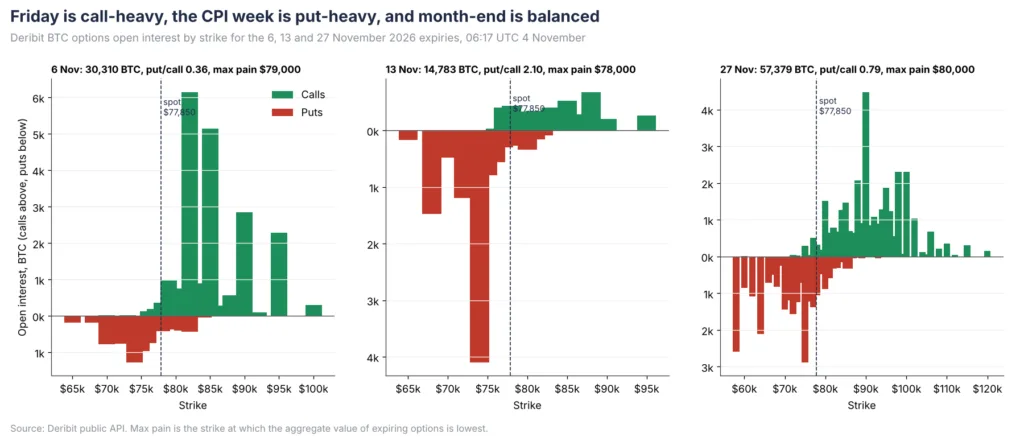
The November 6 expiry held 30,310 BTC in open interest, with a put/call ratio of 0.36, or nearly three calls for every put. Calls were concentrated at $82,000, with 6,146 BTC, and $85,000, with 5,152 BTC. Puts were concentrated at $74,000 and $75,000, according to Bitfinex.
Max pain, the strike at which expiring options have the lowest value, stood at $79,000. With at-the-money implied volatility at 41%, the report estimated a one-standard-deviation price range of about $75,500 to $80,200 through Friday’s expiry. Both the short-term holder cost basis, or STH-CB, and the upper price band fell within that expected range.
The November 13 expiry showed the opposite positioning, Bitfinex said. Open interest totaled 14,783 BTC, with a put/call ratio of 2.1 and 4,098 BTC concentrated in $74,000 puts. That expiry covers the November 10 Consumer Price Index (CPI) release, suggesting traders were hedging the inflation reading rather than the election.
John Kim
John Kim reports on the digital-asset business for TokenPost. Send corrections or tips to [email protected].