Share
Bitcoin options traders have found their favorite floor. The $60,000 put on Deribit now carries open interest of nearly $900 million, making it one of the most prominent contracts on the exchange by notional value.
That strike sits roughly 7 to 8% below where Bitcoin has been trading. When that much money gathers just under the market, it tells you where people expect trouble, or at least where they want to be covered if it shows up.
What the options board is saying
A put option is a bet that an asset’s price will fall, and traders often buy one the way homeowners buy fire insurance.
The strike is the line in the sand. This particular contract pays off if Bitcoin slides below $60,000.
Open interest measures the total value of contracts that are still open and haven’t been closed or settled. So nearly $900 million sitting at one strike means a large crowd is holding the same insurance policy at the same address.
On Deribit, the $60,000 put ranks third in popularity. Across all major trading venues, total Bitcoin options open interest came to approximately $32 billion as of November 16, 2026.
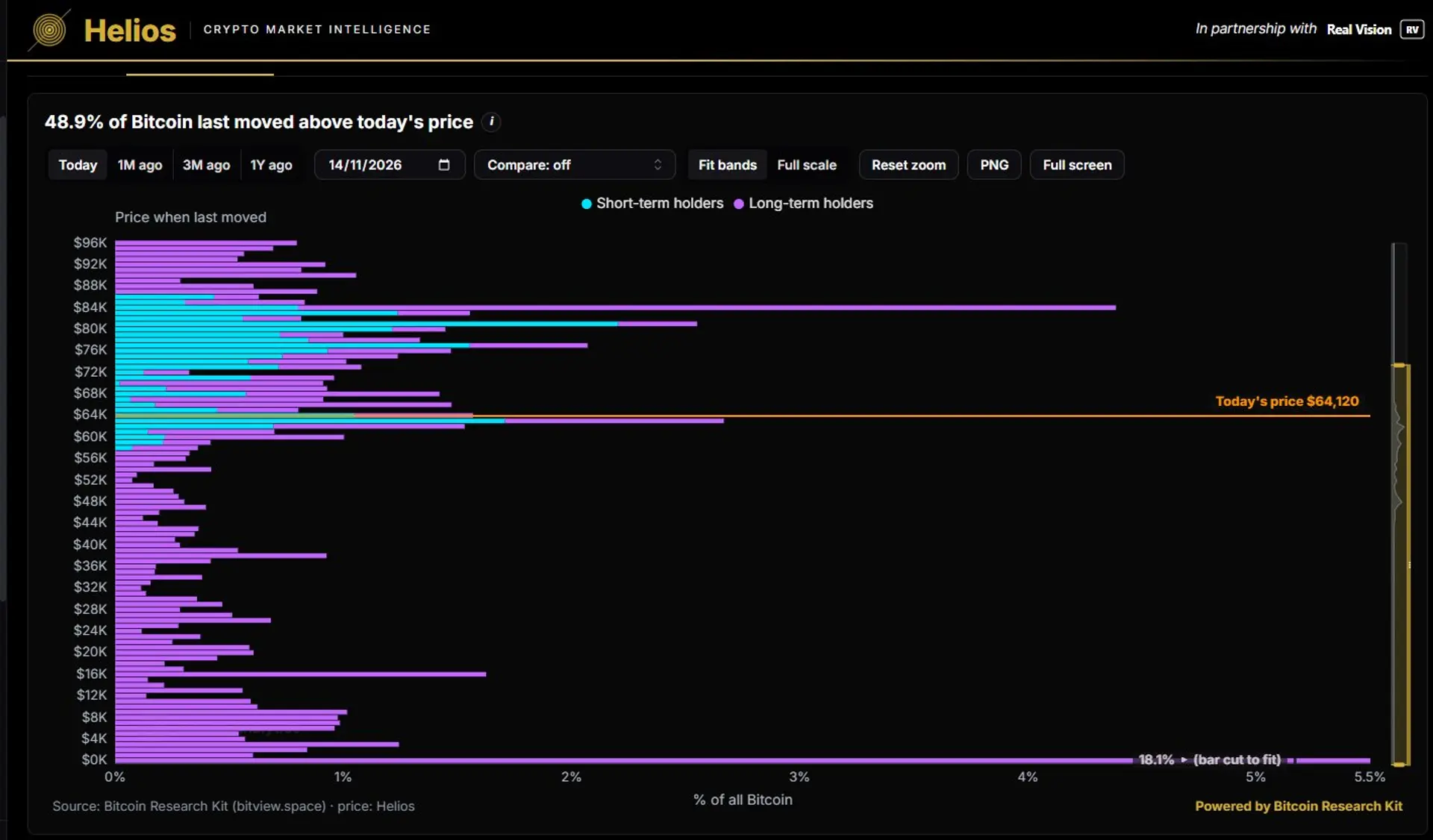
Meanwhile, Bitcoin itself has been hovering around $64,500 to $65,000. Earlier in the month it touched $71,000, so the mood has cooled a bit since then.
Market watchers call a concentration like this a “put wall.” Picture a big cushion of protective contracts parked below the current price, waiting to see whether the market comes knocking.
Complex trades and a nervous volatility gauge
The positioning isn’t limited to simple, single-contract bets. Options analytics platform SignalPlus noted interest in multi-legged put strategies over the weekend.
The crypto and markets news you actually need—every morning.
Daily. Free. Join 34,000+ readers across crypto, finance, and policy.
We respect your privacy. Unsubscribe anytime.
SignalPlus has also flagged block trades involving put strategies targeting strikes between $63,000 and $68,000. Block trades are large, privately negotiated deals, typically the domain of bigger players rather than retail accounts clicking buttons on a phone.
Those strikes cluster tightly around and just above the current price. That suggests some traders want protection that kicks in sooner than the $60,000 level, not just a deep safety net.
Volmex, which publishes a Bitcoin volatility benchmark, noted a surge in its implied volatility index. Implied volatility reflects how much price movement options traders are baking into what they pay for contracts.
The Volmex Bitcoin 30-day implied volatility index, known as BVIV, traded in a range of 44 to 46 during mid-November 2026.
Bears and bulls sharing the same table
Bullish demand persists at higher strikes, specifically calls at $80,000 and $90,000. A call is the mirror image of a put: it pays off if the price climbs above the strike.
Some of that put demand is likely defensive hedging by holders who want to keep their Bitcoin but limit the damage from a drop. Some of it may be outright bearish speculation. The options data alone can’t fully separate the two, and both can coexist at the same strike.
What this means for the market
The most immediate takeaway is that $60,000 has become a reference point traders will watch closely. With nearly $900 million in open interest stacked there, any move toward that level could draw more attention and more trading activity around it.
The elevated BVIV reading reinforces that point. Options traders are not pricing in a quiet month, and the cost of protection reflects that expectation.
There are a few things worth tracking from here. One is whether open interest at the $60,000 strike keeps growing or starts to unwind as positions are closed or rolled.
Another is whether the SignalPlus-flagged block activity in the $63,000 to $68,000 range continues. A steady flow of near-the-money protection would suggest traders see risk as close at hand, not distant.
Finally, watch the BVIV. If it climbs out of the mid-40s range, the market would be signaling even greater expected turbulence. If it eases, some of the urgency behind all this hedging may be fading.