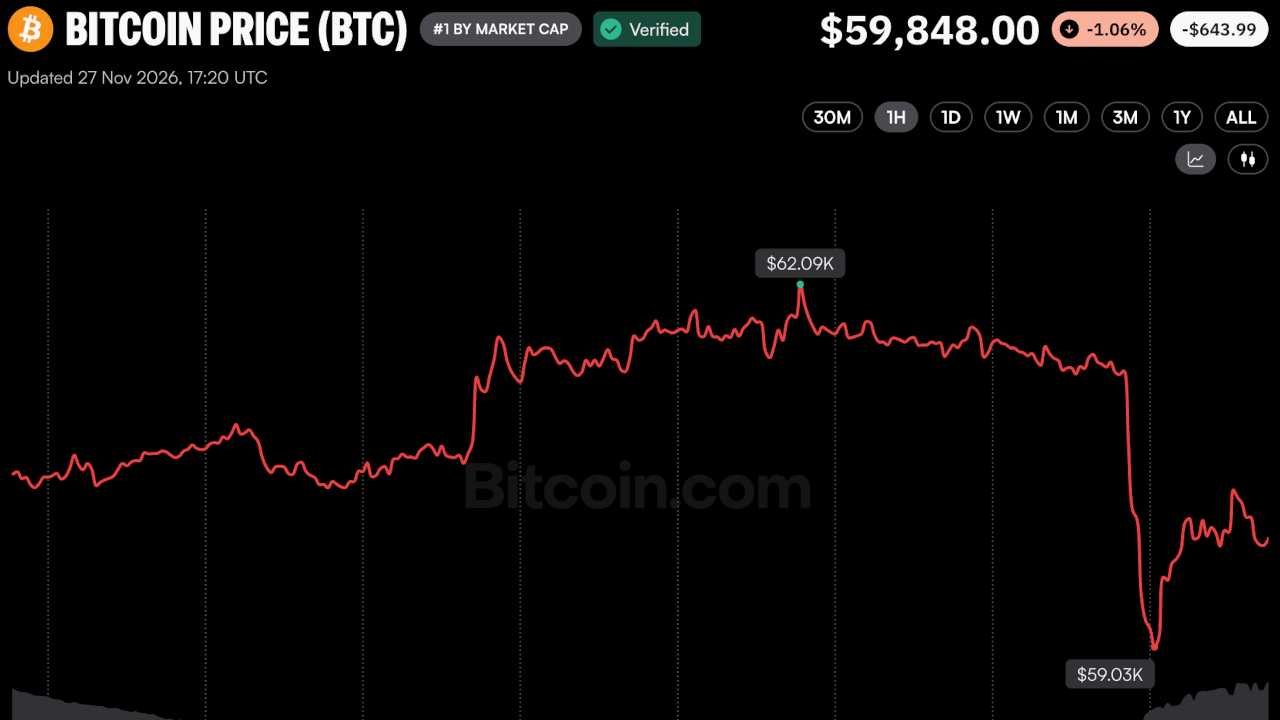
Bitcoin traders looking for a bottom may need to watch the metals market first. Benjamin Cowen, founder of the research platform Into The Cryptoverse, argues that gold and silver have historically turned higher before the largest cryptocurrency finds its footing, making their current slide a warning sign rather than a sideshow.
The thesis rests on a pattern Cowen has flagged in recent commentary: precious metals have bottomed weeks or even months ahead of Bitcoin in past downturns. In 2018, gold found a low around August while Bitcoin and U.S. equities did not trough until December. In 2022, gold stabilized before Bitcoin's November low. Until gold and silver stop falling, the analyst contends, Bitcoin's own decline may not be finished.
"If gold and silver continue to weaken, Bitcoin can keep moving lower," Cowen said in an interview published Nov. 23, adding that a durable turn in metals would be the first place to look for a recovery signal. He cautioned that the gap between the two markets means any Bitcoin rebound would likely arrive with a lag.
The call comes at a moment when all three assets are under pressure. Bitcoin was trading near $61,500, more than 50% below its record high set in October 2025 and down roughly 30% for the year. Gold was hovering around $3,650 an ounce, off about 18% year to date, while silver at $44.20 had lost about 40% over the same stretch.
Note: Price levels and year-to-date moves as cited in Cowen's late-November commentary.
Broader market commentary has pointed to the same synchronized weakness. One market observer noted that nearly every major asset class sold off in the fourth quarter of 2026, reinforcing the view that the crypto drawdown is part of a wider risk-off move rather than an isolated crypto event.
Why metals matter for a digital asset
Cowen's framework treats gold and silver as leading indicators partly because of how each asset responds to interest rates. Gold pays no yield, so a decline in bond yields lowers the opportunity cost of holding it. Tech stocks must also absorb shifts in earnings expectations, while Bitcoin is more sensitive to liquidity and risk appetite. When long-dated Treasury yields fall, the reason matters: if the move reflects easing inflation pressure, gold tends to benefit first; if it reflects growth fears, money may flow into bonds while both Bitcoin and tech stocks are sold.
Others see a structural shift behind the correlation. Bloomberg Intelligence analyst Mike McGlone has pointed to a broader deflation of bubbles spanning commodities and crypto, while Jared Tate has argued that the spread of futures markets and exchange-traded products has made Bitcoin's price behavior resemble that of gold and silver more closely. The upshot, in this view, is that the digital asset no longer trades on crypto-specific news alone, and institutional flows have tightened its link to traditional markets.
Two paths from here
Cowen sketches two scenarios. In the bearish case, continued weakness in metals drags Bitcoin toward its realized price near $53,000-$54,000. A harsher selloff could take it toward the on-chain "balanced price" in the high $30,000s, a level he pegs at roughly $38,600. That metric estimates the aggregate cost basis of coins based on the market price when they last moved on-chain, adjusted for how long they were held and how they changed hands. Bitcoin has approached that level in prior bear markets, though it has also bottomed before reaching it.
Note: Levels cited by Cowen; the balanced price is an on-chain estimate, not a forecast.
In the bullish case, gold and silver steady first and then turn higher, a sequence that in past cycles preceded stronger Bitcoin recoveries. If a durable low forms in the coming weeks, the 2027 outlook could improve and the four-year cycle could support a fresh advance.
Timing remains the weak link in the argument. Cowen initially expected the bottoming sequence to play out between late 2026 and early 2027, but he trimmed his confidence as the interview concluded, noting that gold was still falling. Should metals fail to stabilize, the adjustment in Bitcoin and equities could run past that window. He gives Bitcoin roughly four to seven weeks from late November to avoid a new low; if it holds, some bears could capitulate in early 2027 and set up a rally between March and June.
The cycle itself may be shifting. Cowen notes that the 2025 peak landed in the fourth quarter of the year after the halving, in line with past cycles, but speculative money did not rotate into altcoins the way it once did, and Bitcoin topped out against gold about a year earlier than it did against the dollar. Even if the four-year rhythm still helps frame the timing of lows, the length of the next upswing may be shorter than history suggests.
What investors are watching
For equities, Cowen frames the selloff as a repricing of rate expectations, drawing a parallel to the 1997 pullback during the internet buildout. The question is whether tech shares can reclaim prior highs on a rebound; repeated failures near those levels, combined with downgrades to expected returns on AI spending, would undercut the buy-the-dip playbook that worked in earlier corrections.
On monetary policy, the key variable is whether markets stop marking up rate-hike expectations. If the tightening path already priced in proves more aggressive than what policymakers deliver, Bitcoin could rally before an actual policy pivot.
The practical takeaway from Cowen's framework is a sequence of checkpoints rather than a single trigger: gold stabilizing first, Bitcoin holding its prior low within the four-to-seven-week window, and tech stocks clearing their highs on any rebound. Metals can offer an early signal, but the two risk assets will still have to prove the turn in their own price action.
Once added, BigGo Finance appears first in Google Search Top Stories, so you get the broadest, most up-to-the-minute, and most comprehensive global financial news first.