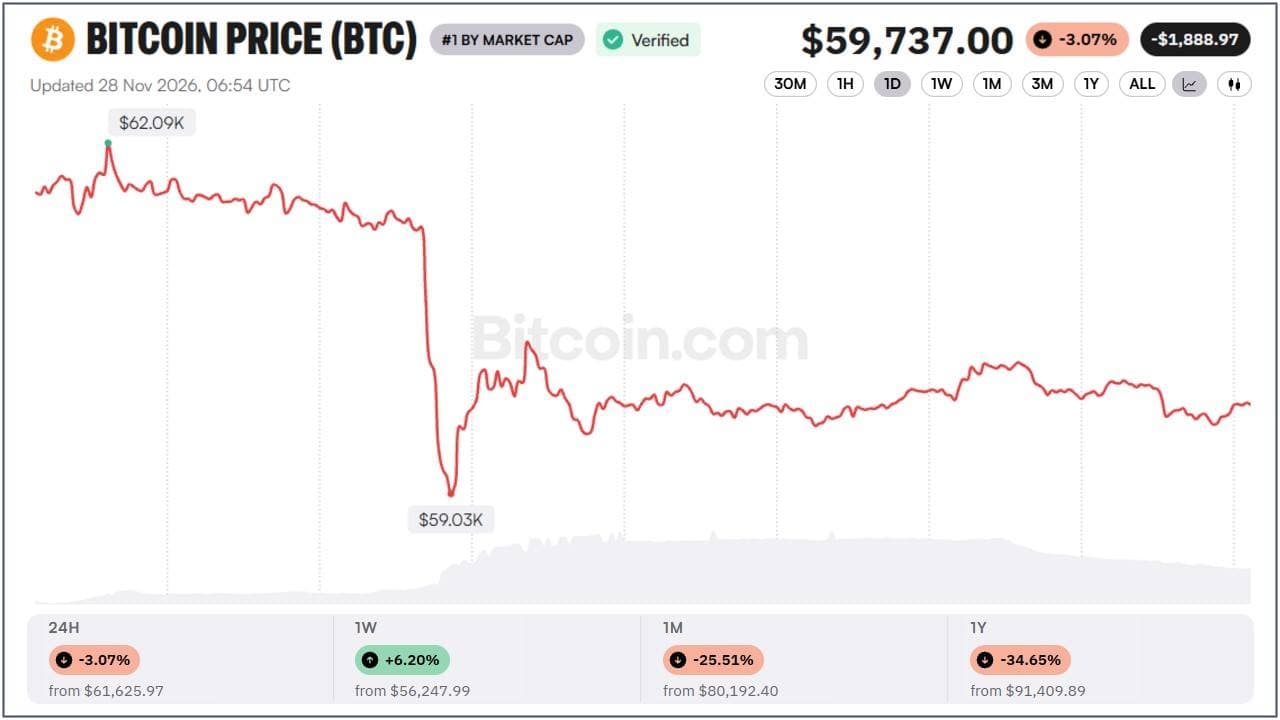
Bitcoin's retreat toward a two-year low reflects a selloff in equities rather than any breakdown specific to crypto, and the token could climb back to $100,000 by the first quarter of 2027, according to Michaël van de Poppe, founder of MN Capital.
Speaking Thursday on Bitcoin Magazine's BMTV, the analyst described the recent decline as an "extreme outlier" and argued that institutional investors are dumping the asset to hedge risk elsewhere. Gold, silver, artificial intelligence stocks and Bitcoin all fell together in the latest rout, he noted, adding that "it still trades like a risk-on asset."
The distinction matters for anyone waiting on a rebound. Van de Poppe expects the recovery to unfold in two stages: a fast relief rally first, followed by a steeper climb once the Nasdaq finds a bottom. He said Bitcoin typically lags equities on the way back up because portfolio managers want more evidence before rebuilding positions, and he expects several sessions of gains on the tech-heavy index before money returns to Bitcoin exchange-traded funds.
He put the recent drawdown in statistical terms, calling it the kind of move that occurs roughly once a year and tends to be followed by a short-term bounce of 15% to 40%. Applied to current prices, that would lift Bitcoin into the $68,000 to $72,000 range.
A longer-lasting turnaround will take time. Bitcoin is trading below its 200-day moving average, and the analyst said it needs to reclaim both that line and its 21-week average, a process that has historically taken four to eight weeks. He compared the setup to late 2015, when a similar shakeout preceded a sharp advance.
The fund flows that powered the prior two years have reversed. Spot Bitcoin ETFs shed about $5.7 billion in November through Friday, according to SoSoValue data, exceeding the previous record outflow of $4.51 billion set in June.
Note: Outflow figures reflect the period through Friday in November.
Van de Poppe tied the 2024 and 2025 bull markets directly to ETF inflows, saying that without them "Bitcoin would probably stay in a bear market for four to five years, trading around $20,000 to $30,000."
In a separate monthly roadmap posted on X, he laid out a path in which Bitcoin pushes higher into the end of November and settles between $64,000 and $65,000, then tests the $70,000 to $72,000 zone in December. He expects a final correction back to $60,000 to $62,000 that month, followed by a period of low volatility and a decisive breakout in January tied to cooling inflation data. Altcoins, in his view, should outperform in the first quarter of 2027.
Bitcoin briefly reclaimed $62,000 on Friday before slipping back, meaning his November target would require a gain of roughly 5% in the final days of the month.
The analyst also made a case that crypto now has uses beyond its own borders, pointing to stablecoins, tokenization and AI agents and likening the moment to the early days of Apple's (AAPL) iPhone. He brushed aside fears that artificial intelligence or quantum computing could compromise the network, which he said has already survived far worse. "If the agentic era or quantum can break Bitcoin, I think we have way bigger problems to deal with," he said.
He expects the next bull market to resemble 2017 in scale rather than deliver more modest gains.
For investors, the forecast cuts both ways. The near-term case rests on equities stabilizing and ETF flows turning positive, while the path to six figures depends on a multiweek technical repair and a friendlier inflation backdrop. Bitcoin was down more than 3% over the prior 24 hours, and retail sentiment on Stocktwits shifted to bullish from neutral even as discussion volume cooled to normal from high.
Once added, BigGo Finance appears first in Google Search Top Stories, so you get the broadest, most up-to-the-minute, and most comprehensive global financial news first.