TLDR
Table of Contents
- October CPI rose 0.4% and core CPI rose 0.3%, both above forecasts.
- Core inflation matched the 0.3% level Fed Governor Christopher Waller flagged for a possible larger rate hike.
- Bitcoin fell to an intraday low of about $72,836 before recovering near $73,300.
- About $178 million in long crypto positions were liquidated within an hour of the report.
- Analysts say a sustained break below $73,000 could open a path toward $69,000 or $70,000.
Bitcoin dropped below $73,000 on November 10 after US inflation data came in hotter than expected. The report hit a level that one Federal Reserve official had named as a possible trigger for a larger rate hike in December.
The October Consumer Price Index rose 0.4% from the previous month, above the 0.3% forecast. Core CPI, which leaves out food and energy, rose 0.3% against expectations of 0.2%.
Inflation Meets the Fed’s Warning Line
Before the report, Fed Governor Christopher Waller said he would back a 25-basis-point rate increase in December even if inflation cooled. He also said a stronger move may be needed if core prices rose 0.3% or more from September.
Waller added that a 50-basis-point increase should be considered in that case. October’s core reading landed right on that 0.3% line.
Reuters reported that market odds for a 50-basis-point hike climbed to nearly 15% by midmorning. A quarter-point increase at the December 8 to 9 meeting was already seen as almost certain.
🚨 FED RATE HIKE IS ALMOST CONFIRMED NOW
US inflation data was released, and it again came in higher than expectations.
US CPI rose 0.4% MoM, while the Core CPI rose 0.3% MoM.
Last week, the job data already came better than expected, which means the Fed's biggest concern is… pic.twitter.com/vgTAVctnAR
— Crypto Rover (@cryptorover) November 10, 2026
Core CPI has now risen 0.3% for three months in a row, following similar gains in August and September. Shelter costs rose 0.3% in October and made up more than 30% of the monthly increase.
Food prices rose 0.5%, while energy costs climbed 0.7% after a 5.2% jump in September. Headline CPI had risen 0.6% in September.
The Bureau of Labor Statistics did not publish a yearly inflation figure. The 2025 government shutdown stopped the collection of October 2025 price data, leaving no base for an annual comparison.
Bitcoin’s Price Floor Under Pressure
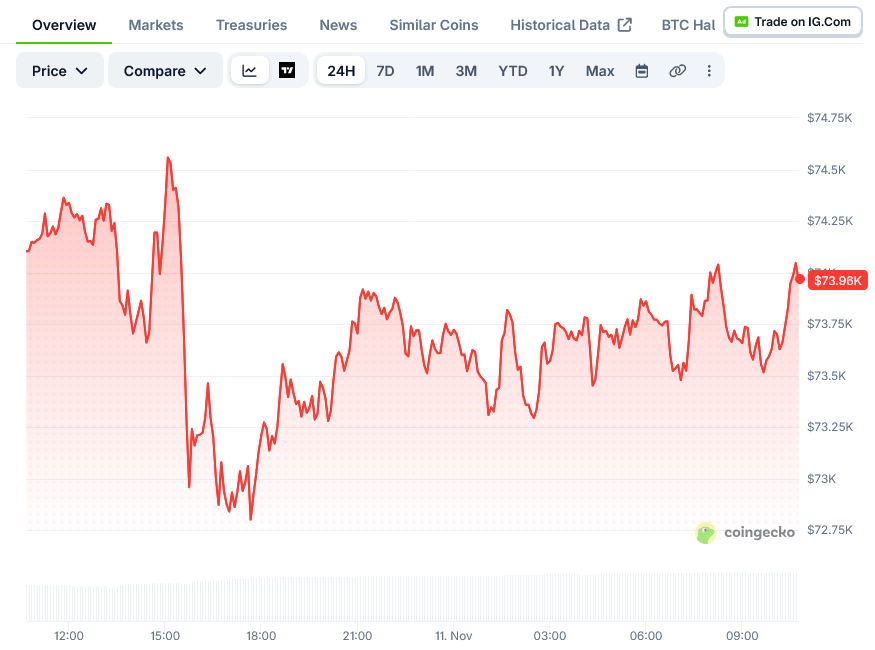
Bitcoin traded near $74,264 before the release and fell to about $73,494 within five minutes. It later reached an intraday low of about $72,836 before recovering to around $73,294 by 11:01 a.m. ET.
The $73,000 level has history behind it. Matt Mena, senior crypto research strategist at 21Shares, said it sits near Bitcoin’s pre-election 2024 all-time high and its April 2025 lows.
Mena said a sustained break below that level could send Bitcoin toward $69,000, near its 2021 cycle high. Bitget analyst Lewis Huang pointed to the 200-day moving average near $73,200 as a key support to watch.
About $178 million in long crypto positions were liquidated within an hour of the CPI release, according to TokenPost. CoinDesk reported about $1.1 billion in futures liquidations in the 24 hours to November 9, before the data came out.
US spot Bitcoin ETFs saw about $201 million in net outflows on November 9, their third straight day of withdrawals. BlackRock’s iShares Bitcoin Trust recorded $213.2 million in redemptions, partly offset by inflows into other funds.
Other tokens also fell. Ethereum touched about $2,006 and traded near $2,027, while XRP fell to about $1.0336 before trading near $1.05.
Solana traded around $82.49 after touching an intraday low near $81.59. It was down about 5.2% over 24 hours.
Mena said a break of Bitcoin’s 50-week moving average could pressure Ethereum’s $2,000 support, with $1,800 the next level. If Bitcoin holds $73,000 and stocks keep rebounding, 21Shares sees a possible retest of $78,000 and a path to $85,000 by year-end.
November has been Bitcoin’s strongest month historically, with an average return of 34.4% since 2010. Paul Howard, senior director at Wincent, said that without a shift in policy, regulation or institutional flows, a gradual downward drift is more likely than a rally toward $100,000.