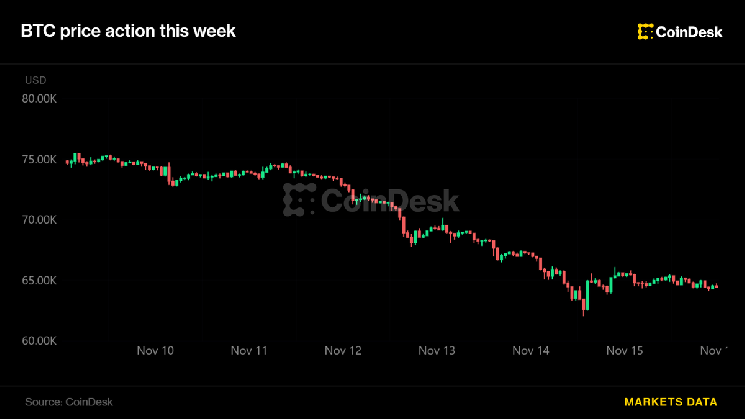
Bitcoin BTC$63,986.11 has crashed 16% this month, briefly dropping to nearly $62,000, the lowest in four months, over the weekend.
The more worrying news is that the slide occurred alongside a selloff in AI-linked stocks such as Nvidia NVDA and in exchange-traded funds like the iShares AI Innovation and Tech Active ETF (BAI) and the VanEck Semiconductor ETF (SMH). All have dropped around 30% from recent highs.
The price action runs counter to a crypto-market view that a cooling AI trade would trigger a rotation into digital assets and spark a sharp rally.
"The idea that an AI unwind would automatically send capital into crypto was always too simplistic,” Lacie Zhang, the research lead at Bitget Wallet, told CoinDesk. “AI equities and Bitcoin are both long-duration, liquidity-sensitive risk assets, often held in the same leveraged or momentum-driven portfolios. When volatility rises, institutions tend to reduce gross exposure and raise cash rather than rotate immediately from one high-beta trade into another.”
In other words, funds that hold both tend to sell both when markets get shaky, preferring to hold cash. Bitcoin ETFs have seen $2.35 billion in net outflows over two weeks, according to data source SoSoValue.
"Crypto also faces its own headwinds, including forced liquidations, weak US spot demand and security concerns," Zhang said.
Martin Lee, the insights lead at market maker DWF Labs, said the AI trade has been unwinding since July.
"Whether the capital flows into crypto will depend on whether investors are shifting their attention into alternative risk-on assets (after unwinding from AI) or are they shifting completely to completely different types of assets," he said.
Right now, the appetite for risk is clearly not there, though that might change after the impending Anthropic IPO.
"How the markets shift when Anthropic IPOs will be a good indicator of that," he said.
Marcin Kazmierczak, co-founder and chief operating officer at DeFi-focused blockchain RedStone, indirectly pointed to yield as the dividing line.
Tokenized real-world assets (RWAs), which include Treasury funds and credit funds recorded on a blockchain, barely saw capital leave even as bitcoin slumped.
"The weekend split the onchain market in two,” he told CoinDesk. Even as bitcoin fell, “tokenized real-world assets barely moved. Distributed RWA value sits at $39.5 billion, down 1.7% over 30 days, and the number of holders grew 6% to 5.75 million in the same period,” he said.
“Tokenized assets are bought for yield and held, so hardly anybody sells a tokenized credit fund to cover a bad week in tech," he added, stressing that expectations for another U.S. interest-rate increase in December could bode well for RWAs.