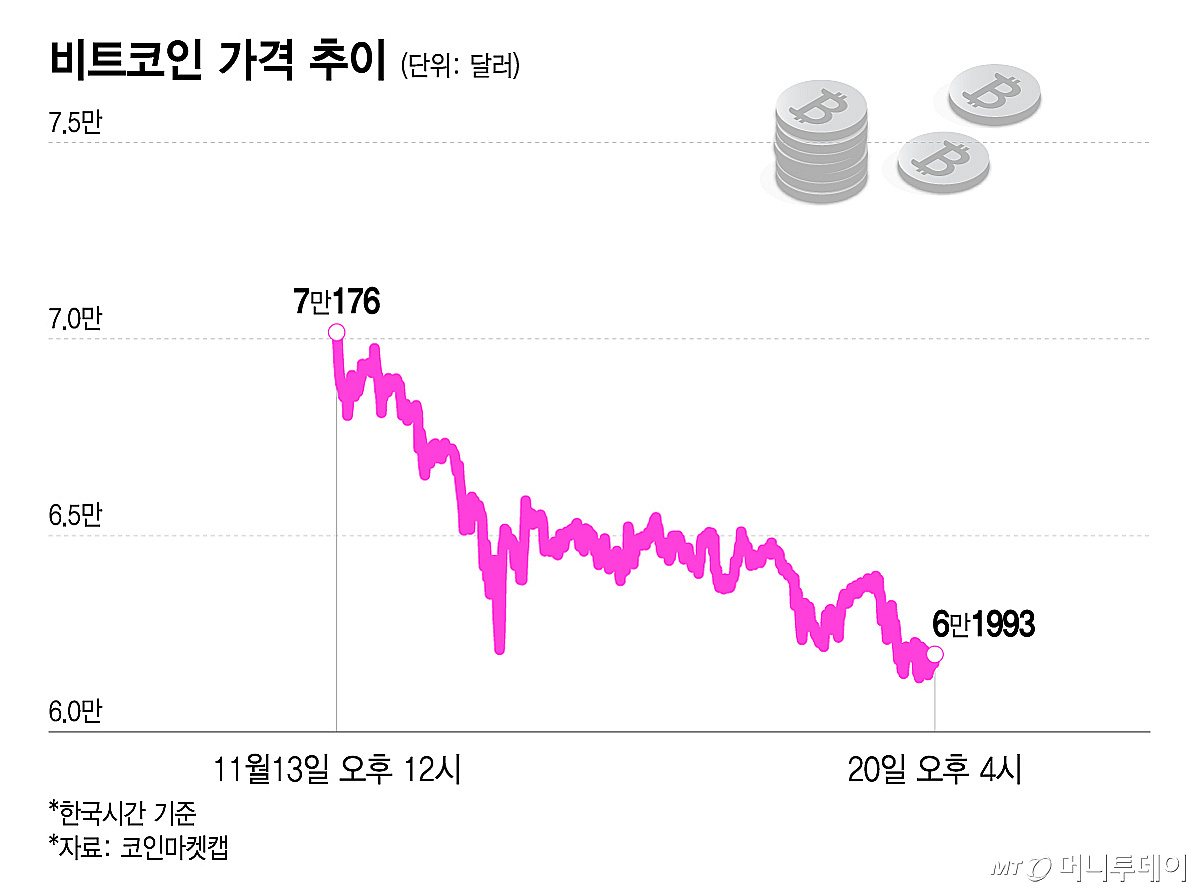
Bitcoin has plunged to stand at the threshold of $60,000. The virtual asset market is cooling sharply as risk-averse movements expand, stemming from the possibility of monetary tightening and a contraction in artificial intelligence (AI) investment. Amid continuing bad news, experts forecast that the correction phase will continue.
As of 4 p.m. on Friday, Bitcoin was recorded at $61,993 on the virtual asset market platform CoinMarketCap, down 10.18% from a week earlier. The domestic trading price stood at 84.16 million won based on Upbit, forming 1.58% higher than Binance.
Ethereum fell 9.80% over the same period and was traded at $1,748 at this time. CoinMarketCap's "Fear and Greed Index," which approaches zero as investor sentiment weakens, stood at 10 out of 100 points, indicating a stage of "extreme fear."
Kim Ji-won, a researcher at KB Securities, stated, "The simultaneous effects of the listing of Anthropic, the hawkish stance of the Federal Reserve System (Fed), and the sluggishness of AI stocks have caused the sharp decline that began on the 13th to continue for a week." He added, "Deleveraging across AI stocks in general and concerns over interest rate hikes are acting together, so it is necessary to consider further price and duration adjustments."
Park Seong-je, a researcher at Shinhan Investment Corp, said, "Outflows from Bitcoin spot exchange-traded funds (ETFs) and concerns over the exclusion of Strategy from the Morgan Stanley Capital International (MSCI) index may have expanded Bitcoin's decline." He added, "In the short term, we judge $60,000 to $62,000 as the support zone and $65,000 to $68,000 as the resistance zone."
The altcoin market showed a cooling phase where it was virtually impossible to avoid losses. Among the top 100 stocks by market capitalization aggregated by Zangle at 9 a.m. that day, only three stocks (Fibers, Falcon Finance, and Venice Token) exceeded a weekly return of 10%. Stocks with losses also appeared in the top 10 returns.
Kim Jun-seong, a researcher at Zangle, stated, "While Bitcoin fell more than 10% in two days, spot selling increased and futures open interest decreased." He added, "After futures positions are unwound, how much spot buying absorbs the selling volume will determine the sustainability of any rebound."
Researcher Kim said, "Funds flowed out of all U.S. Bitcoin and Ethereum spot ETFs from the 13th to the 18th, and only six stocks rose among the 86th assets aggregated." He added, "While ETF redemptions continue, it is difficult to judge that overall market buying has recovered based solely on the performance of top-gaining stocks."