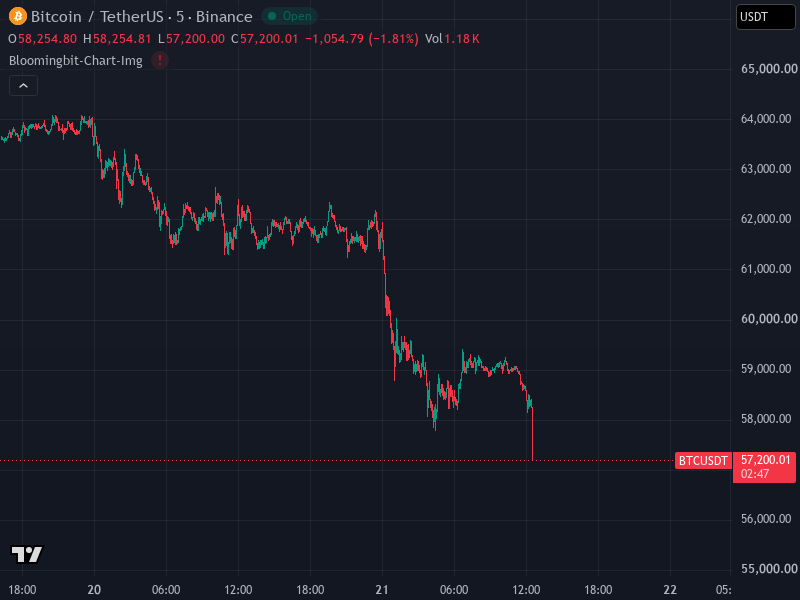
Bitcoin slid to its weakest level in more than two years on Friday, surrendering every gain booked since Donald Trump returned to the White House and dragging the wider digital-asset market into a broad flight from risk.
The largest cryptocurrency dropped as much as 6.1% to $57,716, its lowest since September 2024, according to Bloomberg. From an all-time peak above $126,000 in October 2025, it has now given up more than half its value. The move lower rippled across the sector: the combined market value of cryptocurrencies fell roughly 5.7% in 24 hours to about $2.03 trillion, and a widely followed sentiment gauge slumped to 8, a reading associated with extreme fear.
"The broader market has shifted into a sharp lack of confidence, and investors are de-risking," said Andy Baehr, managing director of asset management at GSR. "Bitcoin is along for the ride here, typically weak in deleveraging environments."
The selloff forced the closure of roughly $2 billion in leveraged long positions across crypto over the 24-hour window, with Bitcoin accounting for the bulk of that total, according to Coinglass data. A separate tally from the same data provider put derivatives liquidations at about $1.57 billion across 265,465 traders, of which $560.41 million was tied to Bitcoin and $334.22 million to Ether. Longs made up $1.43 billion of the total against $143.70 million in shorts.
The unwinding was heavily concentrated. About $888.87 million of positions were closed in the final four hours of the measured period, including $459.26 million in the last hour alone. Binance, Bybit and OKX together liquidated $94.6 million in Bitcoin positions within a single hour as the coin broke below $60,000, according to Andrew Yang, a research analyst at Kaiko.
"What made the move so fast was leverage," Yang said. "As Nasdaq losses deepened again in late-morning New York trading, Bitcoin broke below $60,000."
Note: Prices in US dollars as of the CoinMarketCap snapshot referenced in the reporting.
The pressure has been building for weeks. A hack at Binance, the world's largest crypto exchange, in late October rattled sentiment, and sweeping Democratic victories in the US midterm elections the following week raised doubts about whether the industry's lobbying push for lighter rules still has momentum. More recently, investors have pulled money from US spot Bitcoin ETFs -- year-to-date outflows have topped $3 billion -- as the artificial-intelligence trade that had lifted risk assets more broadly began to unravel.
The macro backdrop has turned less forgiving as well. A firmer dollar and growing expectations of another Federal Reserve rate increase are weighing on speculative assets generally. Coinbase Institutional's cross-asset comparison for the 30 days through Nov. 18 showed Bitcoin down 24.0% and Ether down 26.5%, against a 10.2% decline in gold, 6.4% in the Nasdaq 100 and 4.3% in the S&P 500. The dollar was the only gainer among the 14 assets and benchmarks tracked.
"The market is pricing a more aggressive Fed rate hike and slowdown in the AI buildout, prompting an excessively negative market interpretation right now," said Fabian Dori, chief investment officer at Sygnum Bank.
What sets this episode apart from earlier crypto crashes is its shape. Past downturns were punctuated by spectacular blowups or waves of forced selling at major platforms. This one has been a steadier erosion of demand. Bitcoin kept falling even as inflation worries mounted, doing little to support its case as a hedge, and when geopolitical turmoil sent investors hunting for safety they went to traditional havens instead.
The timing is awkward for the industry. Under Trump, crypto has secured much of what it spent a decade pursuing: a sympathetic White House, friendlier regulators, institutional acceptance and a legislative framework that treats digital assets as a durable part of the financial system. Those wins have coincided with one of Bitcoin's deepest retreats in years rather than a fresh wave of demand.
Technical signals point to how stretched the decline has become. The daily relative strength index stood at 17.70 against a signal average of 27.74, a reading that flags severe downside momentum but says nothing about when selling will stop. Bitcoin was trading about 2.2% above the 0.886 Fibonacci retracement at $57,822, a level derived from a range between roughly $49,050 and $125,998. A sustained break below it would weaken the longer-term recovery structure and put the bottom of that range in play. A reclaim of the 0.786 retracement near $65,117 would be needed to signal repair.
Liquidity had already been thinning before the latest leg down. Stablecoin supply contracted by about $11.5 billion over the month through mid-November, while US spot Bitcoin ETFs recorded $1.44 billion in net outflows in the five sessions to Nov. 11, according to Coinbase's weekly commentary. The two measures capture different things -- redemptions of digital-dollar balances on one side, regulated fund withdrawals on the other -- but both point to reduced support as the market entered the slump.
For investors, the immediate question is whether forced derivatives selling is exhausting itself or whether spot demand can absorb the supply. A slower pace of liquidations would curb short-term volatility without reversing the deterioration in liquidity. Institutional participation has not disappeared, but the early enthusiasm has cooled, and the market's next move will hinge on whether the biggest buyers keep adding at the pace the industry once assumed.
Once added, BigGo Finance appears first in Google Search Top Stories, so you get the broadest, most up-to-the-minute, and most comprehensive global financial news first.