Having weathered the U.S. midterm elections, Bitcoin reclaimed the $80,000 mark. Leveraging the resolution of short-term uncertainty, it recovered from the decline triggered by hacking shocks within six days. Market focus on the medium to long term is now centered on whether the pro-crypto drive of the second Trump administration can maintain its momentum after losing control of both chambers of Congress.
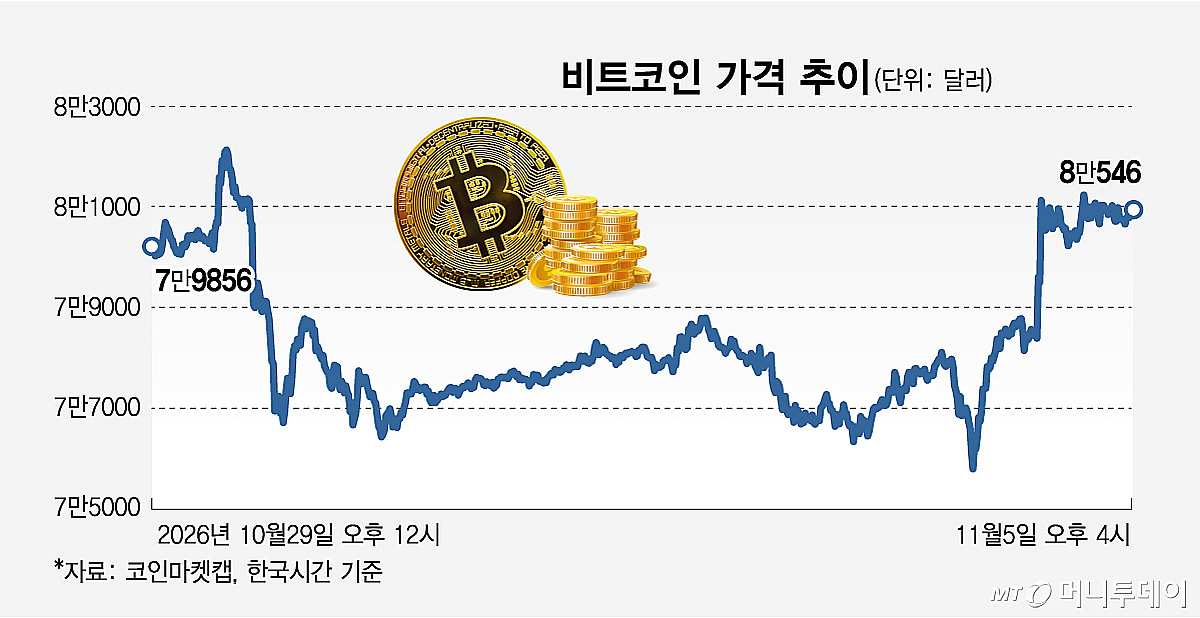
At 4 p.m. on Thursday (Korea Time), Bitcoin was priced at $80,546, up 3.50% from the previous day, according to CoinMarketCap, a virtual asset market data platform. The domestic price stood at 183 million won on Upbit. Bitcoin had fallen to the $75,000 range around noon the previous day during the early stages of U.S. midterm election vote counting, but gradually rebounded before surging in tandem with the opening of the New York Stock Exchange at 11:30 p.m.
Experts explained that this fully reflected the characteristic of risk asset markets treating the disappearance of major events as a positive factor. Spot Bitcoin exchange-traded funds (ETFs), which saw net inflows of $74.6 million (approximately 100 billion won, according to CoinGlass) in a single day on the New York Stock Exchange, also added upward pressure to virtual asset prices.
Hwang Hwan-wook, an analyst at Yuanta Securities, said, "As the Democratic Party's landslide victory was confirmed, a short squeeze and a sharp drop in the volatility index overlapped, causing Bitcoin to rebound in a V-shape."
However, weight is being given to analyses predicting a cooling period for the medium- to long-term policy environment. This is because U.S. President Donald Trump, who had led legal reforms aimed at integrating virtual assets into the regulated financial system since the second half of 2024, entered a political landscape where the opposition holds majorities in both houses following the midterm elections.
President Trump now faces not only a lack of legislative support from Congress but also various investigations. The New York Times mentioned World Liberty Financial (WLF), a virtual asset company that listed President Trump and his sons as co-founders, while enumerating likely targets for investigation. WLF has triggered conflict-of-interest controversies since last year by selling its own token, WLFI, and the meme coin Official Trump (TRUMP).
The "Clarity Act," designed to comprehensively cover the U.S. virtual asset market and closely watched by financial regulators and markets worldwide, is assessed as having failed to pass within the year. After clearing the House last year, the bill continued to face stalemates in the Senate over provisions such as preventing conflicts of interest for high-ranking officials and prohibiting interest payments on stablecoins, resulting in no vote before the midterm elections.
The domestic virtual asset industry is in a state of anxiety over changes in the U.S. legislative landscape. In discussions regarding the enactment of the Digital Asset Basic Act, which has been pursued thus far, regulatory consistency between countries has served as one of the justifications for rapid legislation. However, signs indicate that U.S. legislation, which was being used as a model, may be delayed for an extended period.
Some in the industry argue that domestic regulations on stablecoin issuance and circulation should be reviewed separately, citing the fact that the U.S. enacted the Genius Act as separate legislation for stablecoin-related rules. Critics point out that attempting to prepare a regulatory framework covering the entire industry within a single bill has revealed structural limitations, leading to larger institutional gaps.
Hong Seong-wook, an analyst at NH Investment & Securities, said, "Local media reports have emerged suggesting that the U.S. Democratic Party is drafting an amendment to the Clarity Act immediately after the midterm elections, focusing on strengthening conflict-of-interest prevention provisions and the authority of the Securities and Exchange Commission (SEC)." He added, "Without the Clarity Act, President Trump's virtual asset business could continue, and it would be impossible to prevent platforms like Coinbase from paying interest on stablecoins."
He continued, "Parting ways with President Trump, whose conflict-of-interest issues have damaged the image of the virtual asset industry, could actually serve as an opportunity for a fresh start for the sector." He noted, "The Democratic Party may also push forward with legislation to assert its stance on core issues and publicize its achievements. While the 'coin' sector is unclear, it is judged that there will be no impact on the long-term direction of real-world asset (RWA) tokenization and stablecoins."