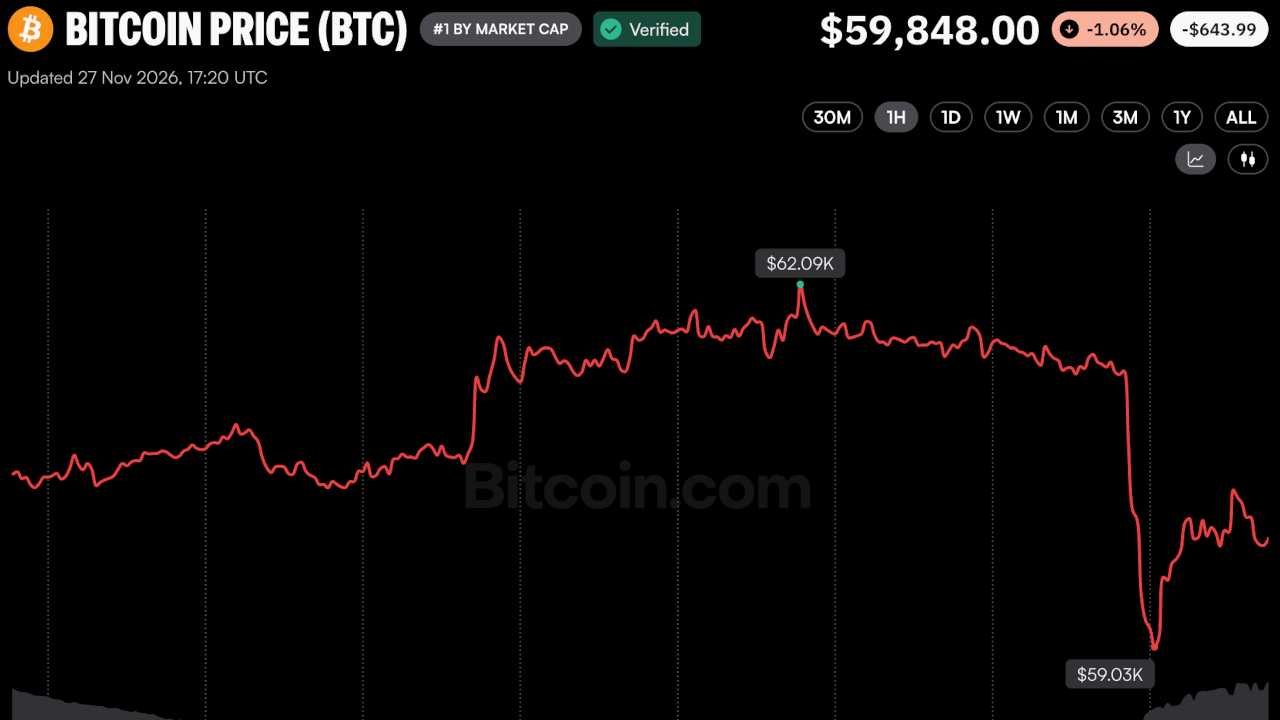
- Bitcoin gains ground above $61,000, reflecting subtle improvements in the MACD and RSI indicators.
- Gold trades higher, rising 2% on Friday, but upside remains capped by major moving averages.
- The broader macro environment remains shaky as market participants price in 99% odds of the Fed raising interest rates in December.
Bitcoin (BTC) and Gold (XAU/USD) are showing early signs of recovery on Friday. The Crypto King hovers above $61,000, up about 1.5% on the day, while Gold edges higher by roughly 2% to trade at $3,646.
The recovery follows a major macro-driven correction which saw Bitcoin test lows near $55,000 and XAU/USD $3,427. Macro headwinds remain, with the Federal Reserve (Fed) widely expected to raise interest rates in December.
Focus shifts to the Fed interest rate decision
Market participants are pricing in a 99% chance that the Federal Open Market Committee (FOMC) will hike interest rates by 25 basis points to the 4.00-4.25% range. Elevated inflation in the United States (US) has forced the Fed to balance its dual mandate to support maximum employment and stabilize prices.
Higher rates often reduce demand for risk assets, prompting a potential liquidity flight into stable financial instruments such as Treasury bonds.
The Fear & Greed Index at 12 in the Extreme Fear territory on Friday suggests a minor improvement in market sentiment. However, appetite remains largely subdued, as market sentiment holds well below 51 in Neutral territory last month.
Technical analysis: Bitcoin extends gains
Bitcoin trades around $61,442, keeping a bearish near-term bias as price holds well below the key Exponential Moving Averages (EMAs). The 50-day EMA near $71,169, the 100-day EMA at about $73,460 and the 200-day EMA around $74,629 all sit overhead, reinforcing a capped tone, while the SuperTrend line at roughly $67,771 adds to the topside supply cluster.
Momentum is mixed, with the Moving Average Convergence Divergence (MACD) turning positive and hinting at an attempted recovery, but the Relative Strength Index (RSI) only edges up toward 32, suggesting BTC remains in a weak market phase rather than a decisive bullish reversal.
Initial resistance lies at the SuperTrend barrier around $67,771, which guards the path toward the 50-day EMA near $71,169. A sustained break above that short-term average would expose the next resistance band defined by the 100-day EMA at about $73,460, ahead of the broader trend hurdle at the 200-day EMA around $74,629.
With no clear technical support levels in the current indicator set, renewed selling pressure would leave BTC vulnerable to fresh demand zones below the current price, and only a daily close back above the $67,000-$71,000 area would start to weaken the prevailing bearish structure.
Technical analysis: Gold springs back
Gold ticks up to $3,646 while remaining under clear bearish pressure, holding below the SuperTrend resistance at $3,847 and a descending trendline near $3,952, while all key moving averages cap upside. Momentum is weak rather than exhausted, with the RSI near 38 and the MACD in negative territory, suggesting selling pressure persists after the latest slide.
Initial resistance lies at the SuperTrend level around $3,847, ahead of the broken trendline barrier near $3,952 and the 50-day EMA at $3,966, which together form a dense cap for any corrective bounce. Further up, the 100-day EMA at $4,109 and the 200-day EMA at $4,190 mark broader bearish continuation checkpoints. As long as XAU/USD trades beneath this stacked EMA complex, rallies are likely to be faded, and the near-term risk profile stays skewed toward additional downside.
(The technical analysis of this story was written with the help of an AI tool. Know more.)
Bitcoin, altcoins, stablecoins FAQs
What is Bitcoin?
Bitcoin is the largest cryptocurrency by market capitalization, a virtual currency designed to serve as money. This form of payment cannot be controlled by any one person, group, or entity, which eliminates the need for third-party participation during financial transactions.
What are altcoins?
Altcoins are any cryptocurrency apart from Bitcoin, but some also regard Ethereum as a non-altcoin because it is from these two cryptocurrencies that forking happens. If this is true, then Litecoin is the first altcoin, forked from the Bitcoin protocol and, therefore, an “improved” version of it.
What are stablecoins?
Stablecoins are cryptocurrencies designed to have a stable price, with their value backed by a reserve of the asset it represents. To achieve this, the value of any one stablecoin is pegged to a commodity or financial instrument, such as the US Dollar (USD), with its supply regulated by an algorithm or demand. The main goal of stablecoins is to provide an on/off-ramp for investors willing to trade and invest in cryptocurrencies. Stablecoins also allow investors to store value since cryptocurrencies, in general, are subject to volatility.
What is Bitcoin Dominance?
Bitcoin dominance is the ratio of Bitcoin's market capitalization to the total market capitalization of all cryptocurrencies combined. It provides a clear picture of Bitcoin’s interest among investors. A high BTC dominance typically happens before and during a bull run, in which investors resort to investing in relatively stable and high market capitalization cryptocurrency like Bitcoin. A drop in BTC dominance usually means that investors are moving their capital and/or profits to altcoins in a quest for higher returns, which usually triggers an explosion of altcoin rallies.