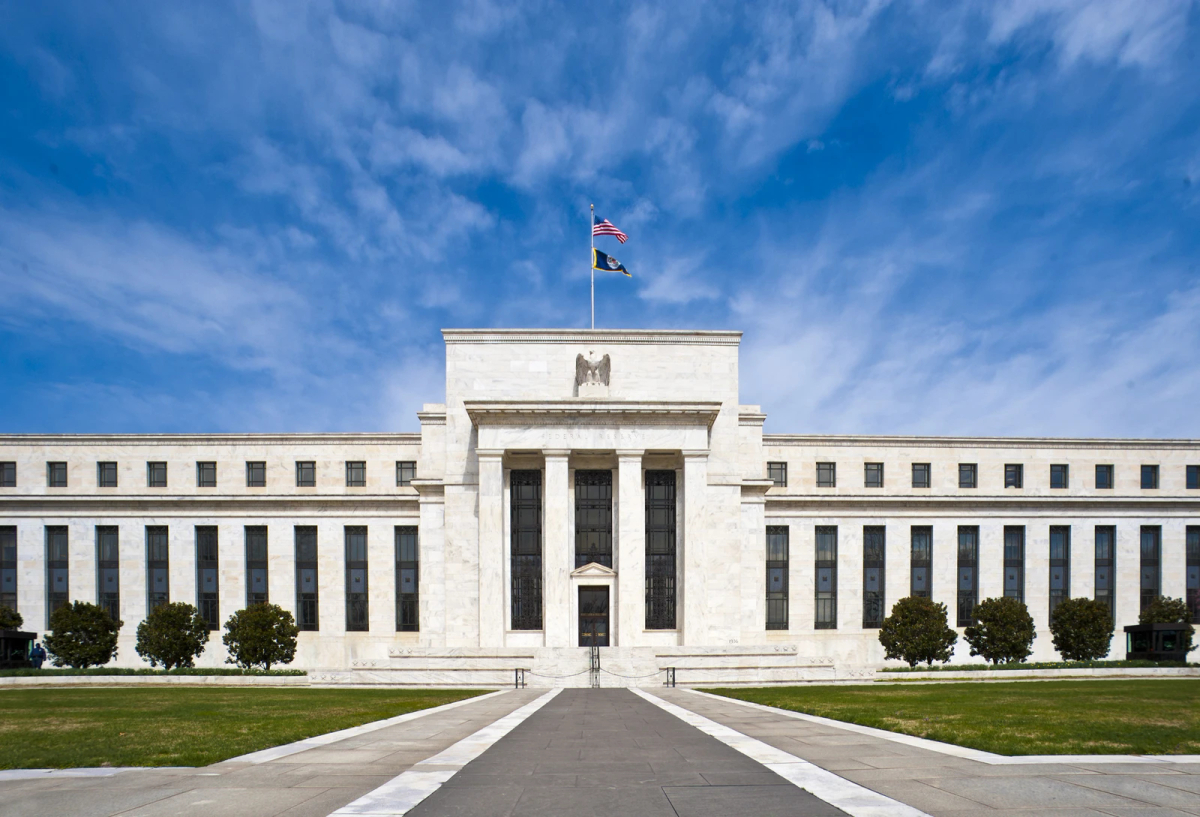
BlackRock is betting the Federal Reserve will raise interest rates just twice over the next year, a view that puts the world's largest asset manager at odds with market pricing that has already baked in three increases. The split has landed squarely on Bitcoin, which traded at $59,288 on November 25, down 1.8% over 24 hours and 8.45% over the prior week, according to CoinGecko.
The firm's November commentary lays out a quarter-point increase to the federal funds rate on December 9, followed by one more move in the first half of 2027. Traders, by contrast, have priced as many as three hikes across the same 12-month window. The gap matters for risk assets: every additional increase lifts the yield on government debt and raises the opportunity cost of holding something that pays nothing, which is precisely what Bitcoin is.
BlackRock's case rests on core inflation that it expects to hover near 3%, a full percentage point above the Fed's 2% objective. Wage growth running at roughly 4% and a labor market it describes as historically tight are the main obstacles to a faster return to target. Falling energy prices and tighter financial conditions could pull inflation lower, the firm concedes, but it argues that continued pay gains and firm hiring will keep the price outlook elevated relative to the central bank's goal.
The asset manager also sees U.S. economic growth holding above 2% in 2027, though it flags two drags: waning momentum in artificial intelligence investment and the gradual unwind of tax incentive policies. Those factors could soften demand without forcing the Fed into a more aggressive tightening cycle.
The debate follows the Federal Open Market Committee's September 16 decision to lift the target range by a quarter point to 3.75%-4.00%, a move approved unanimously and attributed to elevated inflation. BlackRock estimates the earlier energy shock added about 1.5 percentage points to headline inflation at its September peak, and projects that cheaper energy could push inflation 0.8 points below its pre-shock path by the end of 2027. The firm nonetheless cautions that energy relief will not continue indefinitely, and it raises the possibility that the neutral rate - the level that neither speeds nor slows growth - sits above previous estimates, which would argue for less easing than in past cycles.
On portfolio positioning, BlackRock favors shorter-duration Treasuries with two-year yields near 4.6%.
Crypto markets have already voted. U.S. spot Bitcoin ETFs logged $569.7 million in net outflows on November 23, with BlackRock's own IBIT accounting for $509.3 million of the total. The withdrawals came even as equities staged a modest rebound, a divergence that suggests appetite for regulated Bitcoin exposure has cooled rather than merely tracked broader risk sentiment.
The dollar has compounded the pressure. The U.S. Dollar Index closed at a 20-month high after four consecutive weekly advances, and the Crypto Fear & Greed Index sat at 13, deep in extreme fear territory. Analysts noted a brief Bitcoin bounce alongside stocks and gold but found no catalyst specific to crypto behind it.
Note: Price and change data from CoinGecko; ETF flow figures for November 23; sentiment reading from Alternative.me.
The next checkpoint is October's Personal Consumption Expenditures inflation report, scheduled by the Bureau of Economic Analysis for November 25. A hot reading would keep hike expectations elevated and reinforce the market's three-move scenario; a softer one would lend credence to BlackRock's more restrained path. Either way, a single data point is unlikely to settle the policy trajectory.
After that come the December 4 employment report and the December 9 FOMC decision, both treated by strategists as pivotal. Traders will also monitor the pace of ETF redemptions and the direction of the dollar. Sticky core services inflation could keep a third hike in the price curve, while moderating prices would narrow the gap with the two-hike forecast.
For Bitcoin, the arithmetic is straightforward but not deterministic. A shallower tightening cycle would remove one headwind without eliminating the others, and the recent flow data suggest that macro expectations are only part of what is driving allocations. The coming three weeks of inflation, payroll and policy news will determine whether the market moves toward BlackRock's view or the asset manager is forced to revise its own.
Once added, BigGo Finance appears first in Google Search Top Stories, so you get the broadest, most up-to-the-minute, and most comprehensive global financial news first.


