Musings on Information Problems of Our Times
Before I present my brilliant idea, I would like to provide definitions essential for better understanding of my main argument:
Blockchain
Blockchain
Blockchain is a shared digital record-keeping system in which information is stored in interconnected blocks, making it extremely difficult to secretly alter or erase previously recorded information.
Blockchain literally describes how the information is organized: blocks of records connected in a chronological chain. While blockchain is tamper-resistant, it is not infallible: even perfectly protected records can contain false information if it was introduced there by the creator on purpose.
AI slopaganda
AI slopaganda
The term combines AI slop (low-quality, often mass-produced AI-generated content) with propaganda (communication intended to shape attitudes or behavior in support of particular interests or ideologies). Oxford University Press shortlisted slopaganda as a 2026 Word of the Year and defines it as "low-quality propaganda produced using generative artificial intelligence and widely distributed online, esp. via social media."
You can actually vote for the shortlisted words to win here:
Now, to my main idea.
In 2026 in particular, slopaganda has become pervasive. It can include fabricated photographs of political events, AI-generated videos of politicians making statements they never made (eg. a deepfake ad against Josh Shapiro Stacey Garrety's campaign produced in the 2026 PA gubernatorial race), emotionally manipulative images of nonexistent victims, or thousands of seemingly independent social media posts promoting the same political narrative (Russian internet bots pushing the same talking points on social media).
AI slopaganda becomes more and more sophisticated and often even experts can't tell if the image/message is authentic or fake, produced by humans or AI.
And this is where blockchain technology could be useful.
Originally developed for cryptocurrency and mostly associated with it in the public's mind, blockchain technology can be used for many other purposes where decentralization and authentication of records is required. I asked MAIK (ChatGPT) to give me real examples of blockchain application for various purposes, and here's the condensed summary of what it has already been used for:
Accidentally, I also came across a story about an experiment in Japan. On October 30, 2026, SBI XDC Network APAC announced its collaboration with Socialpath on a project selected by Japan's Ministry of Internal Affairs and Communications.
The project explicitly addresses online misinformation, including AI-generated fake news and phishing. Here's the description of the project (automatic translation from Japanese on the SBI XDC website):
This project is an initiative promoted by the Ministry of Internal Affairs and Communications to respond to risks associated with the distribution of disinformation and misinformation on the Internet, and aims to promote the social implementation of countermeasures through research and development and verification of countermeasures.
SBI XDC Network APAC
In recent years, information transmitted through SNS, etc., is the basis for people's daily judgment and actions, but damage caused by fake and false information, such as fake news and phishing scams associated with the misuse of AI generation, is becoming more serious as a social issue. In order to respond to these issues, Social Pass is developing "environmental inherent NFTs" and "robustness NFTs" (both patent application technologies) that can authenticate and verify the authenticity of the outgoing information using the blockchain as a trust platform. With these technologies, we aim to realize reliable information distribution by making it possible to confirm whether "who", "where" and "information that has not been falsified" is transmitted about information on the Internet.
This project is an initiative promoted by the Ministry of Internal Affairs and Communications to respond to risks associated with the distribution of disinformation and misinformation on the Internet, and aims to promote the social implementation of countermeasures through research and development and verification of countermeasures.
In recent years, information transmitted through SNS, etc., is the basis for people's daily judgment and actions, but damage caused by fake and false information, such as fake news and phishing scams associated with the misuse of AI generation, is becoming more serious as a social issue. In order to respond to these issues, Social Pass is developing "environmental inherent NFTs" and "robustness NFTs" (both patent application technologies) that can authenticate and verify the authenticity of the outgoing information using the blockchain as a trust platform. With these technologies, we aim to realize reliable information distribution by making it possible to confirm whether "who", "where" and "information that has not been falsified" is transmitted about information on the Internet.
In essence, the experiment's proposed technology uses two types of NFTs (did you already forget what they were, NFT is a Non-Fungible Token, i.e. unique digital token recorded on a blockchain that can be used to represent a particular item, asset, or credential) to help establish who published information, where it originated, and whether it has been altered.
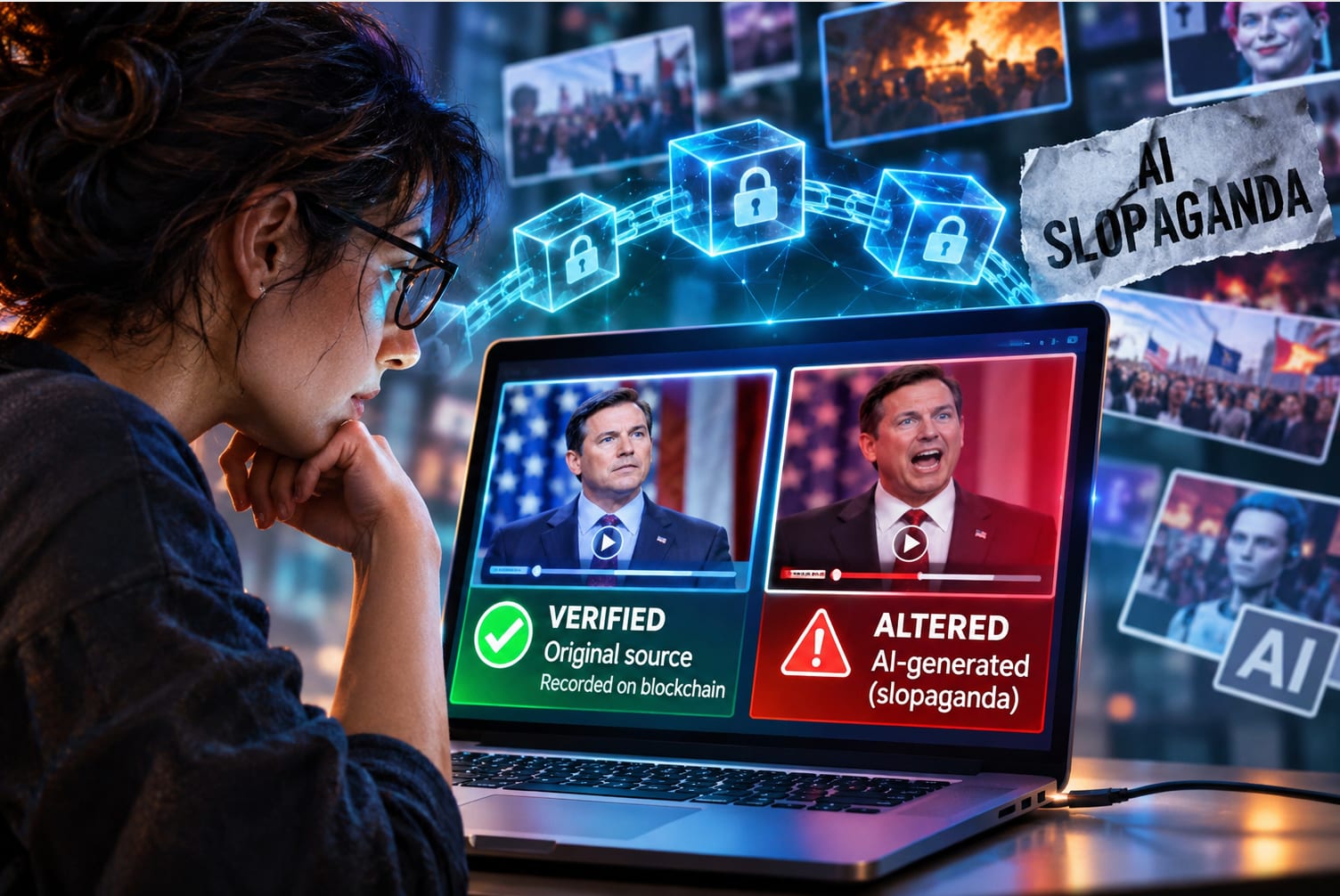
This is how this approach can be applied for authentication of videos suspected to have been generated by AI for political campaigns:
As this illustrates, blockchain can be useful in weeding out AI slopaganda because we wouldn't necessarily need an AI detector to guess whether the suspicious video was artificially generated. We could simply compare it with an authenticated original.
There are two important caveats, however:
This will work only when a trustworthy original exists and can be checked. An unmatched video isn't automatically fake.
Blockchain may help verify the origin and integrity of information, but it cannot independently determine its truthfulness. So if someone who produced the original recording included misinformation or lies into it, blockchain will not be able to detect and flag it.
But even under these caveats, with the amount of AI slop that is churned out every day, blockchain can help us cull and weed it out so that our information environment is a little cleaner. We have to start somewhere, right?
About the Creator
Lana V Lynx
Avid reader and occasional writer of satire and short fiction. For my own sanity and security, I write under a pen name. My books: Moscow Calling - 2017 and President & Psychiatrist
@lanalynx.bsky.social
Enjoyed the story? Support the Creator.
Subscribe for free to receive all their stories in your feed. You could also become a paid subscriber, letting them know you appreciate their work.
Reader insights
Comments
There are no comments for this story
Be the first to respond and start the conversation.