TL;DR:
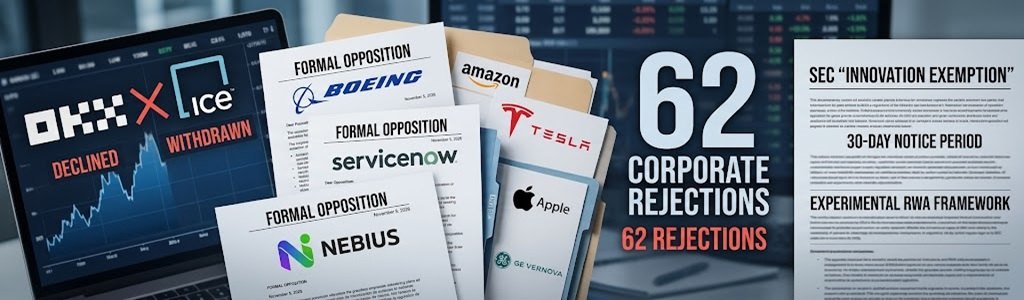
- 62 registered companies: A total of 62 publicly traded companies have formalized their refusal to include their shares on the digital trading platform.
- 87% of initial catalog rejected: Out of the 62 U.S. corporations included in the original proposal, 54 have filed direct objections.
- Regulatory opt-out mechanism: The withdrawal requests were executed under the SEC’s five-year exemption framework, which requires a formal 30-day advance notice.
Aircraft manufacturer Boeing, software platform ServiceNow, and artificial intelligence infrastructure provider Nebius also oppose the joint stock tokenization plan by OKX and Intercontinental Exchange (ICE).
The total number of public corporations refusing to participate in the trading venue now stands at 62. Eleanor Terrett reported that 54 of these entities were part of the initial list of 62 U.S. firms selected by the initiative, while the remaining eight, including Nebius, chose to issue preemptive refusals as they were not included in the preliminary design.
Another three issuers objected today:
Nebius
Boeing
ServiceNowThat brings the total to 62. Boeing and ServiceNow were on OKXICE’s original list. Nebius was not.
In total, 54 of the 62 companies originally proposed have now objected. https://t.co/CUY5vIEtC0
— Eleanor Terrett (@EleanorTerrett) November 5, 2026
Another three issuers objected today:
Nebius
Boeing
ServiceNow
That brings the total to 62. Boeing and ServiceNow were on OKXICE’s original list. Nebius was not.
In total, 54 of the 62 companies originally proposed have now objected. https://t.co/CUY5vIEtC0
— Eleanor Terrett (@EleanorTerrett) November 5, 2026
This institutional statement adds to the exclusions requested in previous days. Between November 2 and 3, companies such as Amazon, Tesla, Netflix, SpaceX, SoFi Technologies, Lam Research, Apple, The Home Depot, and GE Vernova submitted their respective formal rejection letters.
Technical Scope of Deployment and Corporate Objections
The project structure was originally presented in October 2026 with an anticipated catalog of 63 ticker symbols representing 62 U.S. companies. The operating model envisioned using OKX’s XLayer blockchain network alongside automated liquidity pools on Uniswap v4.
Under that technical framework, investors would trade using USDC and USDG stablecoins 24 hours a day. The initiative’s official documentation stipulated that each token would maintain direct one-to-one backing through custody agreements with actual shares, avoiding the use of synthetic contracts or price-tracking derivatives.
Likewise, OKX and ICE stated that the consortium would not assume direct custody of user funds nor act as the issuer of the digital assets. Access would require identity verification protocols, international sanctions screening, and decentralized wallet validation prior to any transaction.
Despite these compliance provisions, corporate opposition has been grounded in the lack of precedent regarding shareholder rights. According to market analyst reports, issuers have expressed concerns related to liquidity fragmentation, the impact on price discovery during non-conventional hours, and legal uncertainty surrounding corporate voting and dividend distribution within decentralized environments.
Regulatory Framework and SEC Timeline
The exclusion process used by issuers is governed by the so-called “Innovation Exemption” approved by the SEC on September 17, 2026. This regime authorizes a five-year experimental period for real-world asset (RWA) platforms while imposing strict safeguards on operators.
The regulation requires any platform to notify publicly traded companies in writing of its intent to issue third-party tokenized securities at least 30 days in advance. During this window, corporate boards retain the legal right to reject the use of their equity capital within secondary infrastructure.
The volume of rejections accumulated to date drastically curtails the trading venue’s original catalog. Market coverage indicates that the withdrawal of 54 out of the 62 planned securities will force the promoters to reconsider the launch timeline or debut with a substantially narrowed offering.
The U.S. regulator will continue receiving notifications from issuers as technical notice periods expire through the second half of November 2026, marking the close of the review window for the first cohort of applications registered under the experimental framework.