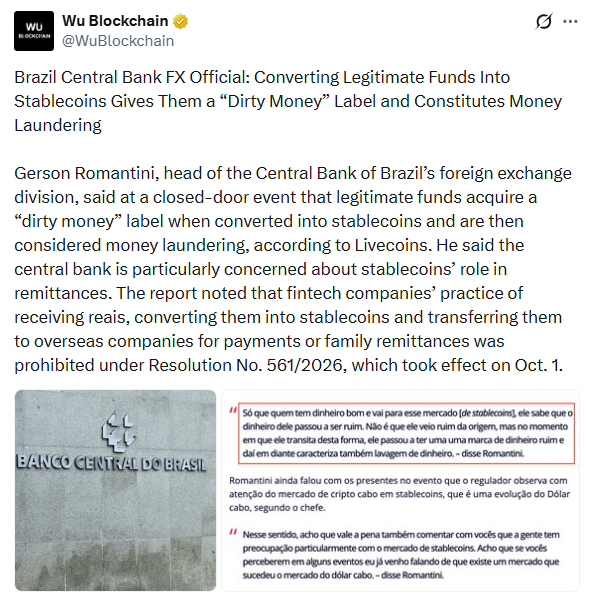
A senior official at the Central Bank of Brazil has warned that converting legitimately obtained funds into stablecoins can expose transactions to money-laundering concerns, highlighting the regulator’s increasingly restrictive approach toward cryptocurrency-based international payments. Gerson Romantini, head of the central bank’s Foreign Exchange Division, made the remarks during a closed-door industry meeting hosted by Exchange Informática, according to Brazilian cryptocurrency publication Livecoins on November 13, 2026.
Romantini argued that funds originating from legitimate sources could acquire a problematic regulatory classification when transferred through certain stablecoin payment arrangements. The comments attracted attention because they appeared to associate otherwise lawful funds with financial crime based on how they were transferred rather than their original source. However, the remarks were reported from a private meeting and do not constitute an official declaration that purchasing or holding stablecoins automatically amounts to money laundering. The controversy follows Brazil’s introduction of stricter rules governing electronic foreign-exchange services, particularly companies using dollar-backed cryptocurrencies for cross-border payments.
Central Bank Targets Stablecoin-Based Remittance Arrangements
Romantini expressed particular concern about a payment structure commonly described as stablecoin sandwiching. Under this arrangement, Brazilian fintech companies receive customer payments in reais, convert the funds into stablecoins such as USDT or USDC, and transfer the digital assets to overseas intermediaries. Those intermediaries subsequently exchange the stablecoins into local currencies to complete commercial payments or family remittances. The process can reduce dependence on conventional correspondent banking infrastructure, potentially lowering costs and accelerating international transfers. However, Brazilian regulators are concerned that certain arrangements could circumvent established foreign-exchange reporting and anti-money-laundering requirements.
Romantini reportedly distinguished between two models: using virtual assets as internal infrastructure supporting an authorized foreign-exchange transaction and transferring stablecoins directly to overseas counterparties as the settlement mechanism. He indicated that the former could remain permissible while the latter faced regulatory restrictions. The central bank has not publicly released an official transcript of the meeting or confirmed the exact wording of his comments.
Resolution 561 Restricts Stablecoin Settlement for International Payments
Brazil’s regulatory position is reflected in Central Bank Resolution No. 561, issued April 30, 2026, and effective October 1. The regulation amended the country’s electronic foreign-exchange framework, known as eFX, requiring settlement between payment providers and their overseas counterparties through authorized foreign-exchange transactions or eligible nonresident accounts denominated in reais. It explicitly prohibits virtual assets from serving as the settlement instrument in those arrangements. However, the restriction does not establish a general prohibition on stablecoin ownership, trading or every form of cryptocurrency-based payment.
The framework also permits certain payment providers outside existing authorization categories to continue operating while seeking regulatory approval, subject to a May 31, 2027 application deadline. Livecoins separately reported speculation that authorities could introduce additional restrictions affecting fintech participation in the remittance market. The central bank has not confirmed such a decision. The distinction between existing regulation and potential future measures remains important for financial technology companies developing cross-border payment services. Brazil’s approach illustrates growing regulatory tension between stablecoins’ potential to improve payment efficiency and authorities’ concerns over transparency, transaction monitoring and compliance with foreign-exchange laws.