By TMF Breakfast News – Nov 20, 2026 at 7:30AM EST
Bitcoin’s Brutal November, Explained
Joshua Simka, TMF Market News Editor
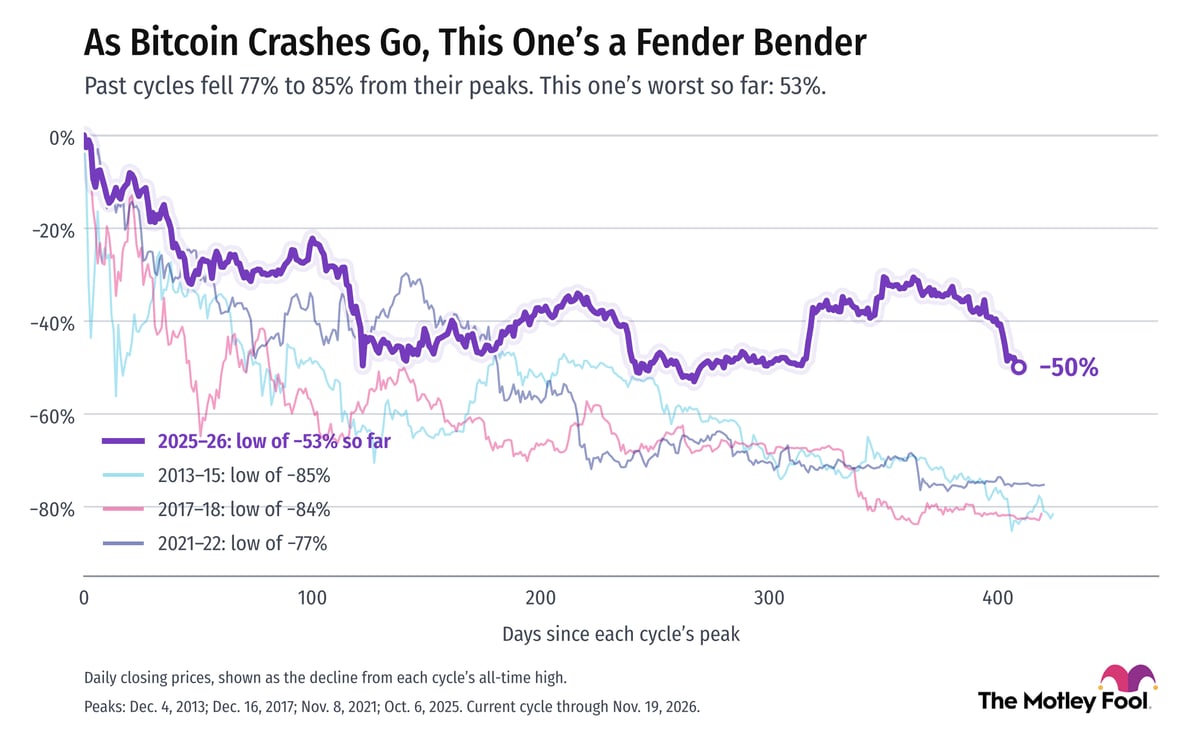
Should Bitcoin (BTC -3.67%), recommended by Team Hidden Gems, come up between the turkey and the pie next week, expect at least one relative to mention the recent slide—probably with some satisfaction. The price fell as low as $62,000 late Saturday, capping a sixth straight week of declines, and dipped below that level Thursday night.
Step back a little, and the picture gets harder to look at. Bitcoin hit a record of about $126,000 on Oct. 6, 2025, and it’s now worth less than half that, down more than a quarter for the year. Since 2016, only November 2022, the month the FTX exchange collapsed, got off to a worse start.
What knocked Bitcoin down?
There wasn't a single shock behind this so much as a pile-up, and most of the pressure started outside the crypto world entirely.
The first domino was tech, with the decline beginning in late October, when worries about AI valuations and spending pulled tech stocks lower, and leadership turmoil at Nvidia (NVDA -3.30%) only made investors more nervous about risk. On top of that, hotter-than-expected inflation pushed the dollar index to its highest level since April 2025. St. Louis Fed President Alberto Musalem also said several rate hikes may be needed before next spring.
Crypto had a scare of its own when the $6.3 billion Binance hack in late October—the largest crypto heist on record—led investors to convert stablecoins back into traditional currency, according to Grayscale. Spot Bitcoin ETFs saw about $1.91 billion in net outflows over seven straight trading days through Nov. 13.
What turned a slide into a rout, though, was borrowed money. Once Bitcoin broke below its 200-day moving average near $73,000, forced selling of leveraged positions took over.
Wall Street hasn’t walked away
In October, J.P. Morgan Asset Management, part of JPMorgan Chase (JPM -1.20%) and hardly a crypto fund, issued its first-ever 10-year return forecast for Bitcoin, calling for 10% a year, compounded, compared with 5.5% for gold. Strategists Sheena Shah and Dennis Cristallo wrote that "bitcoin is the anchor of the crypto ecosystem."
It isn't a moonshot call, either, and JPMorgan was upfront about the caveats, pegging Bitcoin's volatility at 55% and noting that its unstable correlations still keep it out of most portfolios. Still, the asset-management arm of the largest U.S. bank now considers Bitcoin worth modeling a full decade out.
Consider what a few big financial firms actually did over the past several months.
Charles Schwab (SCHW -0.47%) finished rolling out spot Bitcoin and Ethereum(ETH -3.46%) trading to its retail clients in October. "All clients can now access Schwab Crypto," CEO Rick Wurster said on Oct. 15, and the company is adding crypto transfers and three more coins by year-end. Its executives estimate that Schwab clients already hold about 20% of all U.S. spot crypto ETP assets, which gives a sense of how much demand was there to begin with.
Deutsche Bank (DB -0.34%) switched on Bitcoin and Ethereum custody for paying institutional clients on Nov. 11, right in the middle of the selloff. Paul Maley, its global head of trust and securities services, said the bank aims to build "a fully integrated, regulated ecosystem" for digital assets, and it plans to bring the service to Asia. Over at Morgan Stanley(MS -3.42%), the E*Trade platform launched crypto trading in July through crypto infrastructure firm Zerohash.
What the biggest holder is doing
Strategy(MSTR -4.64%), the largest corporate owner of Bitcoin, is still buying, though at a much slower clip than it used to. It bought 485 BTC for $33.4 million between Nov. 9 and Nov. 15, at an average of $68,887 per coin, according to a regulatory filing on Monday, after picking up 1,036 BTC the week before. The treasury company now holds 850,849 BTC, about 4% of the 21 million that will ever exist.
So Strategy hasn’t capitulated, but it isn’t a backstop anyone should count on. Its average cost is $75,452 per coin, leaving its position roughly 15% underwater at about $64,000. Its buying also depends on raising money from investors, which gets harder when its own stock is down.
Foolish thoughts on Bitcoin
If you own some Bitcoin, your time horizon should be among your biggest considerations. Drops of 50% or more have been part of owning Bitcoin since its earliest days, so if you bought it to hold for five or 10 years, this drawdown is part of the deal you signed up for. Position size matters just as much, because the right amount is one you could hold through another leg down without needing to sell.
Finally, Fools know to steer clear of leverage with any speculative instrument. This month's worst damage landed on traders using borrowed money, while investors who owned their coins outright got a scary-looking statement rather than a margin call.
Motley Fool co-founder and CEO Tom Gardner made a similar point during his Quarterly Call last December, when this drawdown was still in its early weeks. He traced Bitcoin’s wild swings to the same kind of borrowed money that did the damage this month: when the price runs, “people start to lever up and think, this is the time when I’ll triple my money in four months. That margin gets exposed, and the asset is very volatile.” He drew a distinction worth holding onto: “Bitcoin is not a stable store of value. But I do believe it is a long-term store of value.”
Today’s Question!
Do you own any Bitcoin—and would you add more at these prices?
Discuss with friends and family, or become a member to hear what your fellow Fools are saying!
Where to invest $1,000 right now
When our analyst team has a stock tip, it can pay to listen. After all, Stock Advisor's total average return is 790%* — a market-crushing outperformance compared to 202% for the S&P 500.
They just revealed what they believe are the 10 best stocks for investors to buy right now, available when you join Stock Advisor.
*Stock Advisor returns as of November 20, 2026.