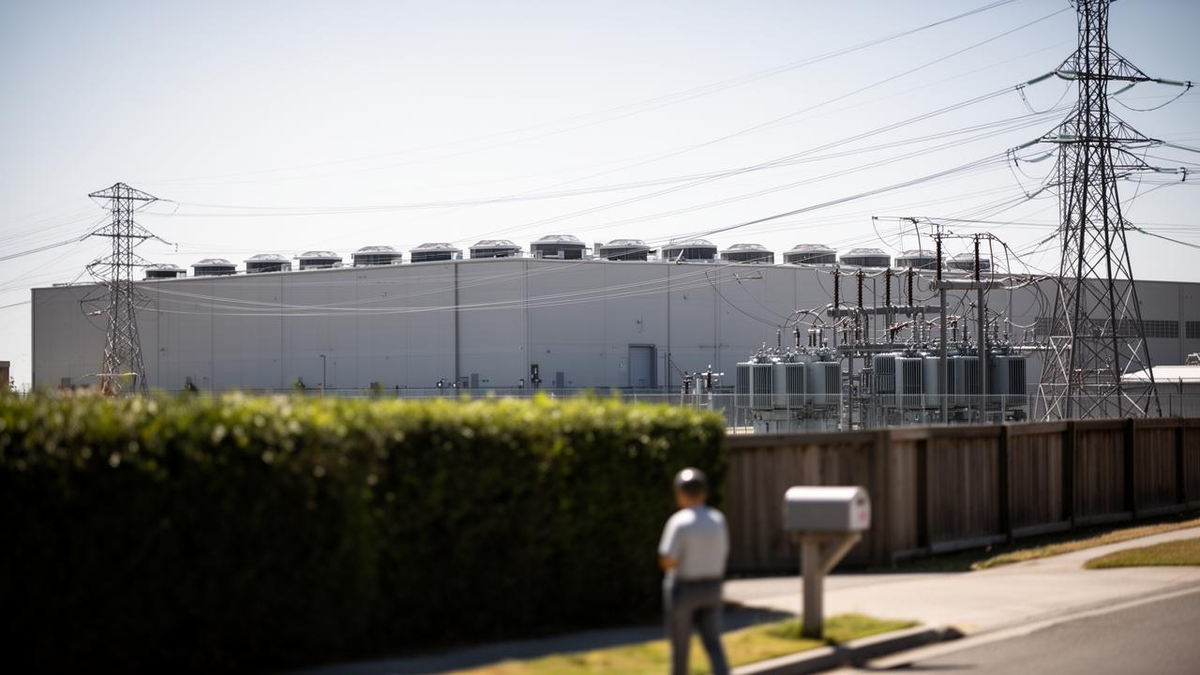
Ethereum co-founder Vitalik Buterin has come out in support of community campaigns resisting the spread of data centers built to train and operate artificial intelligence systems, saying the buildout is outpacing what society can safely absorb.
His position, described in reports from crypto.news and BeInCrypto, stops short of demanding a halt to construction. Instead, the Ethereum co-founder is said to back the right of local communities to challenge projects they consider harmful or poorly planned, and to argue that AI development should move at a slower, more deliberate pace rather than be abandoned.
The intervention puts one of the crypto industry's best-known figures into a debate that has mostly involved energy policy analysts, planners and municipal officials. Over the past two years, opposition to AI infrastructure has hardened in a number of regions, with objections centered on electricity consumption, water use and land requirements at large-scale computing sites.
Buterin has written before about what he calls defensive acceleration, the idea that technological progress should advance alongside safeguards rather than unchecked. The new remarks carry that framework from software into physical infrastructure, according to the reports.
Timing is a factor. Major technology companies are pouring capital into AI computing capacity at a scale that has made data centers among the largest new sources of electricity demand in many markets. Critics contend that the resulting load strains grids and pushes up costs for surrounding areas.
There is no direct connection between the comments and Ethereum's protocol or roadmap, and no crypto market mechanism is tied to them. Still, Buterin's public positions are closely followed by Ethereum-aligned developers and investors, and renewed scrutiny of AI data center expansion could spill over into crypto mining and compute-related projects that draw on the same power and infrastructure.
The remarks landed during a busy stretch for Ethereum itself. Developers paused the planned Glamsterdam hard fork, which was designed to improve fee recalculation on the testnet, after a critical bug surfaced. The defect was judged serious enough to risk disrupting smart contract operations, and the team has begun revisiting architectural decisions before any mainnet shift.
Separately, Buterin pushed back against valuing ETH primarily through the volume of transaction fees burned. He argued that tying the roughly $270 billion base layer to gas destruction does not offer a durable valuation framework, and suggested a store-of-value narrative could prove stronger. The comments mark a departure from the deflationary story that gained traction after EIP-1559.
He noted that periods of heavy burning were largely tied to cyclical speculative activity and did not hold up during crypto downturns. Solana co-founder Anatoly Yakovenko also weighed in, saying transaction fees cannot stand alone as a product and that networks should focus on delivering real value to users.
Developers are meanwhile preparing measures to expand first-layer capacity, including EIP 8037 on fee calibration and EIP 7928 on parallel production, alongside plans to raise the gas limit to 200 million units. Lower transaction costs could reduce the rate of token burning over time, though Buterin maintains that does not undercut the network's core value proposition.
Note: ETH traded around $2,240 during the fee-burn debate, according to the reports.
For crypto markets, the practical effect of Buterin's stance on AI infrastructure is likely to be indirect and sentiment-driven rather than mechanical. Any policy friction that slows data center approvals could, however, alter the cost calculus for energy-intensive computing operations, a category that includes both AI workloads and mining. How the debate translates into project approvals remains to be seen.