A crypto exchange that brings several markets into one interface can reduce the need to switch services. Traders still need to know which account holds their money, what each product represents and how much an order will cost. Those details shape the usefulness of the platform after its September 2026 revamp.
This BYDFi review examines the current crypto trading platform through its public interface and official documentation. Its range includes spot crypto and perpetual contracts referencing both cryptoassets and traditional markets. That breadth may appeal to experienced derivatives traders, while someone making occasional spot purchases has fewer features to evaluate. No live trading or withdrawal tests were performed for this review.
How the accounts work
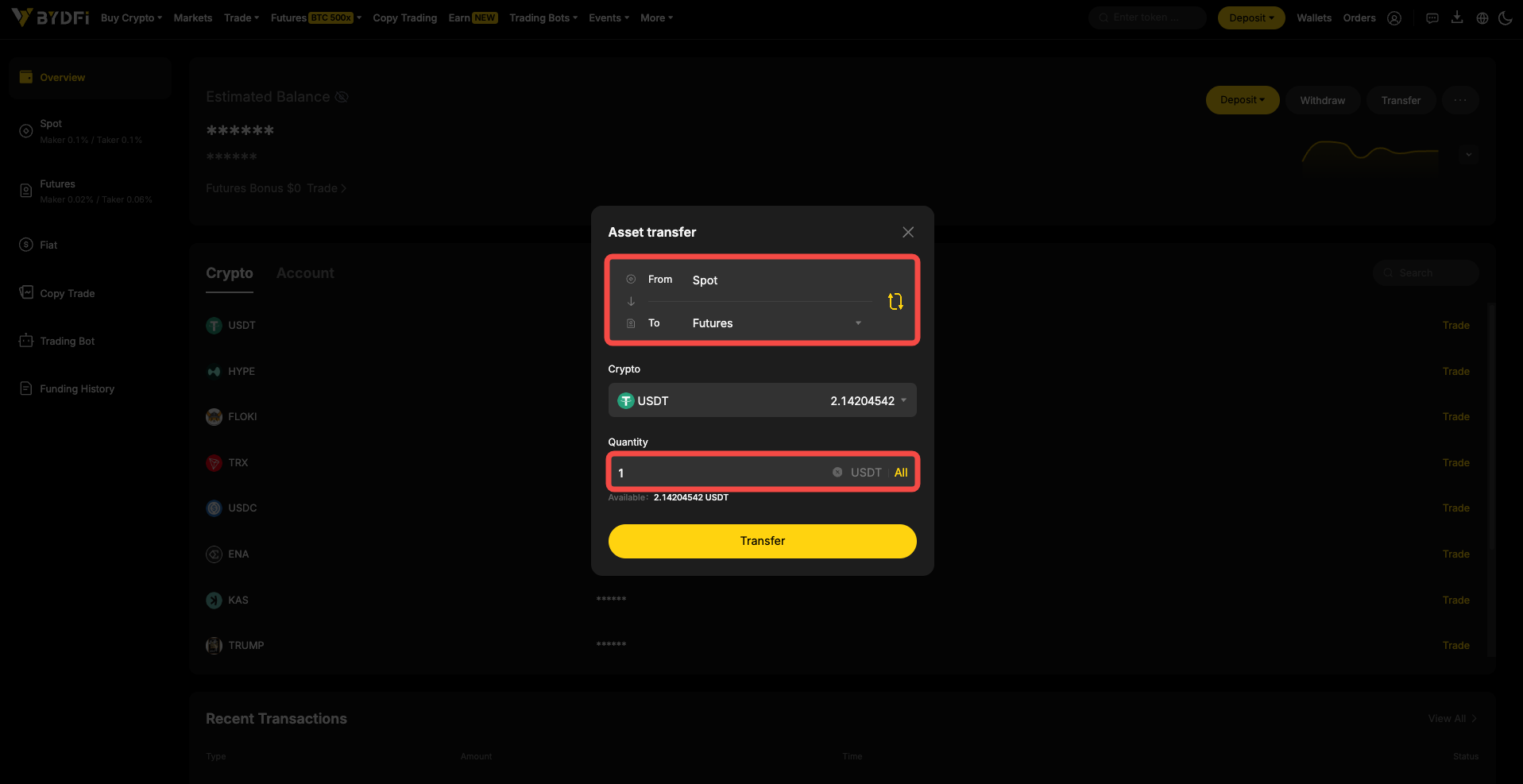
The official transfer guide separates the Spot Account from USDT-M and COIN-M Contract Accounts. Moving funds between them requires choosing a source account, a destination and an amount in the Transfer function. Funds held in either contract account must move to Spot before withdrawal.
For someone switching between spot and futures, that creates a practical step between choosing a trade and funding it. A balance in one account should not be assumed to cover an order in another.
The amount available to transfer can also be lower than total account equity. Open positions, pending orders and margin requirements can tie up funds. Before planning a withdrawal, look at the transferable balance and any commitments against it. This is especially relevant when part of the account is still supporting a leveraged position.
Spot vs futures crypto trading
A fully paid spot purchase acquires a cryptoasset without the margin requirements of a leveraged futures position. Keeping that asset on an exchange still involves relying on the service’s custody and withdrawal arrangements.
Perpetual contracts provide exposure to a reference price without a scheduled expiry. Leverage allows a position to exceed the margin deposited, increasing both gains and losses relative to that margin. A position can be liquidated when its collateral falls below the required level.
The current markets page includes USDT-margined perpetuals referencing US stocks, gold, silver and crude oil alongside crypto contracts. This gives the service scope as a multi asset trading platform. A stock-linked perpetual, however, does not confer share ownership, and a gold-linked contract does not provide ownership of physical gold.
Readers comparing the available crypto spot and futures trading products should identify the underlying exposure before choosing a market. Traditional-market contracts also call for attention to trading schedules and pricing rules, particularly when the reference market is closed. Several instruments may share an interface while requiring different trading decisions.

BYDFi fees and what a trade costs
The public fee overview and calculation guide listed these standard rates when checked on 9 November 2026.
The rate shown for a particular pair or account can differ. At the time of review, the BTC/USDT spot row displayed 0.08% for both maker and taker trades, with the standard 0.1% struck through. Promotions and VIP tiers therefore matter when estimating the actual charge.
A maker execution adds liquidity to the order book. A taker execution matches liquidity already available. Placing a limit order does not guarantee the maker rate: an order that matches immediately can execute as a taker.
For a hypothetical USDT-M trade with an executed value of 1,000 USDT, the standard 0.06% taker fee is 0.60 USDT. If the closing trade also executes as a taker at exactly 1,000 USDT, the combined entry and exit fees are 1.20 USDT. A change in the closing value changes the second charge.
These fees apply to the value traded. Using less of your own money as leveraged margin does not reduce that execution value. The example also excludes funding, spread and slippage, all of which can affect the final result.
Costs beyond commission
For perpetual traders, funding can change the cost of holding a position. Payments pass between long and short holders, with the rate and its direction determining which side pays at settlement. The relevant figures are the specific contract’s current rate and next settlement time.
Execution matters too. The bid-ask spread is the gap between quoted buying and selling prices. Slippage occurs when an order executes at a different price from the one expected. Both belong in a comparison of crypto exchange fees, especially for less liquid markets.
Convert charges no separate transaction fee because its costs are included in the quoted exchange rate. Comparing the amount received with the proceeds of an order-book trade after fees gives a more useful cost comparison than the commission label alone.
Withdrawal fees and minimums vary by asset and network. A fixed charge can take a noticeable share of a small withdrawal, so the cost assessment should extend beyond buying and selling. The receiving wallet or service must also support the selected network.
Account security and access controls
BYDFi’s official security documentation describes passkeys for login and withdrawal authorisation, authenticator-based verification and anti-phishing settings. An official-channel checking tool also gives users a way to check the channels they interact with when seeking help.
Before depositing funds, review the available security settings and check the recovery procedures for a lost device or an unavailable verification method. When contacting support or following account-related instructions, use the channel-checking tool to confirm the source. These are practical steps to consider when setting up an account for regular trading and withdrawals.
Who the platform suits after the revamp
BYDFi is most relevant to traders who understand perpetual contracts and want access to crypto and traditional-market price exposure through one service. Its range gives those readers more markets to consider, with account transfers and contract-specific rules remaining part of the workflow.
For occasional spot buyers, the more useful comparison is narrower: the chosen pair’s fee, custody arrangements and eventual withdrawal cost. Investors seeking direct share ownership will need a product that provides those rights.
The September revamp provides context for reviewing the current platform, but the public material does not establish faster execution or better withdrawal performance than before. The decision rests on the available products, the documented account workflow and the full cost of the intended trade, subject to product eligibility.