Key takeaways
- Bitcoin mining facilities can become AI data centers
- Core Scientific's infrastructure program carries a $5.5 billion budget
- Existing power connections save time but not billions
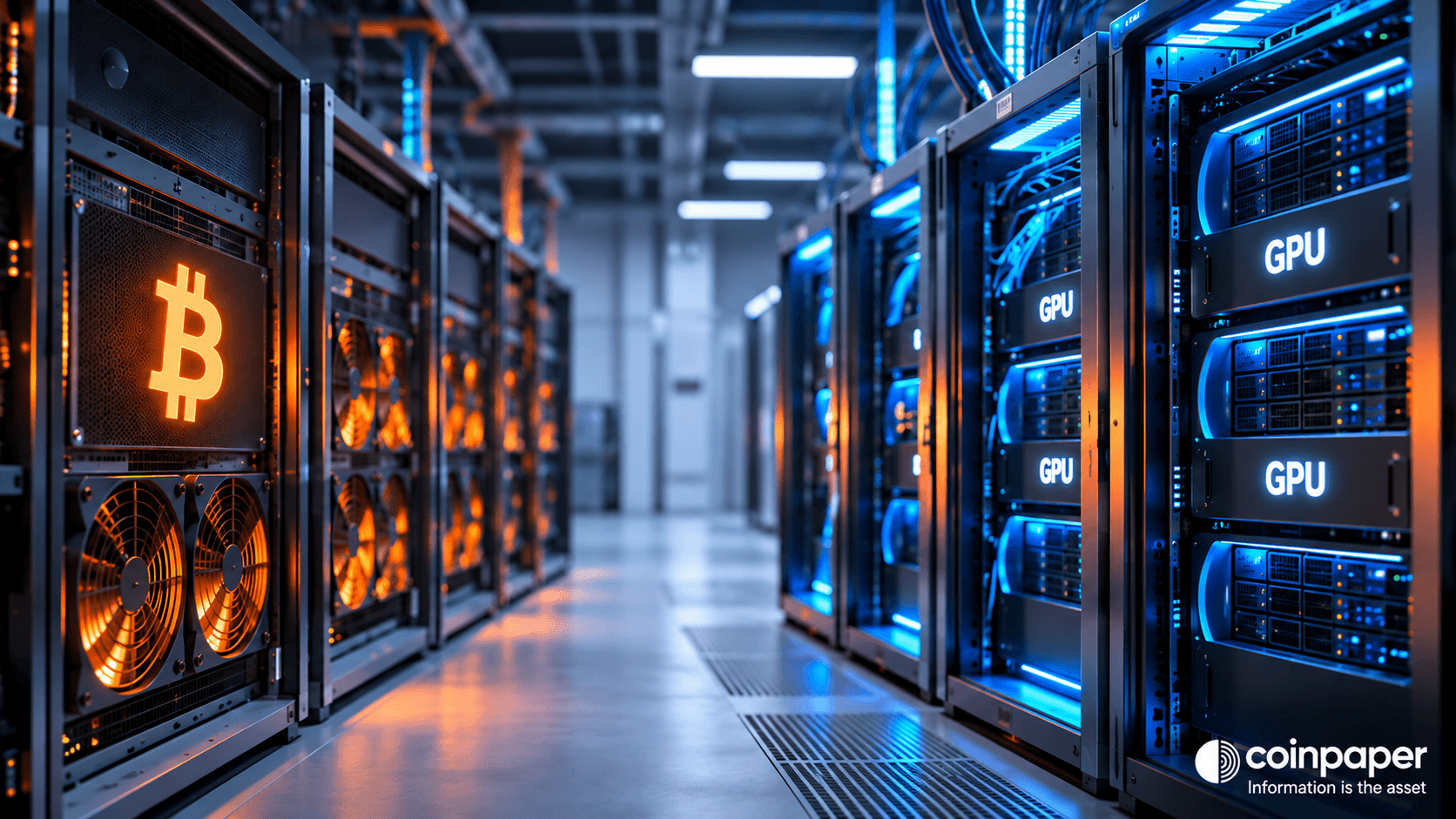
A Bitcoin mining facility already has something AI companies desperately need: access to enormous amounts of electricity. But turning that infrastructure into a modern AI data center is far more expensive than simply replacing Bitcoin mining machines with Nvidia GPUs.
Core Scientific offers a revealing example. According to its April 2026 financing disclosure, six data center projects leased to CoreWeave carried approximately $5.5 billion in anticipated construction expenditures for 590 megawatts of contracted IT capacity.
That works out to roughly $9.3 million per megawatt, although the figure covers a broader development portfolio rather than a standardized retrofit price.
Why a Bitcoin Mine Cannot Simply Run AI
Traditional Bitcoin mines operate specialized ASIC machines designed to perform repetitive calculations. They need electricity, ventilation and connectivity, but their infrastructure is relatively straightforward compared with high-performance AI computing.
Modern GPU clusters require more demanding cooling systems, high-bandwidth fiber connections, advanced electrical distribution and reliable operating environments. A mining warehouse may already have power access, yet still need substantial reconstruction.
That's why Bitcoin miners transitioning toward AI are increasingly valued for their land and electrical infrastructure rather than their existing mining equipment.
Core Scientific has committed to converting its facilities into high-density colocation infrastructure, while other operators including TeraWulf and Hut 8 are pursuing long-term AI infrastructure contracts.
How Much Does Conversion Actually Cost?
Core Scientific's development program illustrates the financial scale. Its disclosed $5.5 billion construction budget across 590 MW implies roughly $9.3 million per MW of contracted IT capacity.
The company separately disclosed an illustrative development cost of approximately $11 million per MW for expanding its broader data center portfolio.
These estimates are not universal conversion prices, and neither figure should be interpreted as including the customer's entire GPU investment.
In its CoreWeave agreements, up to $1.5 million per MW of certain facility expenditures can be funded by the customer and subsequently recovered through hosting-payment credits. Other modifications are purchased directly by CoreWeave.
An additional 70 MW expansion also required Core Scientific to fund approximately $104 million for powered core-and-shell infrastructure.
These expenses help explain why AI infrastructure financing increasingly involves project debt, long-term leases and specialized infrastructure investors.
Is Converting a Bitcoin Mine Worth the Investment?
For miners, the attraction is predictable customer revenue. Bitcoin mining profitability fluctuates with cryptocurrency prices, network difficulty and electricity costs, while AI hosting contracts can secure payments over many years.
Core Scientific's November presentation described approximately $10 billion in potential revenue from its CoreWeave agreements, with around $850 million in average annualized colocation revenue.
However, projected contract revenue is not guaranteed profit, and construction financing remains a substantial commitment.
That distinction matters as mining infrastructure stocks face investor concerns about debt and development costs, even while AI hosting revenue grows.
It also exposes a critical difference between developers and customers. As the broader AI data center financing model demonstrates, the company providing land and electricity may not own the GPUs or bear every construction expense.
ENRICH your inbox with our best stories
Don’t miss out and join our newsletter to get the latest,
well-curated news from the crypto world!
Adrian Cole
Adrian Cole has spent more than 6 years covering financial markets, with a focus on crypto, equities, and macroeconomic trends. He follows Bitcoin, major altcoins, U.S. stocks, interest rates, commodities, and the data points that move markets. Over the years, he has written hundreds of market updates and analysis pieces, with an emphasis on price action, investor sentiment, and the link between traditional finance and digital assets.
https://coinpaper.com/38845/can-you-actually-turn-a-bitcoin-mine-into-an-ai-data-center-here-s-what-it-costs