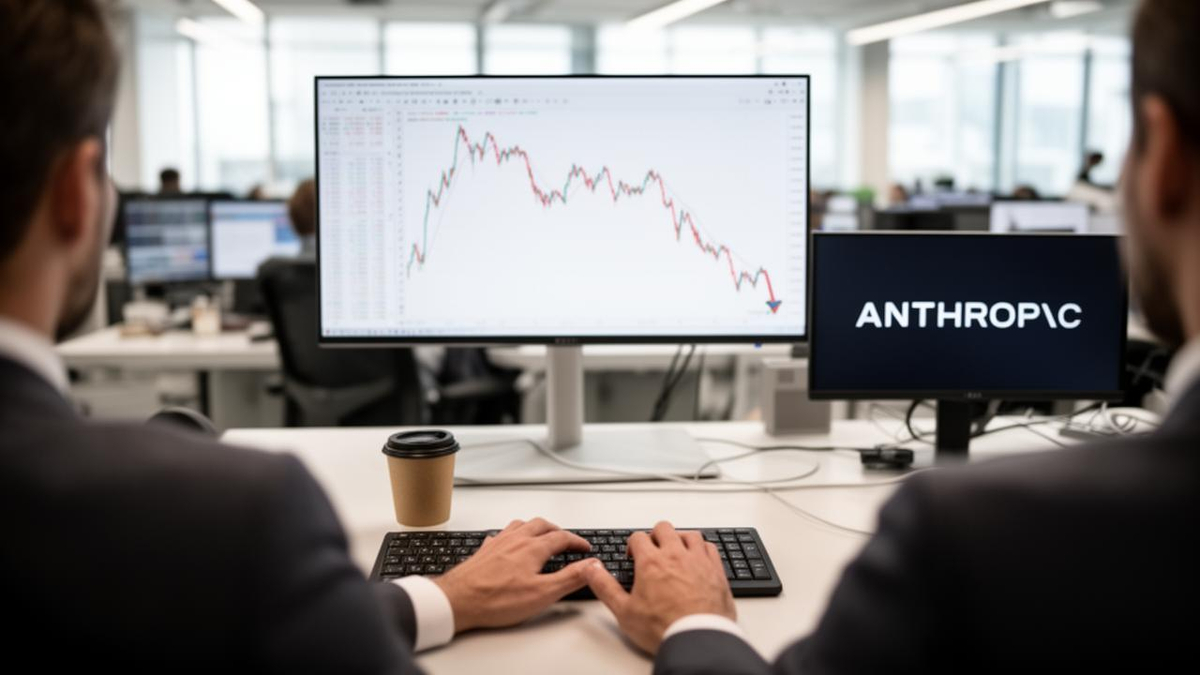
Cathie Wood's Ark Invest spent about $145.9 million buying 1.64 million shares of Anthropic PBC (ANT) across Thursday and Friday, adding to a position in the Claude developer during its first two sessions as a public company and in the middle of a sharp selloff in growth stocks.
The purchases, disclosed in the firm's daily trading reports, came as Anthropic's stock swung violently following the largest initial public offering on record. The shares were priced at $83, opened at $111.50, closed their debut up 17.1% and then fell 8.5% on Friday to $88.91. At one point Friday the stock touched $83.05, within a nickel of the offering price.
Ark's buying was not confined to Anthropic. The firm also picked up shares of SpaceX (SPCX) and Advanced Micro Devices (AMD), both of which were hit hard in Friday's rout, with the three names falling between roughly 8% and 13% on the day.
Note: Price moves reflect Friday, Nov. 20, 2026 trading.
Anthropic's debut briefly lifted its market value to about $2.1 trillion in early trading, above the valuation SpaceX reached at its June listing. By the end of the week, its fully diluted market capitalization stood at roughly $1.6 trillion, behind only Apple, Microsoft, Alphabet, Nvidia, Amazon and SpaceX among U.S. companies.
The revenue picture is what drew the attention. Anthropic's top line grew 1,127% in its latest quarter, following four-figure growth in the first half of the year and through all of last year. About four-fifths of revenue is usage-based rather than subscription or advertising, a model that has scaled quickly as enterprises adopt Claude Code and related platforms. Losses, however, are widening.
Wood has been a SpaceX holder since the rocket and satellite-broadband company listed in June at $135 a share, and the stock has oscillated around that level since. AMD, public since 1972, is the veteran of the trio: revenue is accelerating for a third straight year, with trailing growth of 42%, and analysts project 84% growth in 2027 with profit more than doubling. At 24 times next year's earnings estimate after a 26% pullback from last month's high, the stock is not statistically cheap, but the growth trajectory is unusual for a company of its size.
The buying spree was funded partly by sales elsewhere in the portfolio. Ark unloaded $89.4 million of Nvidia (NVDA), whose shares tumbled 14% on Friday to $125.53 amid controversy involving former chief executive Jensen Huang and ended the week down 22%. It also sold nearly $9 million of the 3iQ Ether Staking ETF (ETHQ.U) and $5.8 million of the 3iQ Solana Staking ETF (SOLQ.U), both Canadian-listed vehicles holding staking positions in their underlying tokens. Those funds closed Friday down 9.64% and 7.86% respectively and are each about a third lower than a month earlier.
Smaller sales included $1.84 million of Bullish (BLSH) and $1.48 million of Robinhood Markets (HOOD). On the buy side, Ark added $24.7 million of Block (XYZ) over the week and picked up $10.4 million of Circle Internet Group (CRCL) and $6.4 million of Coinbase Global (COIN) on Monday, with no further purchases in either name afterward. The firm routinely rebalances its ETFs to keep any single holding below 10% of a portfolio.
The backdrop was punishing. The Nasdaq Composite fell 5.3% on Friday in its worst week since early 2020, the S&P 500 lost 3.7% for a seventh consecutive decline and 8.6% over the week, and the Dow dropped 8%. Both the S&P 500 and the Dow slipped into correction territory.
Wood's flagship Ark Innovation ETF (ARKK) has fallen 16.51% this year, against a 0.95% gain for the S&P 500, according to Yahoo Finance data cited by TheStreet. Over five years through Nov. 20, the fund has returned -10.58% annualized versus 8.02% for the benchmark, Morningstar data show. It gained 35.49% last year and 153% in 2020, but lost more than 60% in 2022. Morningstar analyst Amy Arnott calculated that the fund destroyed nearly $5 billion in investor wealth over the decade through 2025, the fourth-largest among U.S. funds and ETFs.
Investors have nonetheless been adding money. The flagship ETF took in about $8.52 billion in net inflows in the month through Nov. 19, according to VettaFi.
Wood has pushed back on the idea that politics could derail the artificial intelligence buildout. "Can this election derail the AI revolution? We don't think so," she wrote on X on Nov. 7. She argued that data-center construction will benefit local economies through property tax revenue, higher-paying jobs and school funding, and that AI-driven productivity will ease affordability pressure while lifting margins.
"We have experienced just a taste of this technology revolution," she wrote. "The market's uncertainty is understandable, but we believe the economy is on a stronger growth trajectory than most investors recognize."
Not everyone is as sanguine. Swissquote analyst Ipek Ozkardeskaya pointed to the scale of funding the AI buildout still requires just as financing costs rise and credit stress emerges, along with the risk of tighter chip-export restrictions, according to the Wall Street Journal. Yorkville Ives' Dan Ives took the other side in a CNBC interview: "This is not the end. This is just a turbulent, scary time for investors where it's all kind of come to a head here." He added: "I don't believe it's done. It's just getting started."
For Ark, the Anthropic position remains outside the top 10 holdings of the flagship fund. Tesla (TSLA) is the largest at 12.90% of the portfolio, followed by SpaceX at 9.43%, a Goldman Sachs treasury obligations position at 6.46%, Tempus AI (TEM) at 5.52% and Circle at 4.07%. Coinbase, Shopify (SHOP), Twist Bioscience (TWST), Block and Amazon (AMZN) round out the list.
Other recent Ark purchases include Cerebras Systems (CBRS), CoreWeave (CRWV) and Kodiak AI (KDK). Alongside Nvidia, the firm trimmed Palantir Technologies (PLTR), Amazon, Broadcom (AVGO), Taiwan Semiconductor Manufacturing (TSM) and Roblox (RBLX).
Once added, BigGo Finance appears first in Google Search Top Stories, so you get the broadest, most up-to-the-minute, and most comprehensive global financial news first.


