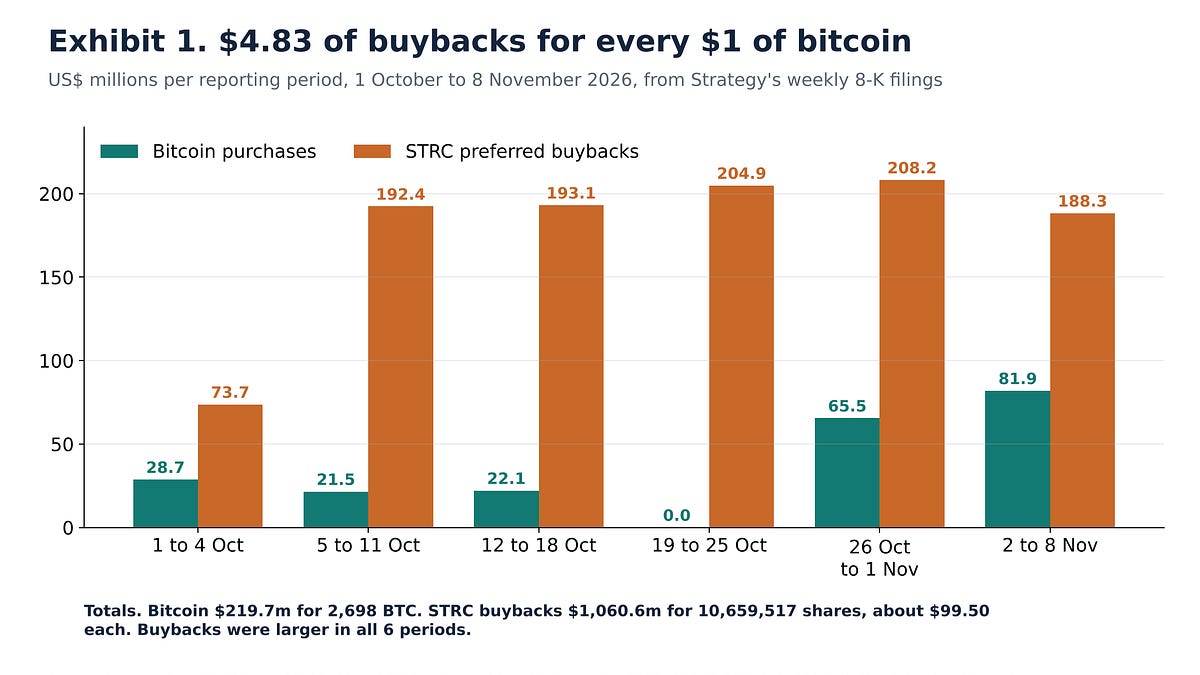
Strategy now spends $4.83 buying back its own preferred stock for every $1 on bitcoin. Its buyback limit runs out the week index funds sell.
From 1st October to 8th November, Strategy spent $4.83 buying back its own preferred stock for every $1 it spent on Bitcoin. Its weekly money from new shares fell 78 percent from the third quarter's pace, it sold no Bitcoin, and index funds are due to sell its shares on 30th November.
From 1st October to 8th November, Strategy spent $4.83 buying back its own preferred stock for every $1 it spent on Bitcoin. Its weekly money from new shares fell 78 percent from the third quarter's pace, it sold no Bitcoin, and index funds are due to sell its shares on 30th November.
Shanaka Anslem Perera - 17th November 2026
Chain of Custody PRO, Issue 02. A monthly letter on Bitcoin and Crypto.
Data as of 9.42pm on 16th November in Melbourne. Strategy’s weekly filings run to 8th November, and its filing for 9th to 15th November, due about when this issue goes out, is not included. Fund flows and Treasury yields run to 13th November. Every other figure carries its own date. Sections 01 to 03 are free. About 26 minutes to read.
01. The biggest buyer is buying something else
On 9th November, Strategy, the company formerly called MicroStrategy, told the US Securities and Exchange Commission (SEC) that it had raised $283.8 million in one week by selling 2,051,348 new common shares, ticker MSTR. $81.9 million of that bought 1,036 bitcoin. $188.3 million bought back STRC, the preferred stock Strategy sells to income investors with a 12 percent dividend and wants to trade near its $100 face value. The last $13.6 million went into cash.
That week fits the pattern. Across the 6 weekly filings that cover 1st October to 8th November, Strategy spent $1,060.6 million buying back STRC and $219.7 million buying bitcoin. That is $4.83 of buybacks for every $1 of coins, and the buybacks were larger in every one of the 6 reporting periods.
This is the next reading of the ledger Issue 01 started. Its point was that money raised from new shares is not the same as money spent on bitcoin. In the third quarter Strategy raised $5.41 billion from new common shares, and its weekly filings sent 9.5 percent of it straight to bitcoin. Since 1st October that proportion has risen to 40.7 percent, $206.1 million of $506.5 million. It rose because the raise collapsed. New share money fell from about $411 million a week in the third quarter to about $91 million a week since, a drop of 78 percent.
The coin count cuts the other way. Gross bitcoin buying fell much less, from about $44.7 million a week to about $39.4 million. And in the third quarter Strategy also sold 5,552 coins, so it added only 1,666 net, about 127 a week. Since 1st October it has sold none and added 2,698, about 484 a week. Net of sales, the stack is growing almost 4 times faster than it was in the third quarter.
Why the stack grows faster matters more than how fast. In the third quarter, Strategy’s quarterly report, the 10-Q, says coin sales paid for $239.9 million of preferred dividends and $108.6 million of STRC buybacks, although the weekly filings for 27th July to 9th August put $160.9 million of sale money into buybacks. The 10-Q’s $108.6 million equals the sale money of the week to 9th August alone, and I have not reconciled the other $52.3 million. Since 1st October about 82 percent of the buybacks have come out of a pool Strategy calls USD Cash instead, on my count, which includes 1 week whose filing names no source. That pool held $833.4 million on 4th October, after the first 4 days of buybacks, and $132.7 million on 1st November, after new share money had added $98.5 million to it that week. It rose to $146.2 million on 8th November because new share money paid for that week’s buybacks directly and topped the pool up. The cushion that took the place of coin sales has mostly been spent.
Permission is a separate limit. The board’s remaining room for preferred buybacks was $560.3 million on 8th November. At the 5-week average of $197.4 million a week, that would last about 3 more weeks, to around the end of November, unless the board raises it again, as it did in September and again in October. A higher limit is permission to spend. It is not money.
Then comes the index date. At the close on Monday 30th November, the index provider MSCI is due to delete Strategy from its MSCI USA index. Strategy’s own estimate, in its consultation response to MSCI, is that funds tracking MSCI’s indexes hold about 13 million of its shares, 3.1 percent of its basic shares at the time. At MSTR’s average volume over the 30 sessions to 13th November, that is about 72 percent of a day’s trading. If those funds sell, the sale moves shares from one owner to another. It does not require Strategy to sell a single coin. It can still weigh on the price of the stock Strategy sells to raise money.
Strategy’s 850,364 bitcoin cost $64.16 billion, an average of $75,456 each. At $64,502 on Coinbase’s BTC-USD market at 9.42pm Melbourne time on 16th November, they were worth about $54.9 billion, roughly $9.3 billion below cost. Bitcoin needs to rise 17.0 percent just to get back to Strategy’s average price.
So the question for the next 6 weeks is a narrow one. The coin sales stopped after the week to 9th August. Share sales paid for the rest of August’s buybacks and filled the cash pool that has paid for most of them since, and that pool is now thin. Once the pool’s last $146.2 million is gone, the next buyback dollar has to come mainly from new shares, from the reserve set aside for dividends, or from coin sales, unless Strategy decides to stop. That choice will shape whether the largest corporate holder of bitcoin is a buyer, a bystander or a seller into December.
02. The funds are not filling the gap yet
The daily buyers are leaving. US spot bitcoin exchange-traded funds (ETFs) had net outflows in all 7 sessions from 5th to 13th November, a total of $1.91 billion on Farside Investors’ daily table. BlackRock’s iShares Bitcoin Trust, ticker IBIT, accounted for $1.42 billion of it. November to the 13th is down $2.35 billion, more than the $1.89 billion of net outflows for 2026 as a whole to that date, because January to October brought in about $0.45 billion net. Since they launched in January 2024 their net inflows still total $54.7 billion. On the calendar-day basis of Strategy’s ledger, the 7 sessions’ outflows ran at about $1.48 billion a week, roughly 38 times Strategy’s $39.4 million a week of bitcoin buying.
These are estimates of net fund flows, not a list of sellers. In the September quarter 76.1 percent of the bitcoin IBIT took in, by value, arrived as coins rather than cash, from authorised participants, the broker-dealers that create and redeem its shares. On redemptions 76.3 percent of what it paid out left as coins too, according to its quarterly filing. A redemption can hand coins to a dealer without a sale on any exchange. What happens next is the dealer’s choice. What the table does show is that fund holders, on balance, are taking money out.
Rates have also moved against an asset with no income. The Federal Reserve kept its target range at 3.75 to 4.00 percent on 28th October, and 2 of its 12 voters wanted a rise. On 13th November the Treasury’s 10-year par yield was 5.15 percent, up from 4.88 percent on 9th November, and the 10-year inflation-protected Treasury yielded 2.91 percent. Bonds can lose value before they mature, but a near 3 percent real yield held to maturity is a high bar for an asset that pays nothing.
None of this shows that bitcoin has no buyers. Wallets that report nothing can be accumulating, and sellers can simply run out. I will watch the daily fund table and Strategy’s Monday filings for signs of a turn, while allowing that other buyers may move first.
03. The scorecard for Issue 01’s 2 calls
Issue 01 made 2 dated calls. One was right and one was wrong.
I put 65 percent on Strategy reporting at least 850,000 bitcoin in an 8-K, its current-event filing with the SEC, filed by the end of 2nd November, New York time. The 2nd November filing showed 849,327, short by 673. Strategy reached 850,364 in the 9th November filing, 7 days late. That call was wrong, and passing the mark later does not change the result.
I put 70 percent on an 8-K reporting shareholder approval of daily STRC dividends by the same deadline. The 28th October filing reported that the vote had passed on preliminary results, and the 29th October filing gave the count, 381,373,199 for and 2,236,551 against. That call was right.
The Brier score counts an outcome as 1 if it happened and 0 if it did not, and squares the gap between that and the probability, so 0 is perfect and lower is better. The 2 calls score 0.4225 and 0.09, an average of 0.256. That is slightly worse than the 0.25 anyone gets by always saying 50 percent. Two related calls about one company prove nothing either way. This issue makes 3 more, each with an exact rule for how it settles, and Issue 03 on 15th December scores calls 2 and 3 and updates call 1.
In the paid sections. Strategy’s 10-Q counts $36.8 million more of buybacks from 1st to 25th October than its weekly filings do. The paid section shows what that gap is, and why it does not shrink the buyback lead. It then gives my reading of the choice Strategy faces next. Once the cash cushion is gone, which of the 4 sources of the next buyback dollar does Strategy use, and what does each one mean for bitcoin and for MSTR? Also inside are the full ledger set against the third quarter and the mechanics of the 30th November index sale and of the listing of Anthropic, the artificial intelligence company, whose shares may join the index at the same close. So are the same bitcoin move run through a coin, a fund and MSTR, my 3 dated calls with their exact settlement rules, and a 1-page dashboard of what would change my mind.
04. The full ledger, and the $36.8 million that is not missing
Start with the gap, because it looks like an error and is not one. The 10-Q, reporting past the quarter’s end, says Strategy bought back 7,050,335 STRC shares for $700.9 million from 1st to 25th October. The 4 weekly filings for the same days add up to 6,680,018 shares for $664.1 million. The difference is 370,317 shares and $36.8 million.
A single line in the 10-Q points to the answer. On 30th September, $36.8 million was still payable for STRC shares that had been bought back but had not yet settled. The weekly filings appear to count a buyback on the day it is made, so those shares sit in the last September week. The 10-Q’s numbers put them in October, when the cash moved. The programme balances fit that reading. The weekly filing put the remaining room at $620.9 million on 30th September and the 10-Q put it at $657.6 million, $36.7 million apart. By 25th October the 2 documents agree, at $956.8 million and $956.7 million, because the 10-Q’s figure for that date counts buybacks made but not yet settled. The share counts close the loop. The 11 weekly periods from 20th July to 30th September report 14,300,490 STRC shares bought back, and the 10-Q puts 13,930,173 in the third quarter, the same 370,317 shares running the other way. Nothing is missing. It is the same trades counted on 2 dates.
This issue uses the weekly filings. On that basis the third quarter’s buybacks from 20th July were $1,379.1 million, and the 6 filings since 1st October total $1,060.6 million. On the 10-Q’s count, which moves those September trades into October, the 1st to 25th October figure is $36.8 million higher, so neither basis shrinks the buyback lead over bitcoin. One filing, for 5th to 11th October, names no source for its buybacks, but its USD Cash fell by $192.9 million, exactly the buybacks plus the $0.5 million of bitcoin it paid from USD Cash, so the 82 percent counts it as cash. In the week to 1st November new share money also added $98.5 million to the pool while it paid out $208.2 million, so part of that week’s cash came from new shares. Net of that refill, about 73 percent of the buybacks came from cash already in the pool.
The 10-Q also reads the third quarter differently from the weekly filings. It puts $588.1 million of the quarter’s $5.41 billion of share money into bitcoin, 10.9 percent, against the $512.4 million, 9.5 percent, that the weekly filings sent straight to coins. The other $4.82 billion went to what it calls other bitcoin treasury purposes, which it says means funding its dollar assets, buying back preferred stock and paying dividends and interest. The $75.7 million difference is one purchase. In the week of 14th to 20th September Strategy bought 950 bitcoin for $75.7 million with USD Cash. The 10-Q says USD Cash was funded mainly from common share sales, so the quarterly figure counts that purchase as share money and the weekly split does not. The conclusion of Issue 01 stands either way.