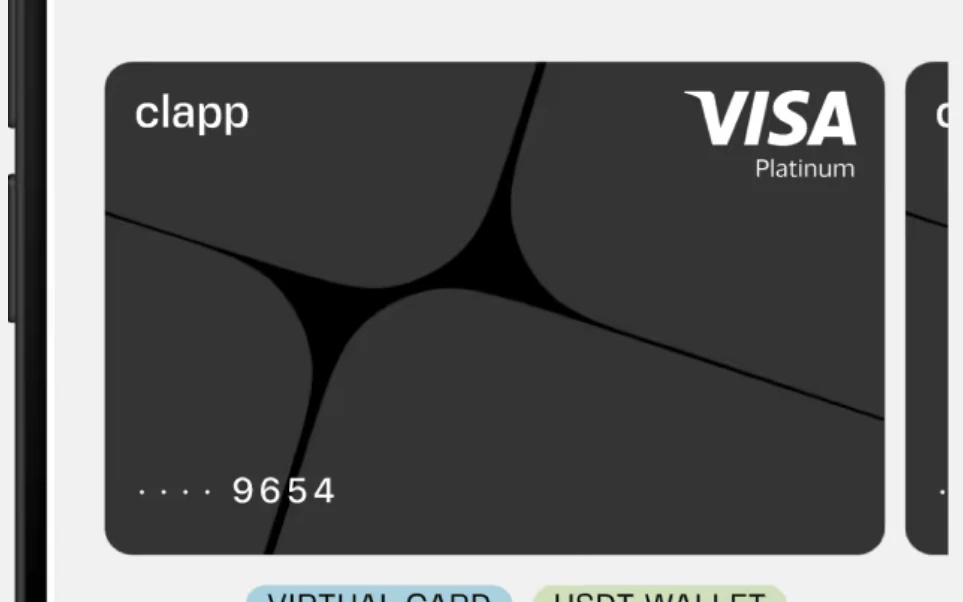
Clapp Finance has introduced a Visa card that settles purchases straight from a holder's USDT or USDC balance, converting the stablecoin to U.S. dollars at the moment of payment and paying the merchant in local currency. The one-time issuance fee is $9.99, currently discounted to $4.99, and Clapp levies no monthly card charge and no conversion fee of its own.
The product, called the Clapp Crypto Card, is issued as a virtual card inside the company's app, so online spending can begin immediately without waiting for plastic to arrive. Adding it to Apple Pay or Google Pay extends it to contactless terminals at Visa merchants. Clapp says the card is accepted in more than 150 countries, both online and in person.
At checkout, the card pulls from the user's stablecoin balance, converts the amount to dollars and settles with the merchant in their local currency. That removes the step of selling coins on an exchange or topping up a separate account before making an ordinary purchase, and it means merchants never have to handle crypto themselves.
Clapp's "0% transaction fees" claim covers only its own conversion charge and the monthly card fee. The company acknowledges that standard Visa network and payment processor fees may still apply depending on the transaction, so the all-in cost of any given payment depends on third-party charges.
Holders can set adjustable spending limits, freeze and unfreeze the card instantly, and approve online payments with a one-time password. Clapp positions those controls for cases such as subscription renewals, where a limit set just above the expected charge caps what a merchant can collect if terms change. The card also carries Visa Platinum benefits, including extended warranty coverage on eligible purchases and 180 days of shopping protection.
The card sits alongside Clapp's wallet, exchange, Savings and staking products, and multi-collateral credit lines that let users borrow against holdings without selling them, all within a single app.
Stablecoin-linked cards are proliferating. Visa counted more than 160 such programs by October 2026, and figures cited by the venture firm a16z put monthly crypto card spending, mostly in USDT and USDC, at roughly $759 million in July, about 2.5 times the year-earlier level.
Note: Fee and coverage details are from Clapp Finance; program counts are from Visa and spending data from a16z.
USDC traded at $1.00 with a market capitalization of $69.00 billion and 24-hour volume of $15.54 billion, according to CoinPaprika data timestamped Nov. 23, 2026, at 20:16 UTC. The card's economics rest on that peg holding, since conversions occur at the point of sale.
For the market, the launch adds another entrant to a segment where the competitive question is shifting from whether stablecoins can be spent to what that spending actually costs. Clapp's pitch is simplicity: a single low issuance charge and no subscription, which compares favorably with recurring-fee models for frequent users, though the effective cost of each transaction still hinges on network and processor charges that Clapp does not control. The next test is adoption beyond Clapp's existing user base and how its all-in pricing stacks up against rival programs once those fees are counted. The company advises users to check spending limits and availability country by country.
Clapp markets the card with a "no KYC" tagline, a positioning that sits awkwardly beside rules in India, where exchanges serving local users must register with FIU-IND as reporting entities and virtual digital asset gains are taxed at a flat 30% under Section 115BBH, with 1% tax deducted at source on transfers under Section 194S. Spending USDT through an offshore card does not discharge those obligations, and losses cannot be offset against other income.
Once added, BigGo Finance appears first in Google Search Top Stories, so you get the broadest, most up-to-the-minute, and most comprehensive global financial news first.