U.S., EU and Japan Focus on Fit-and-Proper Tests for Major Shareholders
The government is pushing a plan to cap major shareholders' stakes in virtual asset exchanges at 20%, prompting criticism that the measure would be excessive regulation. Major economies, including the United States, the European Union (EU) and Japan, oversee exchange governance primarily through fit-and-proper tests for major shareholders.
On November 24, the Financial Services Commission (FSC) released a draft Digital Asset Basic Act and outlined ownership-dispersion standards aimed at ensuring exchanges' public responsibility and neutrality. Under the government proposal, the ownership limit for shares in digital asset platform operators (exchanges) would generally be set at 20%. With FSC approval, the limit could rise to 34%. Voting rights on shares exceeding the limit would be restricted, with a three-year grace period. Small and midsize exchanges could receive an additional grace period of up to six years.
The financial authorities argue that ownership-dispersion rules are needed to ensure public responsibility and neutrality, since exchanges perform core market functions such as approving assets for trading, executing trades and monitoring suspicious transactions. The proposal would therefore apply shareholding restrictions similar to those imposed on alternative trading systems (ATS) in the capital market.
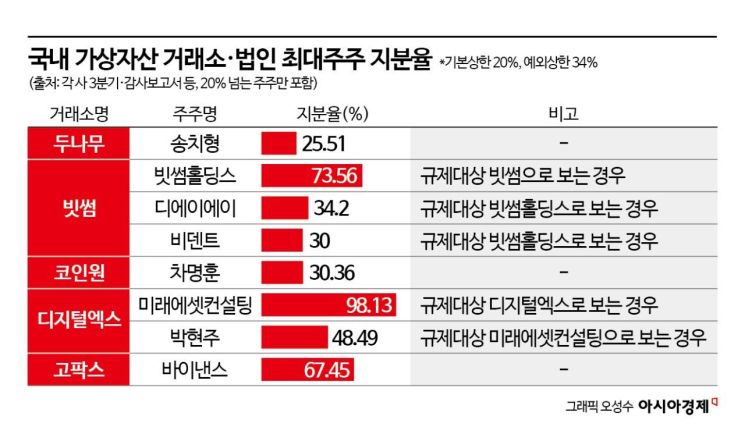
If the government proposal takes effect, the governance structures of major domestic exchanges are also expected to change. The largest shareholders of all five of South Korea's major won-based exchanges (Upbit, Bithumb, Coinone, Digital X and GOPAX) hold stakes exceeding the 20% limit generally set out in the proposal.
However, regulatory frameworks in other major economies differ. The United States, the EU and Japan oversee the soundness of virtual asset exchange operators through assessments of major shareholders' fitness and reviews of changes in control. The EU has established a licensing and supervisory framework for crypto-asset service providers (CASPs) under the Markets in Crypto-Assets Regulation (MiCA). MiCA assesses the reputation and financial soundness of major shareholders holding at least 10% of a company's shares, and requires regulatory review when shareholdings above a certain threshold are acquired or control changes.
New York State's BitLicense, a licensing system for virtual currency businesses, also focuses on reviews of the fitness of major shareholders and executives, as well as changes in control. It verifies information on an operator's governance structure and major shareholders, and oversees certain changes in ownership and control.
Japan also operates a registration and supervisory system for virtual asset exchange service providers. It assesses operators' financial foundations, ability to conduct business and internal control systems, but does not impose a uniform limit on major shareholders' ownership stakes.
Hot Picks Today
- The Era of Getting 200 Million Won After 30 Years Is Over... A Japanese Bank's "Perpetual Department Head" Who Just Clocked In Cries Out
- Spain Hit by Its Worst Tragedy... Lee Kangin, Moreno and Real Madrid Join Soccer World in Mourning
- They Said, “Make It Your Home for Life” - Then Suddenly Kicked 200 Passengers Off... What Happened to the Around-the-World Cruise?
- "130 Rice Bowls Sold Out in a Day"... 'Unfiltered Face' Adds 8 Million Won to Night Market Sales: China's Bungeunwoo
An industry official said, "While major economies such as the United States and Europe oversee exchanges through fit-and-proper tests for major shareholders, South Korea is pursuing regulations that directly limit the size of their stakes. If a uniform ownership cap is also imposed on domestic operators in a digital asset market where competition crosses borders, it could constrain investment and business expansion. In the long term, it could further widen the competitiveness gap between domestic companies and global operators."
© The Asia Business Daily. All rights reserved. Unauthorized AI training and use prohibited.