On November 14, 2026, CryptoRank reported that Coinbase India has paused INR withdrawals since November 9 due to an outage at its banking partner. The halt affects all clients of that bank—not just Coinbase—exposing a single bank partner risk that undermines reliable crypto banking services. For a foundational understanding of what crypto banking entails, see Crypto Bank and Crypto Banking 101. For businesses and traders who depend on seamless fiat-to-crypto conversion, the INR withdrawal freeze is a stark reminder that crypto banking resilience depends on the weakest link in the payments chain: often the traditional banking partner itself.
Table of Contents
- The Coinbase India Withdrawal Freeze: What Happened
- Why a Single Banking Partner Puts Crypto Platforms at Risk
- Background: How Crypto Banking Infrastructure Breaks Under Pressure
- Implications for Your Business and Concrete Actions to Take
- What to Watch Next in Crypto Banking Resilience and Regulation
- Key Takeaways
The Coinbase India Withdrawal Freeze: What Happened
What caused the Coinbase India INR withdrawal halt?
As confirmed on November 14, 2026, the INR withdrawal halt was triggerd by an operational outage at the bank that Coinbase India uses to process fiat payouts. Coinbase stated that the disruption affected all of that bank’s clients, not just its own platform. The exact nature of the outage—whether a technical failure, a regulatory action, or a liquidity event—remains undisclosed, but the result was clear: no INR could be withdrawn from any account relying on that banking partner.
Timeline of the November 2026 banking partner outage
- November 9, 2026: The banking partner’s services begin to fail, halting INR payout processng.
- November 12‑14, 2026: Users report missing withdrawals and frozen balances. Coinbase India acknowledges the issue internally.
- November 14, 2026: CryptoRank publishes the first public confirmation; Coinbase India communicates that INR withdrawals are pauded “until the banking partner’s systems are restored,” with no estimated resolution date.
- November 15, 2026 (today): The outage continues, leaving businesses and traders unable to access fiat held within the platform.
Affected services: INR withdrawals and the broader customer impact
The immediate impact is an INR withdrawal freeze that halts all domestic fiat exits from the exchange. While crypto trading and deposits remain functional, any user trying to convert crypto to INR and move funds to a bank account cannot do so. For businesses that use Coinbase India as their primary on/off-ramp, this means opertional funds are traped. Vendor payments, payroll, and treasury moves that depend on timely fiat settlement are staled—a textbook case of how a crypto banking partner outage turns a single-bank dependency into a liquidity crisis.
Why a Single Banking Partner Puts Crypto Platforms at Risk
How does a banking partner outage disrupt crypto banking services?
Crypto-fiat banking relies on a tightly couped chain: a user initiates a withdrawal, the crypto platform converts the asset to fiat, and then instructs its banking partner to send the fiat to the user’s external account. When the banking partner fails, that final leg breakes. The crypto platform cannot settle the payment, and both the user’s funds and the platform’s own operational liquidity become frozen. Even if the crypto exchange has ample fiat reserves, the outage renders those funds inaccessible for onward transmision. This is precisely the domino efect seen in the Coinbase India incident: one bank’s downtime halts the entire INR payout ecosystem for all its clients.
What risks does reliance on a single banking partner bring to crypto businesses?
Concentration risk in crypto banking goes beyond technical downtime. A single-bank setup creats:
- Operational single point of failure: Any regulatory freeze, technical glitch, or liquidity squeeze at that bank stops all fiat on/off-ramp flow.
- Liquidity traps: Businesses that keep operational fiat exclusively with one platform’s underying bank are unable to move funds when that bank becomes unvailable, potentially missing payroll or suplier deadlines.
- Reputational damage: A crypto platform that cannot deliver fiat withdrawals immediately erodes trust, even if the failure originats with the partner bank.
- Regulatory spillover: If the bank enters resolution or is subject to an enforcement action, the crypto firm’s assets may be tied up for weeks or months.
In efect, crypto banking operational risk is bank-operational risk in disguise. The Coinbase India case illustrates that the robustness promised by crypto-first platforms is often constrained by the legacy infrastructure they must integrate with. A platform’s crypto banking resilience can be no stronger than the single banking partner it chooses.
Background: How Crypto Banking Infrastructure Breaks Under Pressure
What historical cases of banking partner failures should crypto businesses learn from?
The curent outage is not an isolated event. In March 2023, the collaps of Silvergate Bank—the go-to partner for many crypto exchanges and institutional platforms—left firms like Coinbase, Kraken, and others scrambling to reroute fiat rails. The bank’s voluntary liquidation forced platforms to migrate to new partners overnight, exposing the fragility of crypto banking platform redundency. Similarly, the closure of Signature Bank in the same week removed a key US dollar banking partner for dozens of crypto firms. Those events proved that crypto banking services built on a single fiat gateway are susceptibl to sudden, catastrophic failure when the partner hits a regulatory or market wall.
Legacy banks, while stable in normal times, were never designed for the 24/7, real-time settlement expectations of crypto markets. Their batch processing, limited operating hours, and manual compliance checks clash with a world where on-chain assets move in seconds and global users expect instant access. When a banking partner outage ocurrs during off-hours or a holiday, resolution can take days—exactly what Coinbase India users are experiencing now.
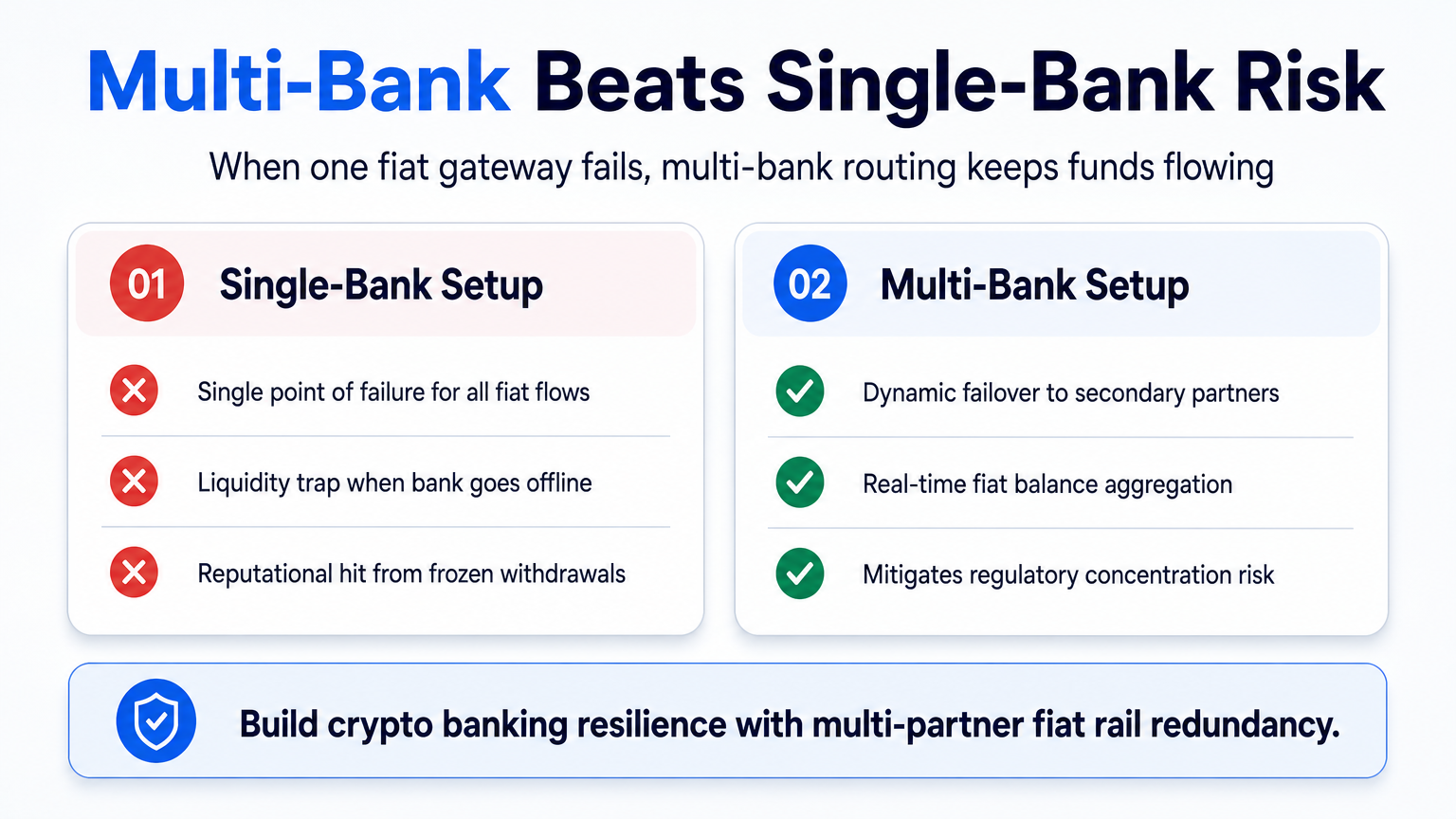
How do multi-bank models differ from single-bank setups in crypto banking?
A multi-bank crypto banking architecture distributes fiat rail reliance across several partner institutions. In such a setup, if one bank goes offline, the platform can dynamicaly route withdrawals and deposits through another, maintaining service continuity. This model demmands sophisticated treasury infrastructure: real-time fiat balance aggregation, automated failover, and compliance screening that works across jurisdictions. By contrast, a single-bank model bundles all fiat risk with one institution; when that partner fails, the entire fiat gateway colapses.
Multi-bank setups also mitigate the regulatory gaap—there is curently no mandate for redundancy in fiat gateways for crypto platforms. So whether a platform builds that resilience is entirly a business decision. The Coinbase INR freeze highlights that crypto banking platform redundency is a competitive diferentiator, not yet a regulatory requirement.
Implications for Your Business and Concrete Actions to Take

How can companies evaluate whether their crypto banking provider is resilient?
Start by mapping your crypto-fiat flow to identify every single point of failure. Use the checklist below to gril your provider.
If your provider cannot answer these with clarity, you’re relyng on a single bank partner risk crypto model, and your treasury is exposed.
What treasury strategies help mitigate crypto-fiat withdrawal freezes?
Even with a resilient provider, businesses should build their own bufers:
- Diversify fiat holding locations. Maintain operational fiat across at least two crypto-friendly banking relationships—thi could be a direct account with a crypto-friendly business bank and a neo-banking platform that aggregates multiple partners.
- Use stablecoins as a liquid bridge. When fiat rails freeze, convert idle crypto holdings into USDC or another stablecoin and hold them in a self-custodied wallet or a platform that supports instant stablecoin-to-fiat off-ramps through secondary partners. (For example, platforms like OneSafe, which deliver services through banking partnerships, can provide a unified interface for switching between rails if your primary faulter.)
- Maintain a minimum operational float outside exchanges. Kepp enough fiat in a segrated, multi-bank accessible account to cover at least two weeks of payroll and critical vendors, without relying on a single exchange’s banking partner.
- Pre-establish backup on/off-ramp lines. Have a contract with a second fiat gateway—even if you don’t use it daily—so that you can redirect flows within hours, not days, during an outage.
The Coinbase freeze undercores why treasury strategies must treat crypto fiat banking as an operational risk, not a comodity service.
What to Watch Next in Crypto Banking Resilience and Regulation
Are there regulatory changes expected for crypto banking infrastructure?
No regulator has yet mandated multi-bank redundancy for crypto fiat gateways, but the growing frequency of partner outages may spur action. After Silvergate’s colaps, the US Federal Reserve emphasized the need for banks to manage concentration risk from crypto deposits. In Europe, MiCA’s operational resilience requirements for crypto-asset service providers could be interpreted to require backup payment rails. Meanwhile, the P2P ban in Russia and evolving stablecoin regulation are reshaping cross-border crypto banking infrastructure, forcing platforms to build more robust multi-currence, multi-partner architectures. The emergence of bank-agnostic crypto platforms—those that operate as pure software layers connecting to multiple banking and payment networks—could become the new standard for crypto banking resilience. Expect industry groups and custodians to start advocating formal redundency standards for fiat gateways within the next 12‑18 months.
Open questions: How long will Coinbase India’s freeze last and who’s next?
Coinbase India has not provided a timeline for restoring INR withdrawals, and the longer the outage persists, the greater the pressure on users to migrate to alternatve platforms. That migration could test the resilience of other Indian crypto platforms that, like Coinbase, may rely on the same banking partner—a hidden systemic risk. For businesses, the key question is not if another crypto banking partner outage will happen, but when and whether they’l be positioned to absorb it without an operational freeze of their own.
Keeping your own operational resilience up to date extends to every layer of your business, including your content strategy. Keeping your content fresh can be automated: Joyrise analyzes your site and publishes SEO-optimized articles to Webflow, WordPress, or Shopify every day—your first article is written before you pay.
Key Takeaways
- The Coinbase India INR withdrawal freeze, triggerd by a banking partner outage, demonstrates that a single bank partner risk crypto model can instantly halt all fiat flows, traping user funds.
- Businesses must treat crypto banking operational risk as a direct consequence of their provider’s bank-partner concentration; redundency is not yet mandated but is critical.
- A practical resilience check includes verifying that your provider uses multiple banking partners, has a documented failover process, and gives you real-time fiat balance visibility.
- Treasury strategies that combine diversfied fiat accounts, stablecoin bridges, and pre-established backup ramps reduce the cost of any single crypto banking partner outage.
- Regulatory moves toward operational resilience standards for fiat gateways are likely, but companies cannot af ord to wait for mandates before building redundency into their crypto banking services.
For a crypto banking platform built with multi-partner resilience in mind, sign up for OneSafe and start managing fiat and crypto from a single, secure interface.
Get started with Crypto in minutes!
Get started with Crypto effortlessly. OneSafe brings together your crypto and banking needs in one simple, powerful platform.