The $6.3 billion Binance hack has turned a market-share story into an operational-risk test for crypto banking. On November 5, 2026, TradingView/Cointelegraph reported that Federal Reserve and Office of the Comptroller of the Currency officials began contacting banks on November 2, 2026, to ask about unusual activity and service disruptions tied to crypto exposures. For founders and finance leads who run a business crypto account and depend on crypto to fiat conversion rails, the immediate question is not whether Binance recovers the funds, but whether their own banking and custody partners can withstand the same scrutiny.
Table of Contents
- What just happened: The Binance hack and regulatory response
- Why this matters for crypto banking customers now
- The background: How crypto banking has handled security until now
- What founders and finance leads should do next
- What to watch: The regulatory path forward for crypto banking
- Key Questions Answered
- Key Takeaways
What just happened: The Binance hack and regulatory response
The $6.3 billion breach and immediate bank assessments
The Binance hack 2026 entered the mainstream financial conversation on October 29, 2026, when The Guardian reported that North Korea was the likely culprit behind the $6.3 billion crypto hack. The following day, CNBC reported that roughly $6.3 billion was stolen and about $3 billion had been frozen.
The breach hit an exchange, not a bank. But it became a banking issue quickly. According to the TradingView/Cointelegraph report on November 5, 2026, banks began assessing the hack and checking their systems to determine whether they could absorb or manage similar threats. One cybersecurity team at a large US bank contacted Binance within hours of the hack, the same report noted. For an immediate read on the response, see Binance Heist Shakes Crypto Banking.
Fed and OCC contacts with banks about unusual activity
On November 5, 2026, TradingView/Cointelegraph reported that officials from the Federal Reserve and the Office of the Comptroller of the Currency began contacting banks on Monday, November 2, 2026, to ask about “unusual activity” or service disruptions. The outreach was cited to Reuters, using people familiar with the matter.
Stefan Muehlbauer, head of US government affairs at CertiK, told Cointelegraph that after an incident of this scale, it would be surprising if the Fed and OCC did not check in with supervised banks. His stated rationale: the regulators’ mandate is to protect the financial system, which means understanding where exposures sit and how quickly institutions can respond.
Why this matters for crypto banking customers now
Heightened oversight means stricter bank policies for crypto businesses
The Fed crypto oversight signal is not a formal rule yet, but supervisory inquiries usually precede tighter expectations. Banks may ask more questions about counterparty exposure, require additional documentation from crypto clients, or restrict certain transaction types while they reassess risk. Founders should not expect account freezes tomorrow, but they should expect longer due diligence and more frequent reviews.
The practical effect is that a business crypto account becomes harder to maintain if the provider cannot clearly explain its bank relationships, custody model, and incident response. This is not a temporary public-relations issue; it is the start of a review cycle that tends to produce written guidance later. For a deeper look at the risk channels, see What the Binance Hack Means for Crypto Banking.
The hack exposes security weaknesses that could affect client funds
The crypto banking security question is no longer theoretical. Binance is an exchange, not a banking platform, but the incident forces a harder look at every provider that touches fiat and crypto rails. The relevant risk is not direct exposure to Binance; it is whether a platform uses custody infrastructure that can survive a similar attack or insider failure.
If a provider holds assets in a single hot wallet, lacks mandatory multi-factor authentication, or cannot segregate client funds from operating capital, the bank partner being solvent does not protect the client. A business crypto account is only as resilient as its weakest custody, conversion, or authentication layer.
The background: How crypto banking has handled security until now
From basic custody to institutional-grade protections (Fireblocks, MPC)
A few years ago, crypto custody for many non-bank platforms meant an exchange wallet bolted onto a business account. The operational floor has since risen. Multi-party computation (MPC) now spreads signing authority across multiple parties so no single key controls an asset. Fireblocks is one widely used custodial infrastructure provider that lets platforms enforce policy controls, approve or block transactions, and keep keys out of a single hot wallet.
This does not eliminate risk. It changes the risk from “single key theft” to “policy and insider risk.” A platform can still be compromised through weak governance, poor role design, or human error. The custody stack matters, but so does the operating discipline around it.
The unique challenge for DAOs and startups managing fiat-crypto treasuries
DAOs and Web3 startups often hold treasury in stablecoins for payroll and contractor payments, then convert to fiat for tax, rent, or vendor costs. The challenge is not just custody; it is operational continuity. If a crypto to fiat conversion rail pauses or a bank closes the account, the organization may be unable to meet payroll that week.
DAO banking adds governance complexity. A multisig requiring three of five signers can be slow; a centralized business account is faster but creates a single point of failure. The answer is not to eliminate centralization, but to make it redundant, observable, and bound by permission controls.
What founders and finance leads should do next
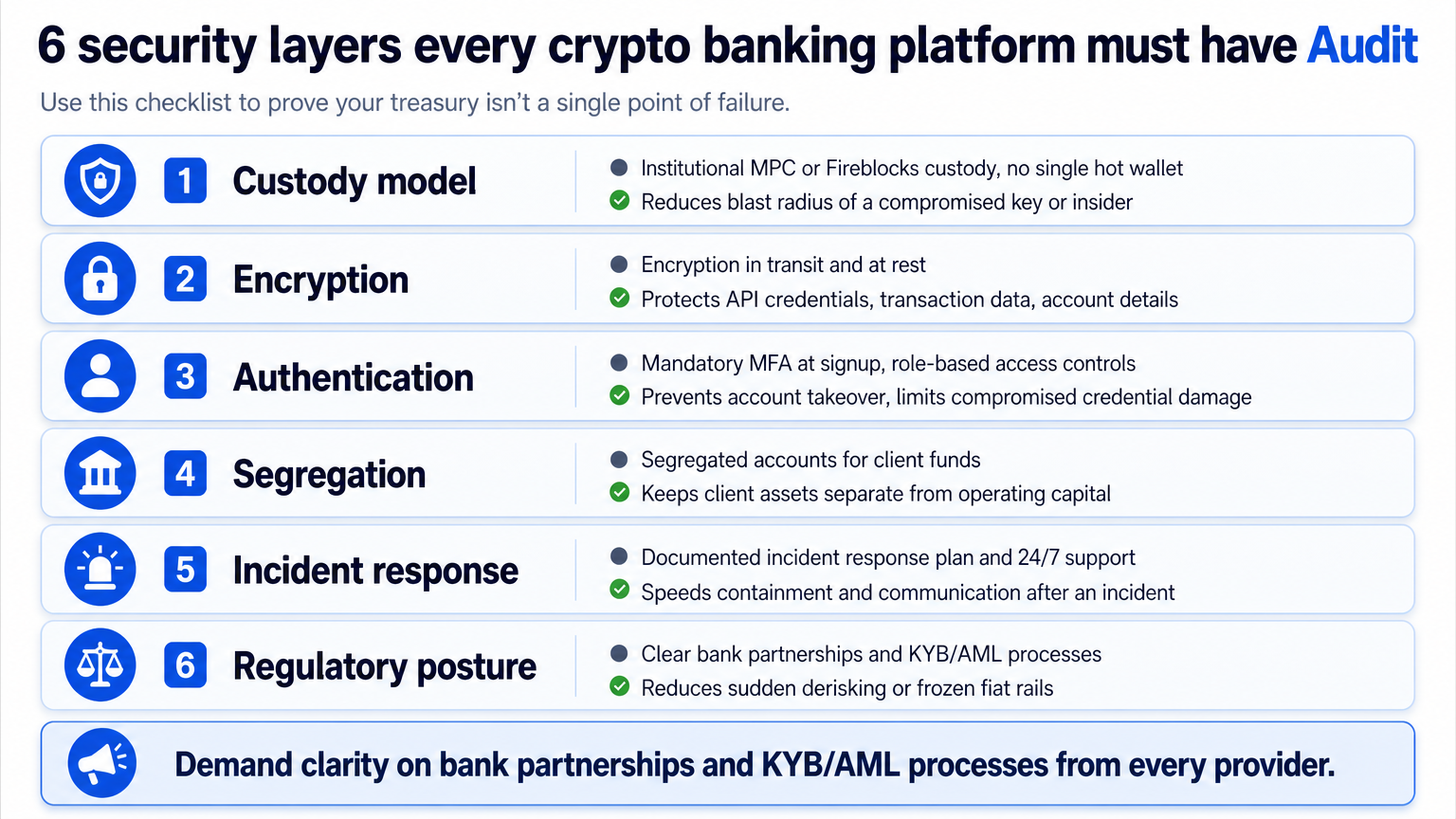
The framework below is a working checklist for finance leads who need to prove to a board—and to a bank partner—that the treasury is not a single point of failure.
Audit your banking platform’s security stack (custody, encryption, MFA)
Audit the custody model, not just the brand name. The table below is a minimum standard, not a nice-to-have.
OneSafe, for example, discloses Fireblocks-based custody and mandatory MFA at signup; it describes itself as a neobanking platform rather than a licensed bank, with banking services delivered by partners. That kind of clarity is exactly what founders should demand from every provider.
Ask banks or platforms about regulatory readiness and incident response
Do not accept “we are secure” as an answer. Ask for written answers to three questions: Which bank partner holds fiat deposits? What happens to crypto assets if the platform stops operating? Who is responsible when a conversion fails during market volatility?
The last question matters because many platforms route crypto to fiat conversion through exchange partners, and a pause at that partner can strand funds. Founders should also ask whether the provider can share an incident response runbook, or at least describe the last tabletop exercise.
Diversify treasury with segregated accounts and stablecoin reserves
No single account should hold 100% of operating cash. A practical split: operating fiat for payroll and vendors, a segregated reserve for taxes and legal, and a stablecoin reserve for crypto-native payments. Stablecoins are not risk-free—they carry issuer, depegging, and custody risk—but they let the treasury move value without waiting on a wire. For a detailed playbook, see Stablecoin Payments After the $6B Binance Incident. The point is not to abandon crypto banking; it is to make sure one frozen rail cannot stop the business.
What to watch: The regulatory path forward for crypto banking
Potential new guidance on crypto custody and bank exposures
The FDIC’s 2025 financial institution letter clarified the process for banks to engage in crypto-related activities, but it did not settle the supervisory treatment of non-bank platforms that rely on bank partners. If the Fed and OCC follow informal inquiries with written guidance, expect more specific expectations on custody segregation, counterparty exposure limits, and incident response.
The stablecoin and SEC tracks are part of the same trend. The GENIUS Act Stablecoin Regulation: A Compliance Guide and DeFi Compliance: SEC Guidance Shapes 2026 Landscape map the compliance terrain. The key point for operators: a non-bank crypto platform is only as stable as its bank partner relationships and its regulator’s tolerance.
Open questions: insurance, consumer protection, cross-border coordination
The Binance hack 2026 leaves four open questions. First, whether crypto asset insurance can cover non-bank custodial infrastructure losses; most policies are narrow and exclusions are wide. Second, whether consumer and business protections will extend to non-bank crypto platforms. Third, whether US regulators coordinate with overseas supervisors on a cross-border incident. Fourth, whether stablecoin reserves receive clearer reserve and redemption rules. None of these have been answered by the current Fed/OCC outreach; they are likely the next chapters.
For operators who want this analysis produced continuously on their own site, Joyrise plans, writes and publishes illustrated SEO articles to your Webflow blog every day.
Key Questions Answered
What happened with the Binance hack and bank inquiries?
On October 29–30, 2026, The Guardian and CNBC reported the hack and frozen funds. On November 2, 2026, Fed and OCC officials began contacting banks about unusual activity or service disruptions, as reported by TradingView/Cointelegraph on November 5, 2026. The inquiries are supervisory, not enforcement actions, but they signal closer scrutiny of crypto-related bank exposures.
How does this affect businesses using crypto banking?
Banks may tighten due diligence and impose more controls on crypto clients, making business crypto account approval slower and ongoing monitoring more frequent. The operational risk is not Binance itself, but the possibility that a bank or conversion partner pauses service during a stress event.
What security measures should a crypto banking platform have?
At minimum: institutional-grade custody through MPC or Fireblocks-style infrastructure, encryption in transit and at rest, mandatory MFA, segregated client accounts, documented incident response, and clear bank partner relationships. The checklist table above is the working standard.
How can DAOs protect their funds?
DAOs should use role-based permissions and multisig governance for treasury moves, maintain segregated operating and reserve accounts, hold stablecoin and fiat reserves with different counterparties, and rehearse a contingency plan for a frozen bank or conversion rail.
What regulatory changes might come?
Formal guidance on crypto custody and bank exposures, clearer insurance or reserve requirements, coordinated cross-border incident response, and potentially stricter stablecoin redemption rules. The Fed/OCC outreach on November 2, 2026 is the earliest signal, not the final rule.
Key Takeaways
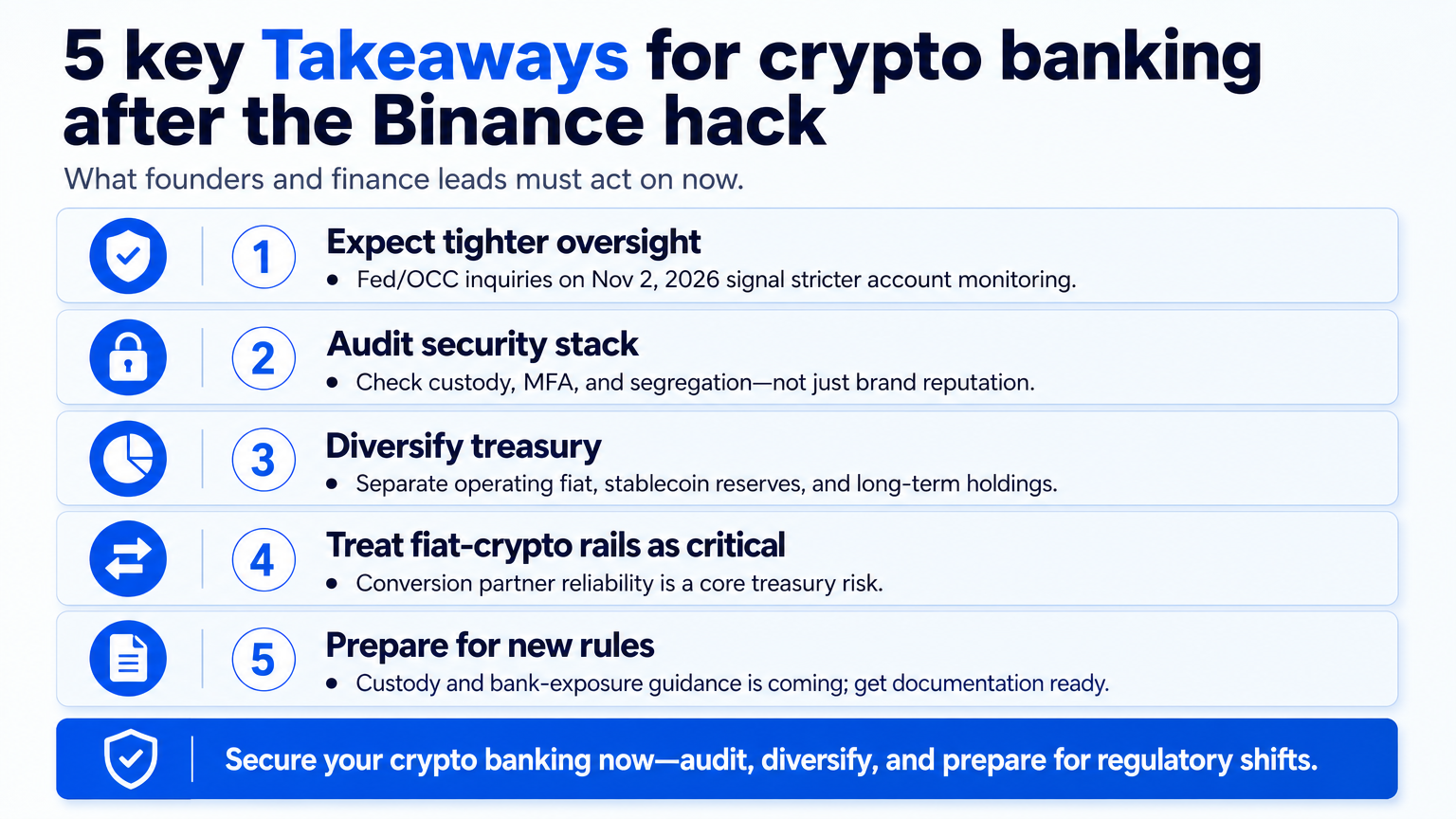
- The $6.3 billion Binance hack is an exchange incident, but bank supervisor inquiries on November 2, 2026 mean crypto banking clients should expect stricter account monitoring.
- Audit custody architecture, mandatory MFA, and segregated accounts—not just brand reputation—before choosing a crypto banking provider.
- Keep operating fiat, stablecoin reserves, and long-term holdings separate so a frozen bank or conversion rail cannot stop payroll.
- Treat crypto to fiat conversion and bank partner reliability as core treasury risks, not secondary operations.
- The regulatory path likely includes more specific custody and bank-exposure guidance, so prepare documentation now.
If you need a neobanking platform that combines multi-currency fiat accounts with Fireblocks-backed crypto custody for startups and DAOs, sign up at OneSafe.
Get started with Crypto in minutes!
Get started with Crypto effortlessly. OneSafe brings together your crypto and banking needs in one simple, powerful platform.