A founder comparing crypto business setup proposals needs to know what the quoted price will deliver. One proposal may cover company incorporation and documents. Another may include work on a licence application. Both can leave banking, compliance systems and continuing administration to be priced separately.
The first question is therefore what the business needs to operate in its intended markets. Once that is clear, the founder can compare the professional work, outside costs and ongoing commitments against the same scope.
Start with the services and customer markets
Describe what the business will actually do: exchange, transfers, custody, trading or providing a technology platform. Explain how money and crypto-assets move, who controls assets or private keys, and which entities sign the customer contracts. List the countries where customers will be based and where the business plans to market its services.
A founder comparing Panama and Costa Rica, for example, needs a written assessment of the proposed activities and customer markets before selecting a company structure. The assessment should identify the applicable requirements and explain the limits of the proposed arrangement. Incorporation alone does not establish permission to provide every service in every customer market.
Founders researching VASP licensing costs should ask which part of the proposal concerns company formation, which concerns regulatory analysis and whether a licence, registration or authorisation application is actually included or required. Each deliverable needs a clear description.
What does the professional fee buy?
Fast Offshore Licenses gives an indicative range of US$5,000–10,000 for its support, depending on the services selected. The written proposal should specify the work covered and identify which official fees, third-party charges and continuing costs are included or payable separately.
A package may bring together incorporation, anti-money-laundering documents, assistance with account applications and a legal opinion on the proposed structure. Ask for the deliverable and responsible person for each item. A legal opinion should explain the facts and activities it assesses, the law it relies on and any limits to its conclusions. Account-opening assistance should state what the adviser will do and which decisions belong to the account provider.
Founders who want one point of contact should also ask how local partners are managed. Who collects the documents? Who answers questions from the registry or service provider? Who resolves a gap between the quoted scope and the work needed? A coordinated service is easier to assess when responsibilities and handovers are written down.
Build one first-year budget
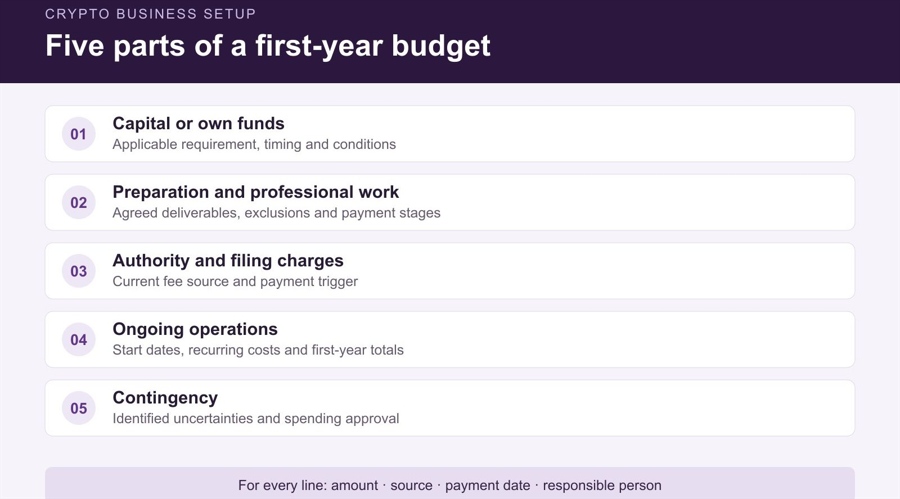
Put the professional fee into a wider cash plan. Use one reporting currency, show tax separately and specify the twelve-month period covered. Each line should have an amount or range, a source, a payment date and a responsible person.
Use five sections:
· Capital or own funds. Record any applicable requirement separately from spending, including its calculation, timing and conditions for maintaining or using the funds.
· Preparation and professional work. List incorporation, assessments, documents and application support within the agreed scope. State exclusions and the information the client must supply.
· Authority and filing charges. Identify any relevant official fees, the source of each amount and when payment becomes due. Mark a charge as not applicable only after checking the chosen route.
· Ongoing operations. Budget for the people, administration, accounting, compliance systems and other services the actual business needs. Record start dates and recurring charges.
· Contingency. Agree an allowance for identified uncertainties, the circumstances in which it can be used and who approves spending it.
Capital and operating expenditure serve different purposes. Ask the adviser to explain any restrictions on funds counted towards a regulatory requirement. The cash plan should avoid counting the same money twice.
Review recurring costs month by month. If a monitoring supplier starts billing during preparation and launch is delayed, the business may incur costs before it earns customer revenue. Include that period in the forecast.
Put responsibilities beside the timeline
Agree which documents the founders must provide, who prepares the remaining material and who checks it. Typical planning inputs include ownership records, management information, a product description, transaction flows and details of the intended customers.
Separate the preparation schedule from any authority review and from banking or payment-provider onboarding. Ask which tasks can proceed together, which depend on earlier decisions and what happens if a provider requests more information or declines the application.
Before paying a deposit, identify the deliverable it funds, the trigger for the next payment and the price of additional work. The proposal should also explain who handles follow-up questions and whether that work is included. A preparation estimate needs stated assumptions; an adviser cannot control every third-party decision.
Leave the consultation with a comparable scope
Before selecting a crypto licensing route, ask for a short written record of the services and markets assessed, the proposed structure, outstanding questions, deliverables and first-year budget assumptions.
This gives the founder a practical basis for comparing proposals. It also shows what the team still needs to decide before committing money to the next stage.
Fast Offshore Licenses offers a free initial consultation. Contact Mark Paat at [email protected] with a short description of the planned services, customer countries, existing company and intended launch window.
Fast Offshore Licenses is operated by Corporate Representation Ltd. This article sets out a budgeting approach; the requirements for a particular business depend on its activities, markets and applicable rules.