Kalshi raised $1B in October, and crypto companies raised $651M across the rest of that month’s disclosed venture rounds. That remainder alone exceeded the $435M in November’s financing data. The October fundraising recap traced the rebound to a handful of large deals. November’s decline also reached beyond the biggest cheques.
The comparison covers venture capital raised by operating companies. Listed-company equity financings, which accounted for a separate $853M in October, sit outside both months’ venture totals.
Fundraising activity
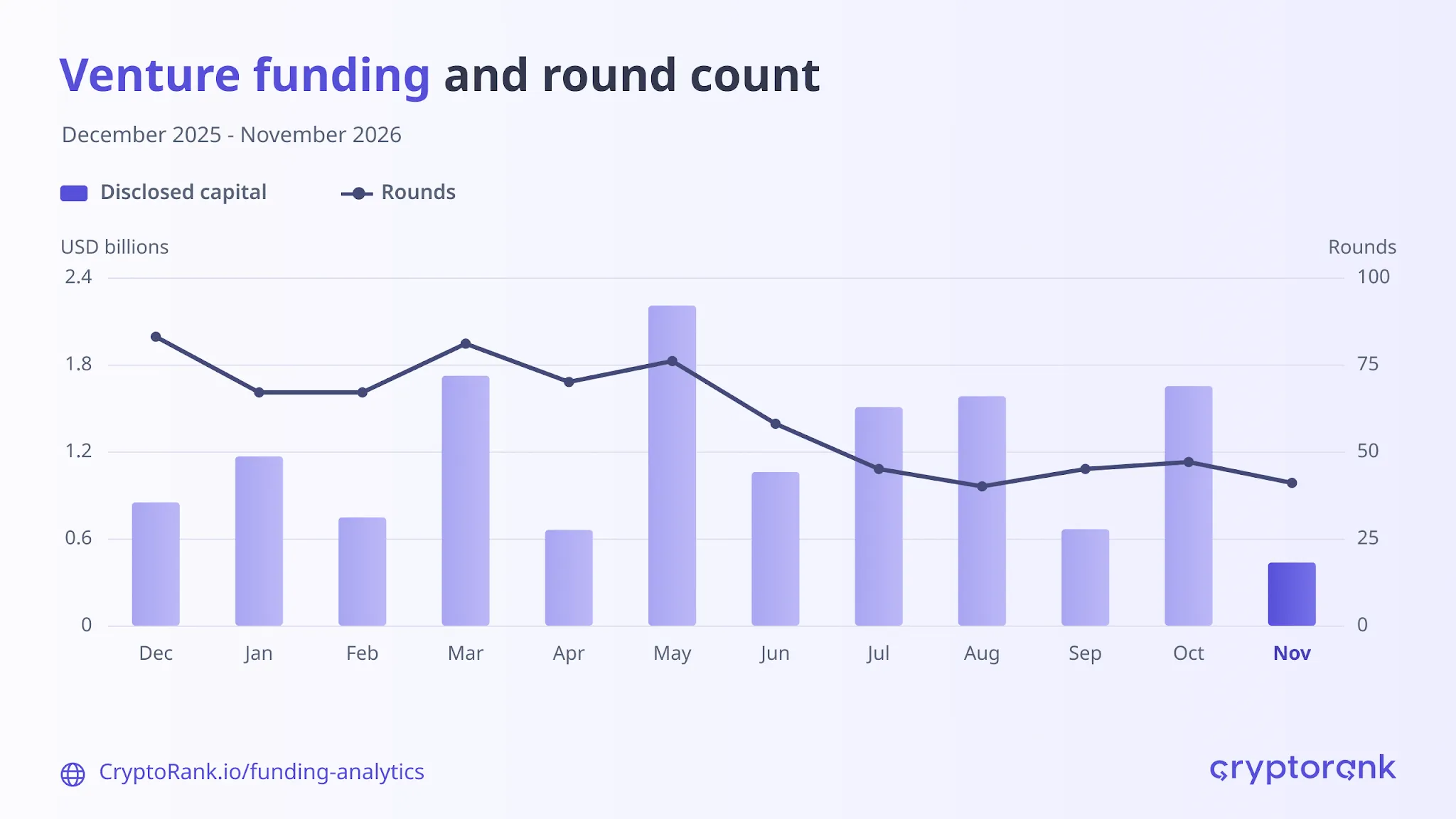
Fewer venture rounds and smaller disclosed raises
Disclosed venture funding fell 74% from October, while the round count fell 13%, from 47 to 41. The share of rounds with public amounts declined from 74% to 68%. Among those with public terms, the median fell from $7.2M to $6M.
Source: CryptoRank MCP. November figures reflect the data available at publication.
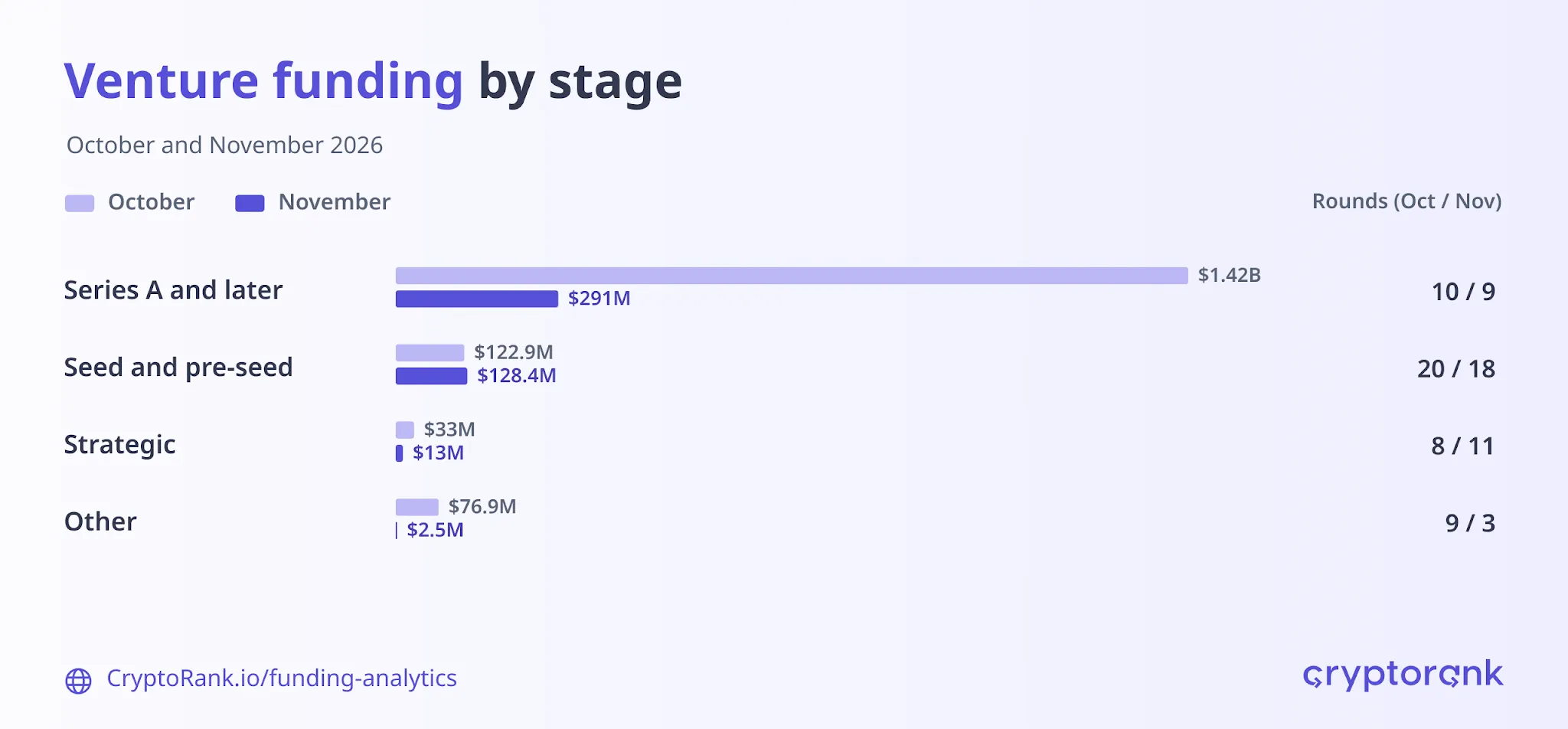
One $50M seed round changed the early-stage picture
Early-stage funding rose from $123M to $128M even as the number of rounds fell from 20 to 18. Index Industries raised a $50M seed to develop a token that tracks US home prices, accounting for 39% of November’s early-stage capital. Series A and later rounds fell from $1.42B to $291M. CryptoRank’s research on crypto seed funding puts that concentration in context.
Source: CryptoRank MCP
Where the capital went
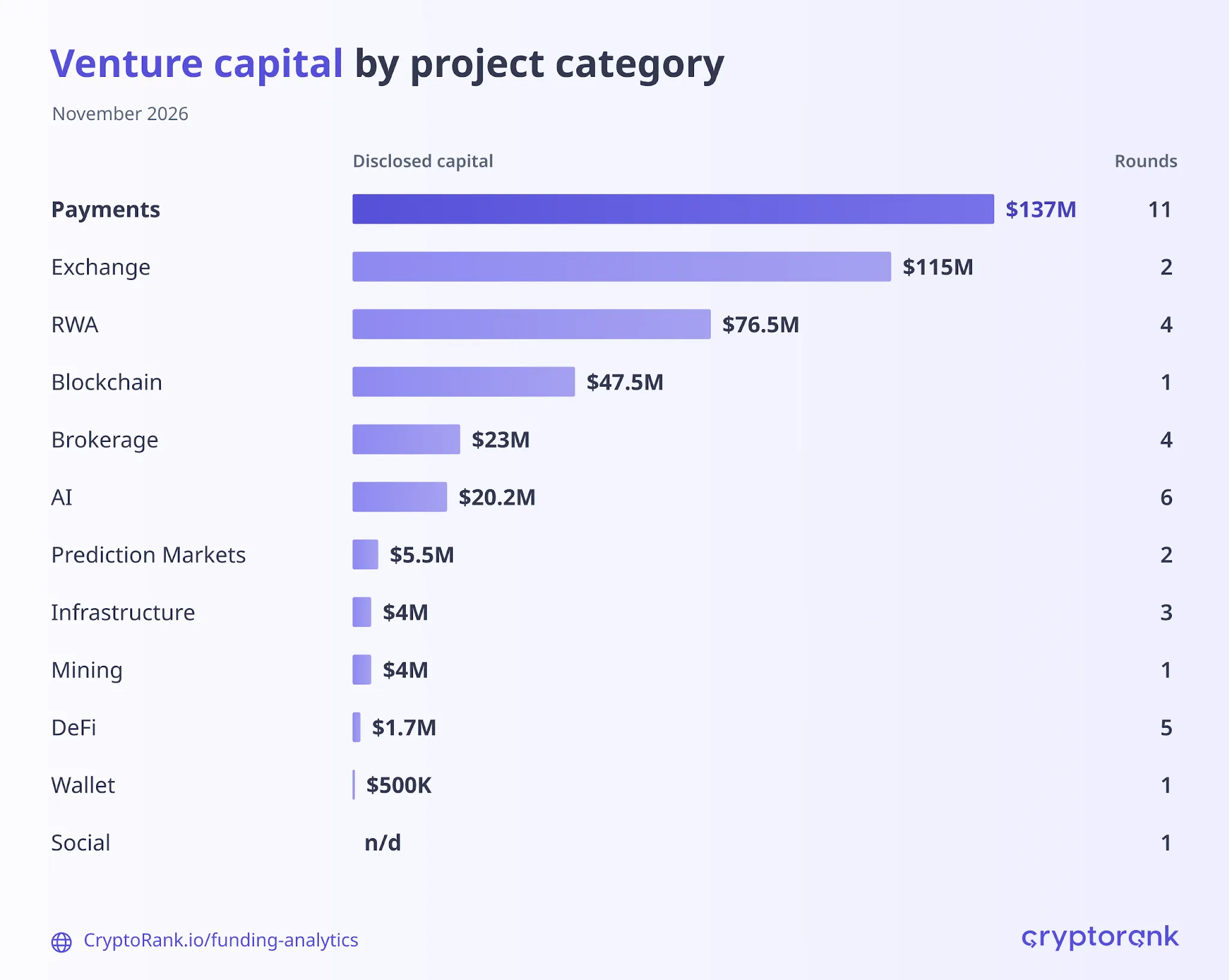
Payments had the broadest field of recipients
Payments businesses attracted $137M across 11 rounds. Exchanges came closest at $115M, split between Variational at $110M and Rialto at $5M. Real-world asset projects followed at $76.5M across four rounds. Index Industries’ seed accounted for almost two-thirds of that total.
Source: CryptoRank MCP
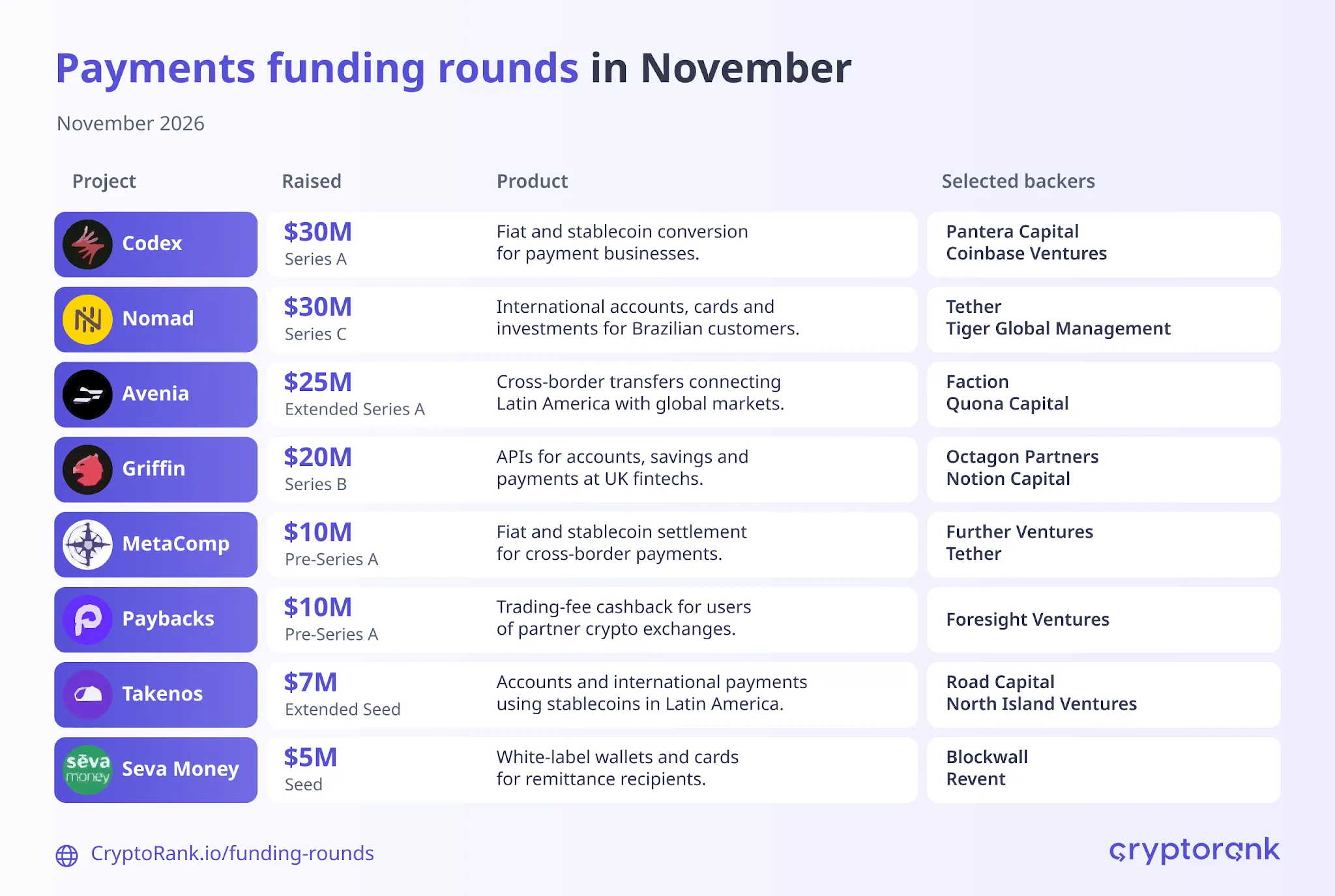
Payments funding reached beyond the two largest rounds
The two largest payments rounds each accounted for 22% of the category’s disclosed capital. Six other businesses shared the remaining $77M. In October, Whop alone raised $200M. October’s other payments rounds raised $142M, close to the entire November total. CryptoRank’s analysis of payments funding follows the sector over a longer period.
The businesses behind payments funding
Codex and Nomad raised similar amounts to serve different customers. Codex’s $30M Series A funds its foreign-exchange platform, which payment companies use to convert between fiat and stablecoins. Nomad offers dollar accounts, cards and investments to Brazilians.
Source: CryptoRank MCP
Paybacks raised a $10M pre-Series A to rebate crypto futures trading fees to exchange customers. Seva Money raised $5M for wallets and cards that remittance providers can offer under their own brands. Three more payments businesses, Lemon, Stables and Scallop, announced rounds with private terms.
The $137M covers whole-company financings. Griffin, for example, raised $20M for its banking platform and named stablecoin payments as one use of the proceeds in its Series B announcement.
Investor activity
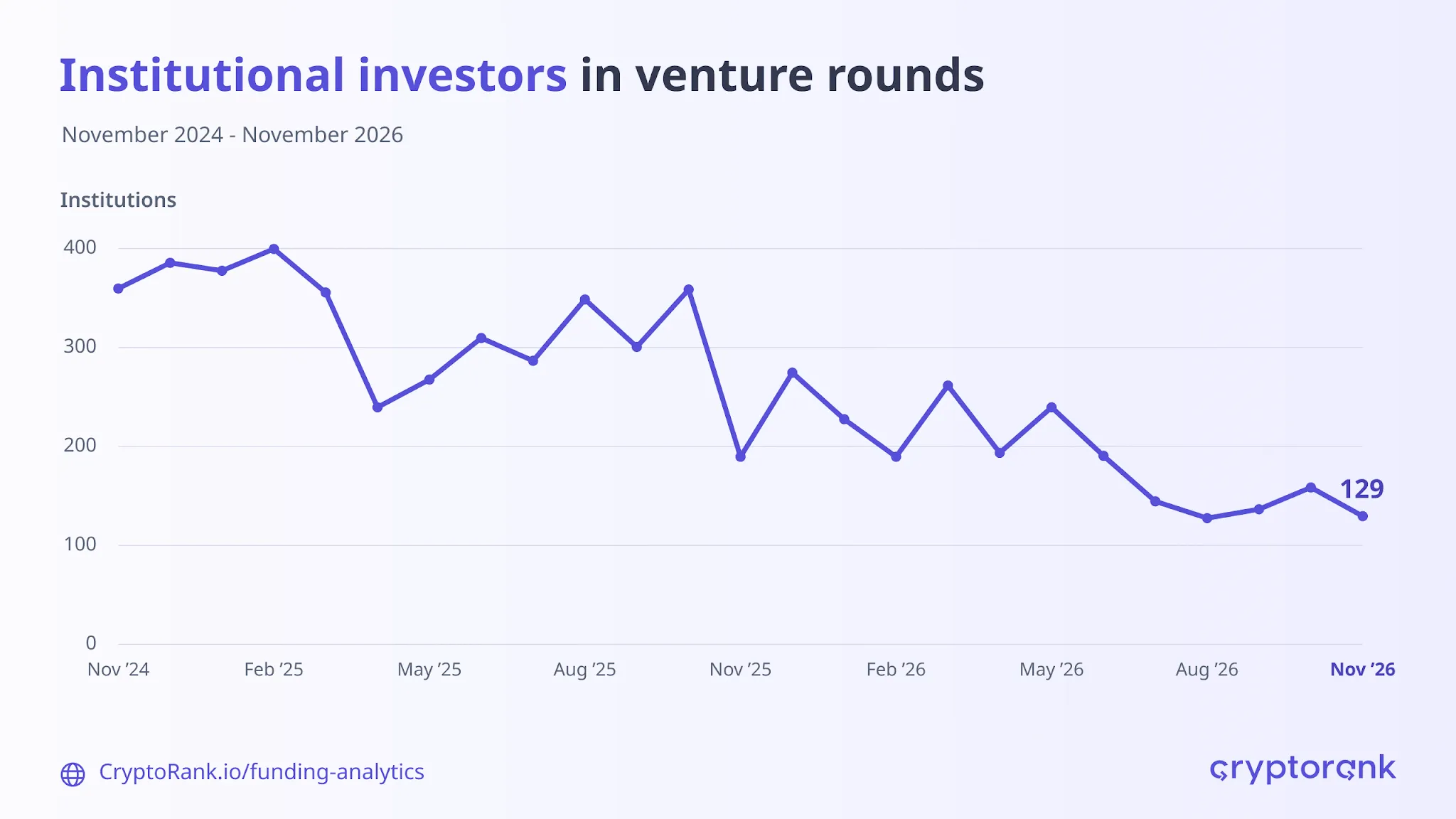
November’s 41 rounds named 129 institutional backers. That compares with 158 in October and 189 in November 2025, declines of 18% and 32%, respectively. Each institution counts once, regardless of how many rounds it joined.
Source: CryptoRank MCP
Tether backed four payments businesses
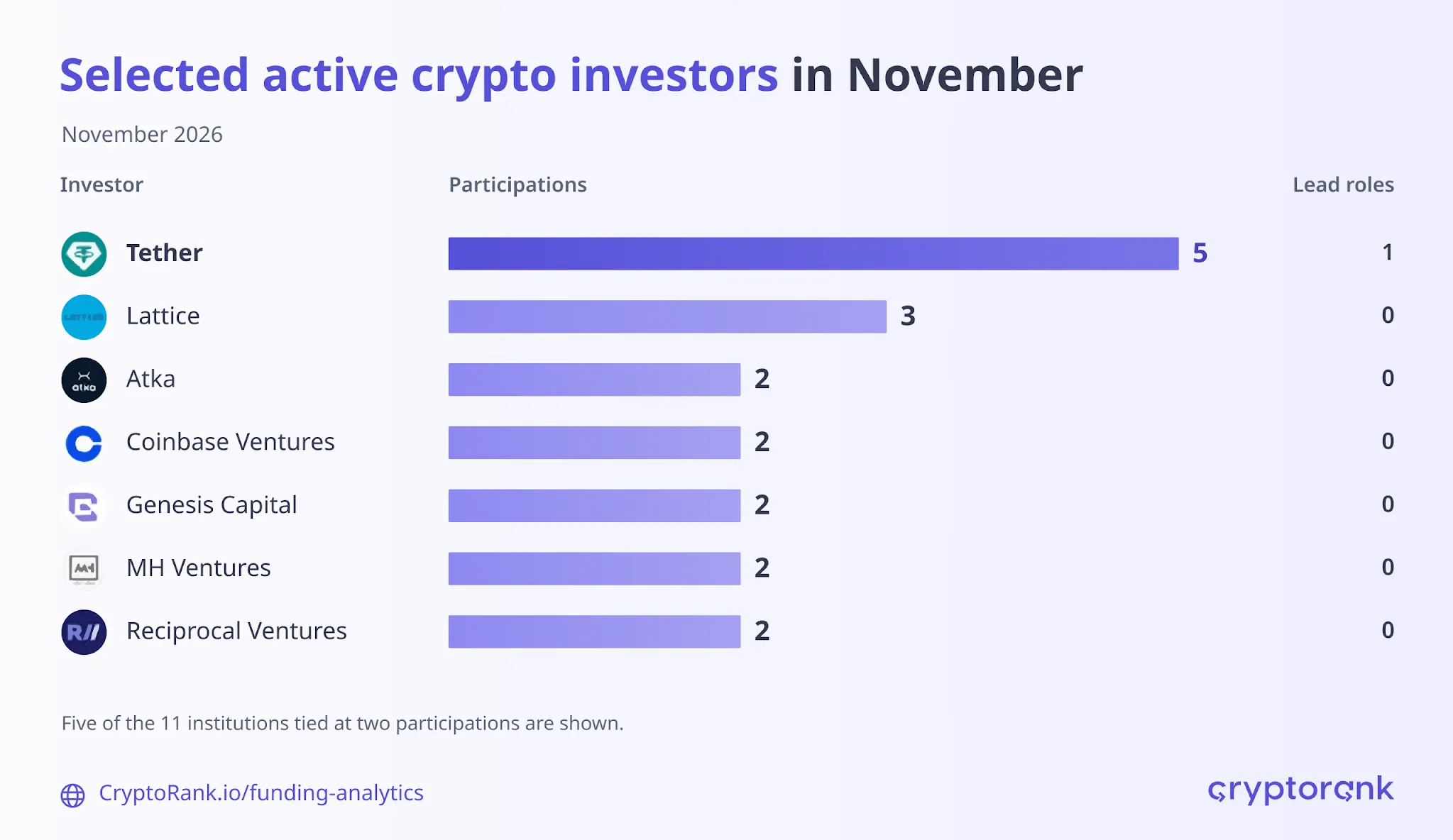
Tether invested in Lemon, MetaComp, Nomad and Stables, alongside a fifth deal in brokerage, SCRYPT Digital. Tether disclosed a $15M investment in Nomad, roughly half of the Series C. Lattice participated in three rounds. Eleven institutions tied at two, including Coinbase Ventures.
Source: CryptoRank MCP
Deal concentration
A derivatives exchange secured the largest round
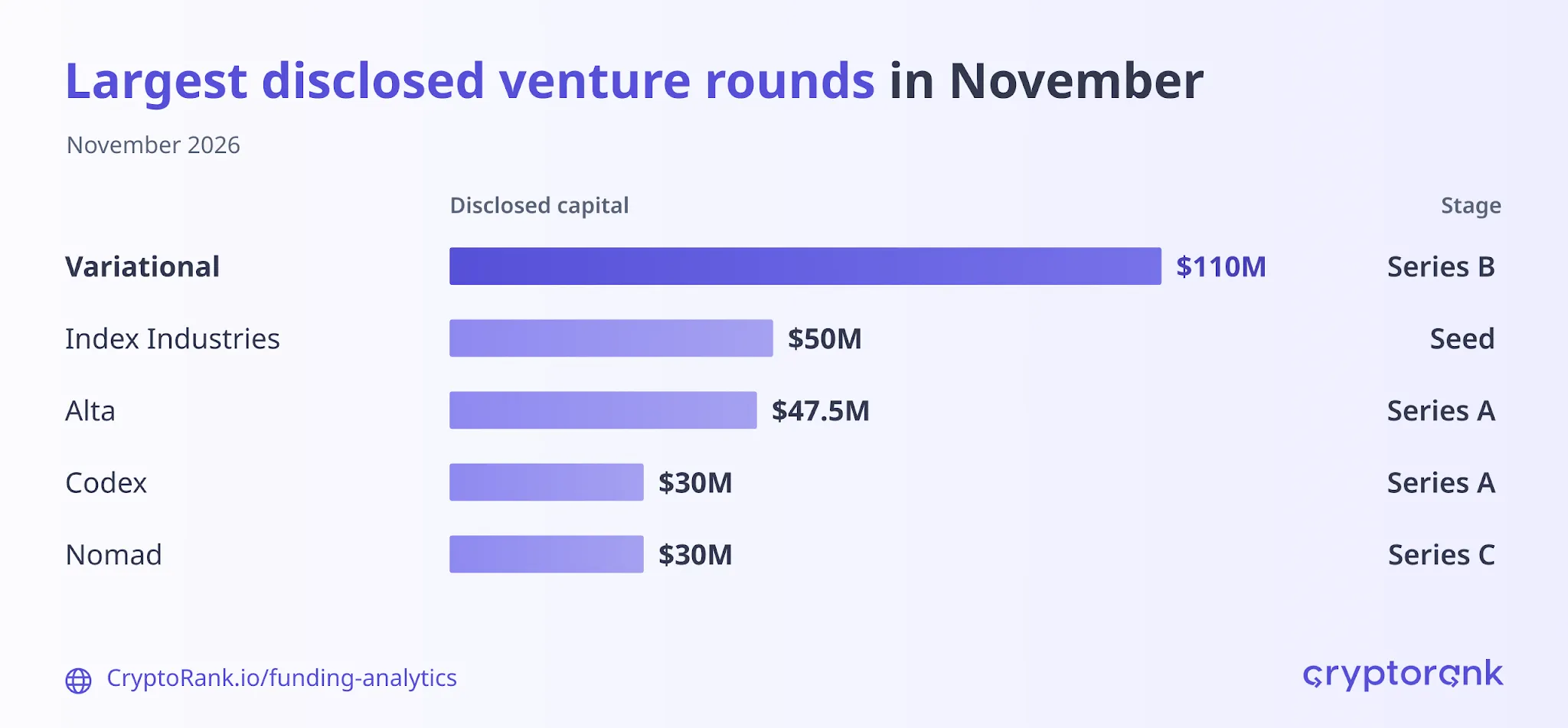
Variational raised its $110M Series B at a $1.5B valuation, with Bain Capital Crypto as lead investor. The company plans to raise limits on open positions on Omni and add stock, index, commodity and currency markets. Alta raised $47.5M to build a blockchain where financial institutions can verify transactions while keeping customer balances private. Its $80M announcement included $32.5M in earlier seed financing.
Source: CryptoRank MCP
How much depended on the largest deals?
Variational accounted for a quarter of November’s disclosed venture capital. Removing the largest deal from each month leaves $325M in November against $651M in October. Removing the two largest leaves $275M against $451M. By that measure, funding fell 39%, compared with the headline decline of 74%.
A year earlier, 64 November venture rounds brought in $2.17B, with 46 amounts disclosed. Removing the two largest deals from each November leaves $671M in 2025 and $275M in 2026, a 59% decline.
M&A activity
Buyers disclosed no prices for the six announcements
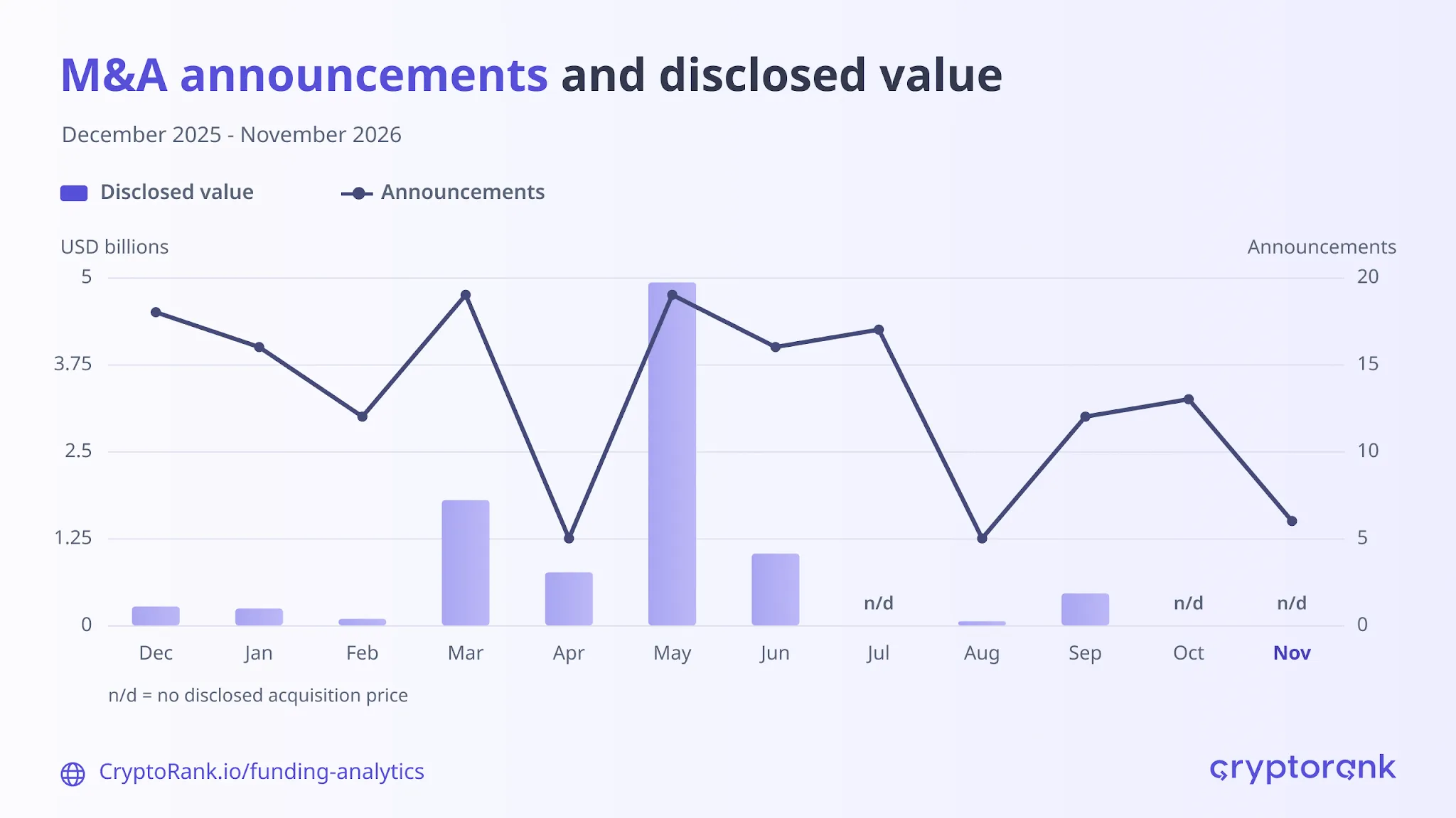
November’s data includes six acquisition announcements, down from 13 in October. Three November targets worked in decentralized finance. Buyers disclosed no prices in either month.
Source: CryptoRank MCP
The same announcement count includes deals at different stages. Aave Labs acquired Avon’s team and technology. Securitize signed an agreement for River One. Yellow Card announced an October closing for GoMoney.
Target
Category
Buyer
What the buyer announced
Avon
DeFi
Acquired the team, fixed- and floating-rate lending technology and onchain order book.
River One
Real-world assets
Agreed to acquire a platform that arranges asset-backed financing.
GoMoney
Payments
Completed the purchase of a Brazilian virtual-asset services company in October.
Can payments funding hold up in December?
Payments offers a useful benchmark for December. In October, payments companies other than Whop raised $142M. In November, eight payments rounds disclosed a combined $137M. Another month near that level, spread across several recipients, would give a clearer indication of sustained demand than a single large financing.